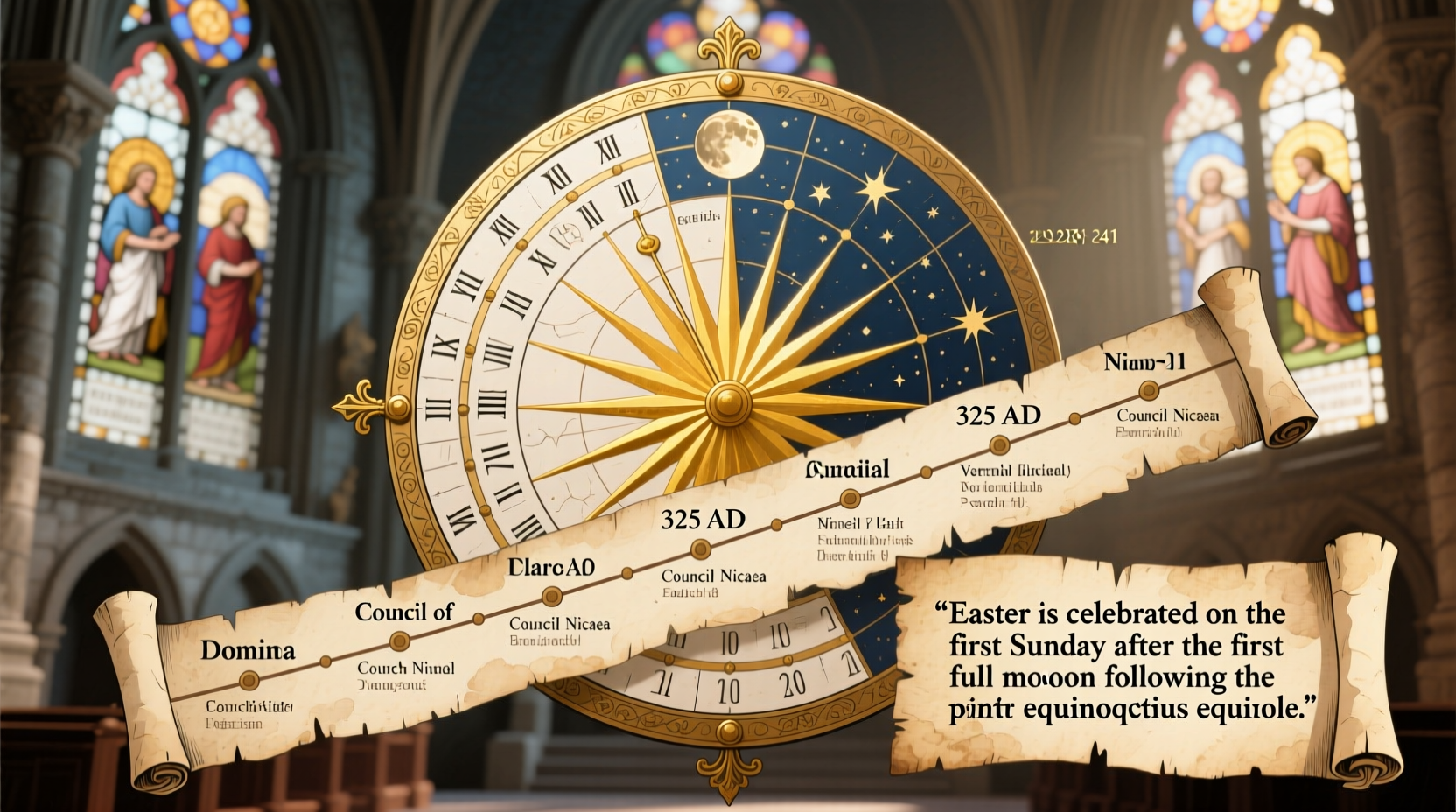
The date of Easter is determined through a complex calculation based on the first Sunday after the first full moon following the spring equinox, which explains how was easter date determined by both astronomical events and ecclesiastical rules. This method results in Easter falling anywhere between March 22 and April 25 each year, making it a moveable feast rather than a fixed-date holiday. Unlike holidays such as Christmas, which occur on the same calendar day annually, Easter’s timing depends on lunar cycles and the vernal equinox, rooted in early Christian efforts to align the celebration of Christ’s resurrection with Jewish Passover traditions. This unique system has been used for centuries and continues to guide both Western (Roman Catholic and Protestant) and Eastern (Orthodox) churches—though they often celebrate on different dates due to variations in calendars and calculations.
Historical Origins of Easter’s Date Calculation
The process of determining when Easter should be observed dates back to the early centuries of Christianity. Before standardization, different Christian communities celebrated Easter on various dates, sometimes coinciding with the Jewish festival of Passover, which is tied to the Hebrew lunar calendar. To unify practice across the growing Church, the First Council of Nicaea convened in 325 CE under Emperor Constantine I. One of its key decisions was establishing a uniform method for calculating Easter.
According to the council's decree, Easter would be held on the first Sunday after the first full moon occurring on or after the vernal (spring) equinox. The equinox was fixed at March 21 for liturgical purposes, regardless of the actual astronomical event. This rule ensured that Easter remained linked to the spring season—a symbol of renewal and rebirth—while also distinguishing it from the Jewish Passover, reflecting theological independence while preserving seasonal alignment.
This system combined solar and lunar observations: the equinox marks the point where day and night are nearly equal, signaling the start of spring in the Northern Hemisphere; the full moon that follows determines the Paschal Full Moon, which serves as the anchor for Easter Sunday. By anchoring Easter to these natural phenomena, the Church created a rhythm that mirrored both agricultural cycles and spiritual symbolism.
The Role of the Ecclesiastical Full Moon
An important distinction in understanding how was easter date determined lies in the concept of the “ecclesiastical full moon,” not the actual astronomical full moon. While modern astronomy can precisely track lunar phases, the Church historically relied on precomputed tables known as the *Ecclesiastical Full Moon* or *Paschal Full Moon*. These tables approximate the lunar cycle using a 19-year Metonic cycle, which assumes that the moon repeats its phases on the same dates every 19 years.
This mathematical model simplifies long-term planning for religious observances but may differ slightly from real-world lunar events. For example, the ecclesiastical full moon might fall a day or two before or after the true astronomical full moon. Nevertheless, it remains the official basis for setting Easter in most Western Christian traditions.
Differences Between Western and Eastern Easter Dates
One of the most frequently asked questions related to how was easter date determined involves why Orthodox Christians often celebrate Easter on a different date than Catholics and Protestants. The answer lies in two primary factors: calendar systems and lunar computation methods.
Western Christianity uses the Gregorian calendar, introduced by Pope Gregory XIII in 1582 to correct inaccuracies in the Julian calendar. However, many Eastern Orthodox Churches continue to use the older Julian calendar for liturgical purposes. Because the Julian calendar is currently 13 days behind the Gregorian, the spring equinox occurs later in their reckoning (April 3 instead of March 21), pushing Easter further into April.
In addition, Orthodox churches rely on the older Alexandrian computus (calculation method), which uses the same Metonic cycle but applies it within the framework of the Julian calendar. As a result, Orthodox Easter typically falls one to five weeks after Western Easter, and occasionally on the same Sunday if the lunar and calendar alignments coincide.
| Year | Western Easter | Orthodox Easter |
|---|---|---|
| 2024 | March 31 | May 5 |
| 2025 | April 20 | April 20 |
| 2026 | April 5 | April 12 |
| 2027 | March 28 | May 2 |
Practical Implications of a Moveable Feast
Because how was easter date determined impacts more than just church services, the variability of Easter affects school holidays, retail schedules, travel patterns, and public transportation in many countries. In nations where Easter is a national holiday—such as the United States, Canada, Australia, Germany, and the UK—schools and government offices close for Good Friday and sometimes Easter Monday.
Retailers adjust their operations accordingly. Major stores may reduce hours or close entirely on Good Friday, especially in traditionally Catholic regions like Ireland or parts of Latin America. Conversely, in secularized societies like Sweden or the Netherlands, most businesses remain open unless Easter Sunday itself falls on a weekday.
Travel demand spikes around Easter weekend, particularly in Europe and North America, where families often gather for meals and religious observances. Airlines and railways frequently operate special timetables, and hotels in popular destinations book up months in advance. Planning ahead is essential for travelers seeking accommodations or transportation during this peak period.
How to Calculate Easter’s Date Yourself
For those curious about how was easter date determined mathematically, there are several algorithms available. One well-known method is Gauss’s algorithm, developed by mathematician Carl Friedrich Gauss in 1800. It allows you to compute the date of Easter for any given year in the Gregorian calendar using modular arithmetic.
Here’s a simplified version of the steps:
- Let Y = the year.
- Calculate the remainder when Y is divided by 19 (this gives the position in the Metonic cycle).
- Apply a series of divisions and remainders involving constants for the century, leap years, and lunar corrections.
- The final output yields the month and day of Easter Sunday.
While manual calculation is possible, most people today consult online calculators, liturgical calendars, or official church publications to determine Easter’s date quickly and accurately.
Common Misconceptions About Easter’s Timing
Several myths persist regarding how was easter date determined. One common misunderstanding is that Easter always falls on the second Sunday in April. While it often lands in April, it can occur as early as March 22 (last seen in 1818, next in 2285) or as late as April 25 (most recently in 1943, next in 2038).
Another misconception is that all Christians celebrate Easter on the same day. As previously explained, differences in calendar systems mean that Western and Eastern churches frequently observe Easter on separate Sundays. Additionally, some independent Christian groups choose alternative dates based on scriptural interpretations or local customs.
A third myth is that Easter’s date is entirely arbitrary. In fact, it follows a precise set of rules grounded in astronomy, mathematics, and historical precedent. Though the system may seem complicated, it reflects centuries of theological reflection and scientific observation.
Regional Variations in Easter Observance
Understanding how was easter date determined also sheds light on regional differences in how the holiday is observed. In predominantly Catholic countries like Italy, Spain, and the Philippines, Holy Week processions and reenactments are central to the celebration. In contrast, Protestant-majority nations such as the United States emphasize egg hunts, family dinners, and church services focused on resurrection themes.
In Eastern Europe, Orthodox communities mark Easter with midnight liturgies, blessing of food baskets, and traditional greetings like “Christ is Risen!” followed by the response “Truly He is Risen!” The use of red-dyed eggs symbolizes the blood of Christ and new life.
Even within countries, practices vary. In Germany, some regions have strict laws limiting work and commerce on Good Friday (stillfege laws), while others are more relaxed. Similarly, in the U.S., states differ in whether Good Friday is a public holiday—Connecticut and Texas recognize it officially, while California does not.
Modern Challenges and Potential Reforms
In recent decades, ecumenical discussions have explored the possibility of fixing Easter on a permanent date—such as the second or third Sunday in April—to simplify scheduling and promote unity among Christian denominations. Proponents argue that a fixed date would benefit education systems, airlines, and international coordination.
However, significant obstacles remain. Any change would require agreement among Roman Catholic, Protestant, and Orthodox leaders—an unlikely prospect given deep-rooted traditions and differing calendar systems. Moreover, moving away from the lunar-based calculation would sever a symbolic link to Passover and ancient biblical chronology.
As of now, no major changes are expected, and how was easter date determined will likely continue to follow the established ecclesiastical rules for the foreseeable future.
Frequently Asked Questions
- Why does Easter change dates every year?
- Easter changes because it is based on the lunar cycle and the spring equinox. It is set as the first Sunday after the first full moon following March 21, leading to annual variation between March 22 and April 25.
- Do all Christians celebrate Easter on the same day?
- No. Western Christians (Catholic and Protestant) usually celebrate on a different date than Eastern Orthodox Christians due to differences in calendar systems (Gregorian vs. Julian) and lunar calculations.
- What is the earliest and latest possible date for Easter?
- The earliest possible date is March 22; the latest is April 25. These extremes are rare, with most Easters occurring in late March or April.
- How can I find out when Easter is in a specific year?
- You can use online Easter calculators, check church calendars, or refer to almanacs and government holiday lists. Many digital calendars automatically include Easter dates.
- Has the method of determining Easter ever changed?
- The core method was established in 325 CE at the Council of Nicaea. The main update came in 1582 with the Gregorian calendar reform, which improved the accuracy of the equinox and lunar tracking in Western Christianity.




 浙公网安备
33010002000092号
 浙B2-20120091-4