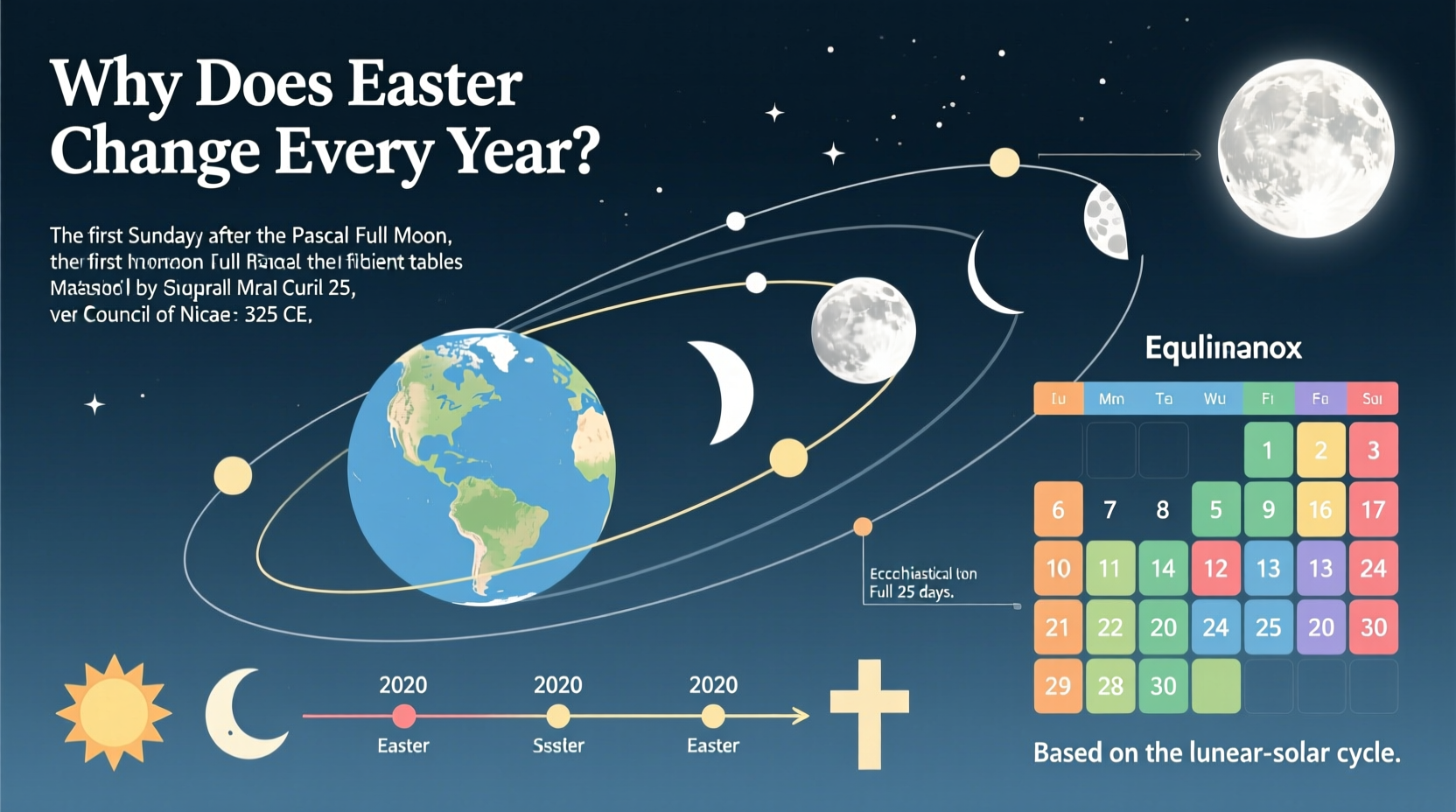
Why is Easter on a different date each year? The reason lies in its unique calculation based on the lunar calendar and the spring equinox—specifically, Easter Sunday falls on the first Sunday after the first full moon following the vernal equinox. This method, established by early Christian councils, ensures that Easter remains aligned with both astronomical events and religious tradition. As a result, Easter can occur as early as March 22 or as late as April 25 in the Gregorian calendar, making it a moveable feast unlike fixed holidays such as Christmas.
The Historical Origins of Easter’s Variable Date
The question of why is Easter on a shifting date each year traces back to the First Council of Nicaea in 325 AD. At this pivotal meeting, Christian bishops sought to standardize the celebration of Easter across all churches. Prior to this, some communities celebrated Easter on the same day as the Jewish Passover (the 14th of Nisan), while others insisted it should always fall on a Sunday, regardless of the lunar cycle. To resolve the dispute, the council decreed that Easter would be observed on the first Sunday after the Paschal Full Moon—the ecclesiastical approximation of the first full moon on or after the spring equinox, set at March 21.
This decision was rooted in both theological symbolism and practical coordination. By linking Easter to the spring equinox and lunar phases, the Church emphasized renewal, resurrection, and harmony with natural cycles. It also allowed for a unified observance across diverse regions without relying solely on local calendars or Jewish festival dates. However, because lunar months do not align perfectly with the solar calendar, the date shifts annually.
How the Date of Easter Is Calculated Today
Modern determination of why is Easter on varying Sundays involves a combination of astronomy and ecclesiastical rules. While actual astronomical observations once guided the process, today most Western Christian churches use a standardized table known as the ecclesiastical full moon, which approximates lunar cycles mathematically rather than through real-time observation.
Here's how it works:
- The vernal (spring) equinox is fixed at March 21, even if the astronomical equinox occurs on March 19 or 20.
- The next step is identifying the “Paschal Full Moon,” which is not necessarily the same as the actual full moon but follows a 19-year Metonic cycle used in the computus (the calculation of Easter).
- Easter Sunday is then set as the first Sunday after this calculated full moon.
For example, in 2026, the ecclesiastical full moon falls on Saturday, April 4. Therefore, Easter will be celebrated on Sunday, April 5. In contrast, in 2025, the Paschal Full Moon occurs on March 13, leading to Easter on April 20—the latest possible date.
| Year | Paschal Full Moon | Easter Sunday |
|---|---|---|
| 2024 | March 25 | March 31 |
| 2025 | April 13 | April 20 |
| 2026 | April 4 | April 5 |
| 2027 | March 24 | March 28 |
| 2028 | April 12 | April 16 |
Eastern vs. Western Easter: Why Do Dates Differ?
Another layer to understanding why is Easter on different days around the world lies in the divergence between Eastern Orthodox and Western Christian traditions. While Western churches (Catholic and Protestant) follow the Gregorian calendar for calculating Easter, many Eastern Orthodox churches still use the older Julian calendar.
This difference often results in Orthodox Easter falling one to five weeks later than Western Easter. For instance, in 2025, Western Easter is on April 20, but Orthodox Easter will be on April 27. The discrepancy arises because the Julian calendar currently runs 13 days behind the Gregorian calendar, affecting both the equinox date and the lunar tables used.
Some efforts have been made to unify the date—such as proposals from ecumenical dialogues—but no global agreement has been reached. Thus, believers in countries like Greece, Russia, Ukraine, and Serbia may celebrate Easter on a different Sunday than those in the U.S., Germany, or Brazil.
Which Countries Celebrate Easter and How Does It Affect the Date?
While the calculation of why is Easter on a specific Sunday is largely uniform within Christian denominations, national customs influence how the holiday is observed—even if they don’t change the official date. Over 100 countries recognize Easter in some form, either as a religious holiday, a public holiday, or both.
In predominantly Christian nations such as Italy, Spain, the Philippines, Mexico, and Poland, Easter is a major religious and cultural event, often preceded by Holy Week observances. In secular societies like Sweden or Japan, Easter may be more commercialized, focusing on egg hunts and family gatherings rather than liturgical practices.
However, the core date remains tied to the ecclesiastical formula. Even in non-Christian-majority countries where Easter is celebrated—such as Australia or Canada—it follows the Western Christian schedule. Retailers, schools, and government offices typically close on Good Friday and Easter Monday in these places, though exact policies vary by region.
Common Misconceptions About Why Easter Moves Annually
Despite widespread familiarity with Easter, several myths persist about why is Easter on a different date every year. One common misunderstanding is that Easter is randomly assigned or influenced by pagan festivals alone. While pre-Christian spring celebrations did shape certain symbols (like eggs and rabbits), the date itself is not derived from pagan calendars but from precise Christian calendrical science.
Another myth is that Easter always falls in April. In fact, it can occur in late March—as it did in 2016 (March 27) and will again in 2024 (March 31). Additionally, some believe leap years affect Easter’s timing, but the leap day (February 29) has no impact on the equinox or lunar calculations used.
How to Prepare for Easter: Practical Tips Based on the Date
Knowing why is Easter on a variable Sunday helps individuals and families plan ahead. Whether you're organizing a church service, hosting a dinner, or shopping for supplies, being aware of the upcoming date allows better preparation.
1. Mark Your Calendar Early: Since Easter changes each year, inputting the correct date into personal and work calendars prevents scheduling conflicts. Many digital calendar apps automatically update Easter dates.
2. Plan Travel and Gatherings: Families often reunite for Easter weekend. Booking travel early—especially when Easter falls in April, coinciding with school breaks—can save money and avoid last-minute stress.
3. Shop Ahead for Supplies: Grocery stores and retailers stock up on chocolate, eggs, and seasonal decorations weeks in advance. Shopping mid-March ensures availability and better prices before peak demand.
4. Check Local Business Hours: While many businesses close on Good Friday and Easter Sunday in Christian-majority countries, operating hours vary. Always verify with individual stores, banks, or transportation services, especially in multicultural urban areas.
Regional Variations in Easter Observance and Their Impact
The answer to why is Easter on differing weekends also intersects with regional legal and cultural norms. In the United States, Easter Sunday is not a federal holiday, so most businesses remain open, though many people attend church services in the morning. In contrast, countries like Colombia, France, and South Africa grant public holidays on Easter Monday, extending the break.
In Germany, strict laws govern what can be sold on Easter Sunday—similar to Sunday trading restrictions—so consumers must prepare in advance. Meanwhile, in New Zealand, Easter is a four-day long weekend including Good Friday, Easter Saturday, Sunday, and Monday, all recognized nationally.
These variations mean that while the religious date is consistent within denominational frameworks, civic recognition differs widely. Travelers should research local customs and closures when visiting abroad during the Easter season.
Future Easter Dates and Predictability
Because the Easter calculation follows a repeating 19-year Metonic cycle, future dates are predictable decades in advance. Astronomers and churches publish Easter tables far ahead of time. Here are key upcoming dates:
- 2024: March 31
- 2025: April 20
- 2026: April 5
- 2027: March 28
- 2028: April 16
This predictability benefits event planners, educators, and religious leaders who coordinate annual programs. However, due to the complexity of the formula, occasional anomalies arise—such as when the astronomical full moon and ecclesiastical full moon diverge significantly.
Frequently Asked Questions
- Why isn't Easter on the same date every year like Christmas?
- Easter is tied to the lunar calendar and the spring equinox, whereas Christmas is fixed to the solar calendar (December 25). This link to moon phases makes Easter a moveable feast.
- Does the Pope decide when Easter is each year?
- No. The date is determined by mathematical rules established centuries ago. The Vatican does not arbitrarily choose the date; it follows the traditional computus.
- Can Easter ever fall in May?
- No. Due to the March 21 equinox rule and lunar cycle constraints, Easter cannot occur after April 25 in the Gregorian calendar.
- Why do Orthodox and Catholic Easters differ?
- Orthodox churches use the Julian calendar and different lunar tables, resulting in a later calculated date in most years.
- Is there a chance Easter could become a fixed holiday?
- There have been discussions, particularly in the 20th and 21st centuries, about setting a fixed Sunday in April for Easter to simplify scheduling. However, no consensus has emerged among global Christian leaders.





 浙公网安备
33010002000092号
浙公网安备
33010002000092号 浙B2-20120091-4