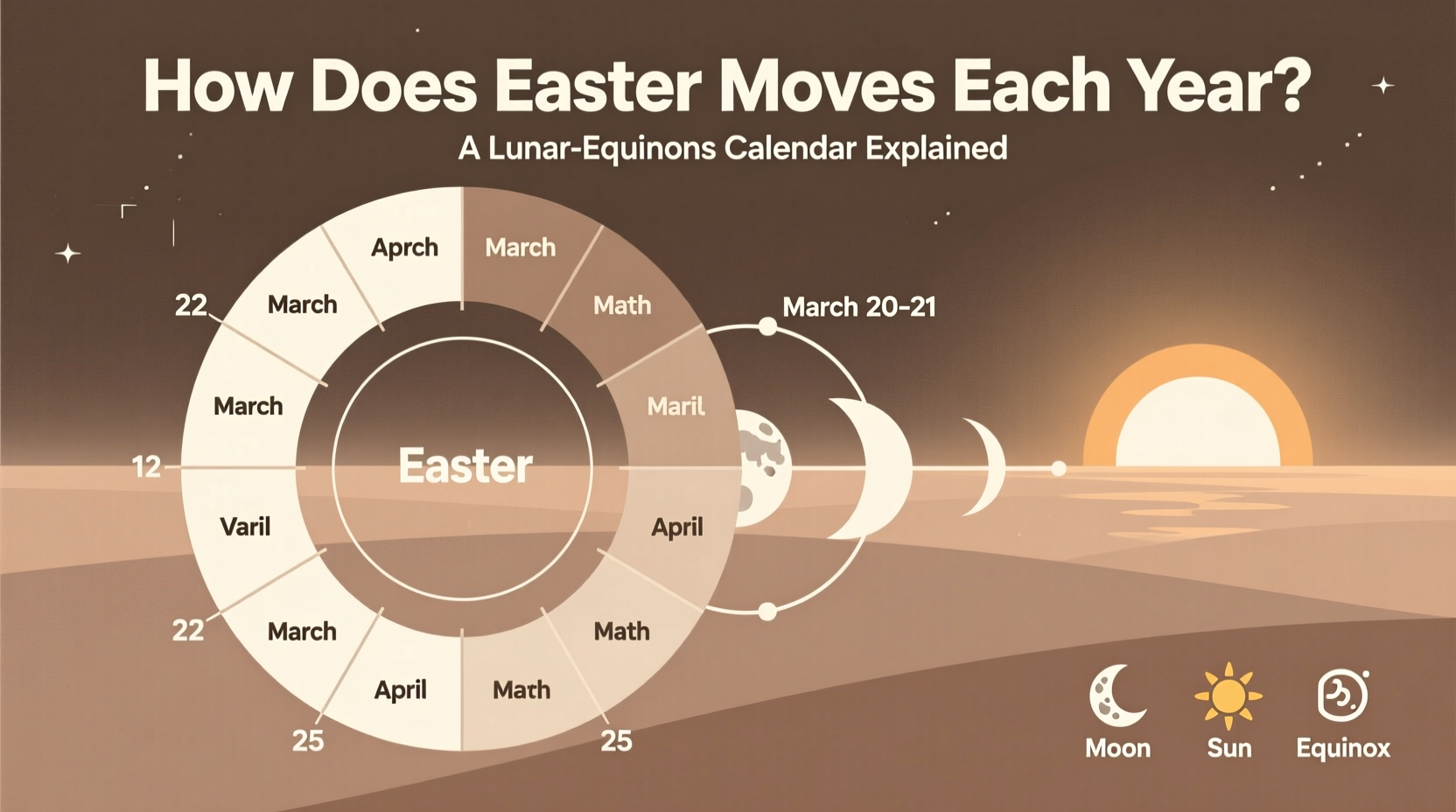
Easter moves each year because its date is based on a combination of solar and lunar calendars, specifically tied to the first Sunday after the first full moon following the spring equinox. This system, known as the computus, explains how does Easter move across the Gregorian calendar, resulting in the holiday falling anywhere between March 22 and April 25. Unlike fixed-date holidays such as Christmas, Easter is a movable feast, meaning its timing shifts annually to align with astronomical and ecclesiastical calculations established by the Council of Nicaea in 325 CE. This unique method ensures that Easter maintains its symbolic connection to the Jewish Passover and the resurrection of Jesus Christ in the context of springtime renewal.
Why Is Easter’s Date Not Fixed?
Easter's variability stems from its deep historical and religious roots. The decision to make Easter a movable celebration was formalized during the First Council of Nicaea, where Christian bishops sought to standardize the date of Easter across all churches. They agreed that Easter should be celebrated on the first Sunday after the Paschal Full Moon—the first ecclesiastical full moon occurring on or after the vernal (spring) equinox, which is fixed as March 21 in church tradition, regardless of the actual astronomical equinox.
This lunar-based calculation means that Easter does not follow the standard solar calendar like most modern holidays. Instead, it follows an ancient lunisolar system similar to those used in Hebrew and other traditional calendars. Because the lunar cycle lasts approximately 29.5 days and doesn't align perfectly with the 365-day solar year, the timing of the full moon shifts each year, causing Easter to move accordingly.
The Role of the Vernal Equinox and the Ecclesiastical Full Moon
To understand how does Easter move, one must grasp two key components: the vernal equinox and the ecclesiastical full moon. The vernal equinox marks the moment when the sun crosses the celestial equator, making day and night nearly equal in length. In the Northern Hemisphere, this usually occurs around March 20 or 21. However, for liturgical purposes, the Church uses March 21 as a fixed reference point.
The ecclesiastical full moon is not always the same as the astronomical full moon. It is calculated using a set of tables known as the Metonic cycle—a 19-year cycle that approximates the relationship between the solar year and lunar months. These tables allow the Church to predict when the Paschal Full Moon will occur without relying on real-time astronomical observations.
Once the Paschal Full Moon is determined, Easter is set for the following Sunday. If the full moon falls on a Sunday, Easter is delayed by one week to ensure it always occurs after the full moon. This rule prevents Easter from coinciding directly with the Jewish Passover, maintaining theological distinction while preserving seasonal alignment.
When Can Easter Occur? The Date Range Explained
Due to these combined solar and lunar factors, Easter can fall on any Sunday between March 22 and April 25. The earliest possible date, March 22, happens when the ecclesiastical full moon occurs on March 21 and that date is a Saturday, making the next day (Sunday) Easter. This scenario is rare; the last time Easter fell on March 23 was in 2008, and it won't happen again until 2160.
The latest possible date, April 25, occurs when the Paschal Full Moon falls on April 18 and that day is a Sunday, pushing Easter to the following Sunday. The most recent occurrence was in 1943, and the next will be in 2038.
Most commonly, Easter lands somewhere in early to mid-April. For example:
| Year | Easter Date | Notes |
|---|---|---|
| 2024 | March 31 | Early Easter due to March 25 full moon |
| 2025 | April 20 | Middle-range date |
| 2026 | April 5 | After full moon on April 4 |
| 2027 | March 28 | Earlier than average |
| 2038 | April 25 | Late Easter; next occurrence |
Differences Between Western and Eastern Easter Dates
Another important factor in understanding how does Easter move is the difference between Western (Gregorian calendar) and Eastern Orthodox (Julian calendar) traditions. While both use the same basic formula—first Sunday after the first full moon after the spring equinox—they apply it differently.
The Orthodox Church continues to use the older Julian calendar for calculating Easter, which currently runs 13 days behind the Gregorian calendar. Additionally, Orthodox Christians often require that Easter fall after the Jewish Passover, adding another layer of complexity.
As a result, Orthodox Easter frequently occurs later than Western Easter, sometimes by a week or even five weeks. For instance, in 2025, Western Easter falls on April 20, but Orthodox Easter is celebrated on April 20 only if Passover has ended; otherwise, it may shift to April 27.
Historical Development of the Easter Dating System
The quest to determine how does Easter move began long before the Council of Nicaea. Early Christians celebrated Easter at different times, often aligning it with the Jewish Passover on Nisan 14, regardless of the day of the week. This practice, known as Quartodecimanism, sparked controversy because it meant Easter could fall on any day of the week.
To promote unity, the Council of Nicaea mandated that Easter be celebrated uniformly on a Sunday, symbolizing the resurrection. Over centuries, various methods were developed to calculate the correct date, culminating in the adoption of the Alexandrian computus, which became the standard in both the Eastern and Western Churches.
In the 6th century, Dionysius Exiguus created the Anno Domini dating system and refined the Easter tables, laying the foundation for today’s calculations. Later, the Gregorian calendar reform of 1582 adjusted leap year rules and improved astronomical accuracy, further refining how Easter is determined in Western Christianity.
Modern Implications of a Movable Holiday
The fact that Easter moves each year affects more than just religious observance. It influences school holidays, retail schedules, travel patterns, and public transportation. Many countries declare Good Friday and Easter Monday as public holidays, though practices vary widely.
In the United States, Easter Sunday is not a federal holiday, but many businesses close or operate on reduced hours, especially on Good Friday. Retailers often run major sales events around Easter, particularly for clothing, candy, and home goods. Schools typically schedule spring breaks around the Easter period, though dates differ by district.
In contrast, countries like Australia, Canada, and the UK observe both Good Friday and Easter Monday as national holidays, leading to four-day weekends. In predominantly Catholic nations such as Italy, Spain, and Poland, Easter is one of the most significant religious celebrations of the year, with extensive closures and processions.
Common Misconceptions About How Easter Moves
Several myths persist about how Easter’s date is chosen. One common misunderstanding is that Easter is simply the first Sunday in April. In reality, it can occur in late March or late April. Another myth is that the date is decided by the Pope each year. While the Vatican publishes liturgical calendars, the date is derived mathematically using established rules, not personal decree.
Some also believe that climate or regional customs influence Easter’s timing. While local traditions shape how Easter is celebrated, the date itself is universally calculated according to the same ecclesiastical principles within each Christian tradition.
How to Predict Future Easter Dates
Because the Easter calculation follows a repeating pattern based on the Metonic cycle, it repeats every 19 years. This allows for accurate long-term predictions. Various online calculators and ecclesiastical tables can provide Easter dates decades into the future.
For individuals planning events, vacations, or religious services, checking official church calendars or government holiday lists is recommended. Websites like timeanddate.com offer reliable tools showing both Western and Orthodox Easter dates globally.
Regional Variations in Easter Observance
While the question of how does Easter move focuses on the date, cultural expressions of the holiday vary significantly. In Western countries, Easter is associated with egg hunts, the Easter Bunny, and family meals. In Eastern Europe, religious processions, candlelight vigils, and elaborate feasts are central.
In Latin America, Semana Santa (Holy Week) features dramatic reenactments of the Passion. In Greece and Russia, midnight services mark the transition from Lent to Easter joy. Despite these differences, the underlying reason for the moving date remains consistent: a desire to honor the resurrection in harmony with natural and scriptural rhythms.
Efforts to Fix Easter’s Date
In recent decades, there have been proposals to fix Easter on a specific Sunday, such as the second Sunday in April, to simplify scheduling. Proponents argue that a fixed date would benefit education, commerce, and international coordination.
However, critics—including leaders from multiple Christian denominations—argue that changing the system would break centuries of tradition and disconnect Easter from its astronomical and theological foundations. As of now, no agreement has been reached, and the movable nature of Easter remains intact.
Frequently Asked Questions
- What determines when Easter is each year?
Easter is set as the first Sunday after the first ecclesiastical full moon following the vernal equinox (fixed as March 21). - Why does Easter change but Christmas doesn’t?
Christmas is tied to the solar calendar (December 25), while Easter follows a lunisolar calculation linked to the moon and equinox. - When is Easter in 2026?
In 2026, Easter Sunday falls on April 5. - Do all Christians celebrate Easter on the same day?
No. Western Christians (Catholic, Protestant) use the Gregorian calendar; Eastern Orthodox use the Julian, so dates often differ. - Can Easter ever fall in May?
No. Due to the current calculation system, Easter cannot occur later than April 25.
Understanding how does Easter move reveals a fascinating intersection of astronomy, theology, and history. Though its date shifts annually, the meaning behind the celebration remains constant: renewal, redemption, and the promise of new life. Whether observing through worship, family tradition, or cultural festivities, Easter's mobility reflects its deep roots in both nature and faith.





 浙公网安备
33010002000092号
浙公网安备
33010002000092号 浙B2-20120091-4