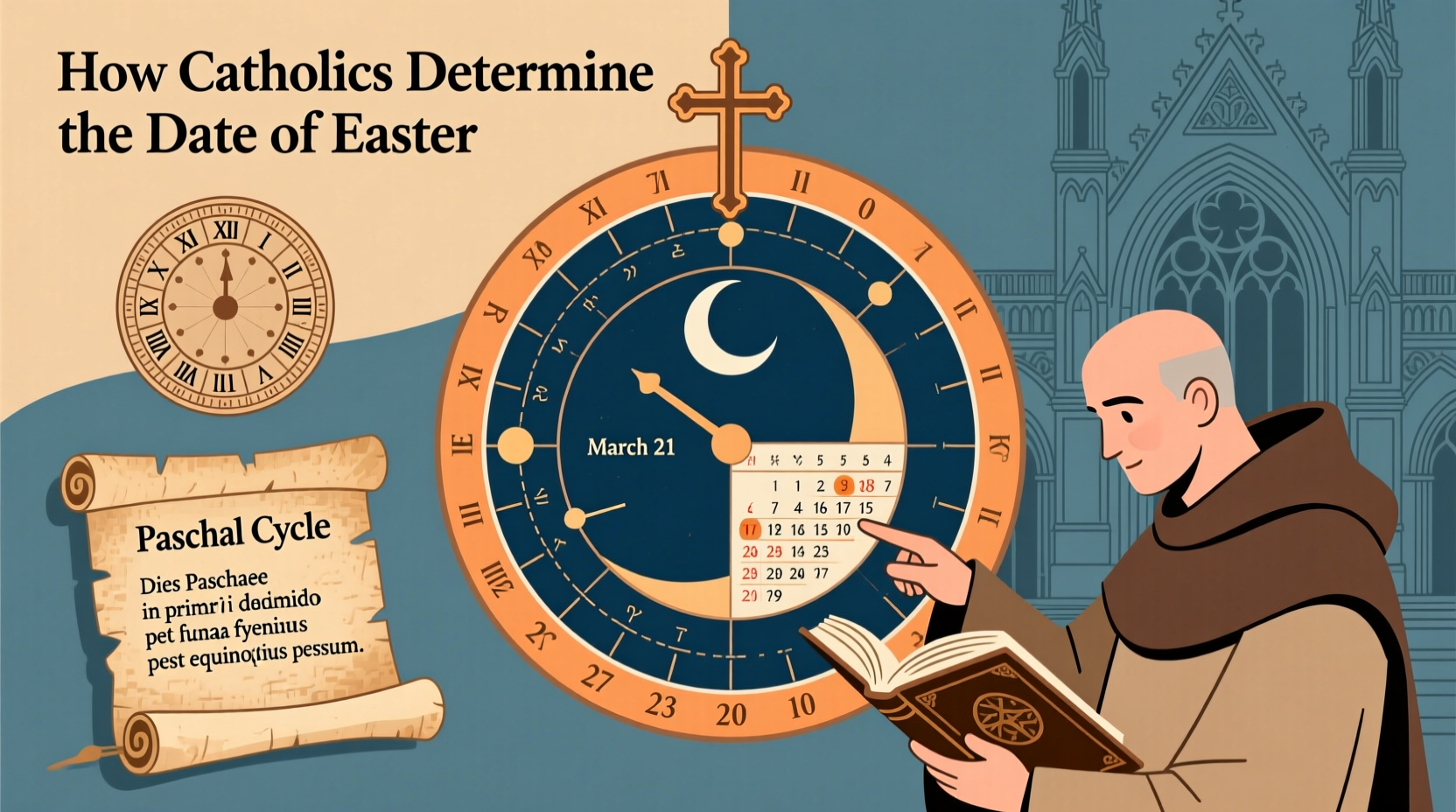
Catholics determine Easter by following a precise ecclesiastical formula that combines the solar calendar, lunar cycles, and historical church traditions. The date of Easter each year is set as the first Sunday after the first full moon following the spring equinox, a system rooted in early Christian councils and still used today. This method—how do Catholics determine Easter—ensures alignment with both astronomical events and liturgical tradition, resulting in a movable feast that can fall anytime between March 22 and April 25.
Understanding the Ecclesiastical Rules Behind Easter
The determination of Easter is not arbitrary; it follows a well-defined set of guidelines established by the First Council of Nicaea in 325 AD. At this pivotal gathering of Christian bishops, the Church sought to unify the celebration of Christ’s resurrection across all regions. Prior to this council, some Christian communities celebrated Easter on different dates, often based on Jewish Passover observances. To standardize the date, the council decreed that Easter must be celebrated on the first Sunday after the first ecclesiastical full moon occurring on or after the vernal (spring) equinox.
This rule means that Easter is always linked to two key elements: the spring equinox and the lunar cycle. However, rather than relying on actual astronomical observations, the Catholic Church uses a standardized 'ecclesiastical' full moon and an official equinox date of March 21, regardless of the true astronomical event. This simplifies calculations and ensures consistency across global celebrations.
The Role of the Metonic Cycle in Calculating Easter
To predict the timing of the ecclesiastical full moon, the Church employs the Metonic cycle—a 19-year cycle that approximates the relationship between the solar year and the phases of the Moon. This ancient method, named after the Greek astronomer Meton, assumes that every 19 years, the phases of the Moon recur on the same dates of the solar calendar. By applying this cycle, the Church assigns a "Golden Number" to each year, which helps identify the position of that year within the 19-year lunar sequence.
For example, the Golden Number for 2025 is 8, meaning it is the eighth year in the current Metonic cycle. Using this number, along with tables developed over centuries, the Church calculates the date of the Paschal Full Moon—the ecclesiastical full moon that determines Easter. Once this date is known, Easter Sunday is set as the following Sunday.
Why Does Easter’s Date Change Every Year?
Unlike fixed holidays such as Christmas (December 25), Easter is a moveable feast because its timing depends on both the solar calendar and the lunar cycle. Since the lunar month is approximately 29.5 days long, and the solar year is about 365.25 days, the full moon shifts relative to the calendar each year. This shifting causes the Paschal Full Moon—and thus Easter—to occur on different Sundays annually.
The earliest possible date for Easter is March 22, which happens when the ecclesiastical full moon falls on March 21 and that date is a Saturday. The latest possible date is April 25, which occurs when the full moon falls just after March 21 and the next Sunday lands on April 25. Most commonly, Easter falls somewhere between late March and mid-April.
Differences Between Western and Eastern Christian Traditions
While Catholics and most Protestant denominations follow the Gregorian calendar for determining Easter, many Eastern Orthodox Churches use the older Julian calendar. This difference leads to divergent dates for Easter in most years. For instance, in 2026, Western Christians will celebrate Easter on March 29, while Orthodox Christians will observe it on April 5.
The discrepancy arises because the Julian calendar currently runs 13 days behind the Gregorian calendar, and the Orthodox Churches also use slightly different rules for calculating the full moon and equinox. As a result, Orthodox Easter often coincides with or follows Western Easter, but never precedes it. Efforts have been made over the decades to unify the date, including proposals for a fixed Easter Sunday, but no consensus has yet been reached among global Christian leaders.
Historical Development of the Easter Calculation
The process of how do Catholics determine Easter has evolved significantly since the early centuries of Christianity. In the first few hundred years, various communities followed local customs. Some Quartodecimans celebrated Easter on Nisan 14—the date of the Jewish Passover—regardless of the day of the week. Others insisted it must always be on a Sunday to commemorate the Resurrection.
The Council of Nicaea resolved this dispute by establishing the Sunday rule and distancing Easter from the Jewish calendar. Over time, the Roman Church refined the calculation methods, culminating in the adoption of the Gregorian calendar reform in 1582 under Pope Gregory XIII. This reform corrected drifts in the calendar caused by inaccuracies in the Julian system and introduced more precise leap year rules, ensuring greater alignment with the astronomical seasons.
Modern Tools and Tables Used by the Church
Today, the Catholic Church relies on precomputed tables known as the Computus to determine Easter decades in advance. These tables are based on complex algorithms that incorporate the Golden Number, the epact (the Moon's age on January 1), and the dominical letter (which identifies Sundays in a given year).
For practical purposes, the Vatican publishes liturgical calendars years ahead of time. For example, the date of Easter in 2026 is already confirmed as March 29. Similarly, future dates such as April 4, 2027, and March 31, 2028, have been officially recognized. These dates are used to structure the entire liturgical year, including Lent, Pentecost, and other moveable feasts.
| Year | Easter Date (Western) | Easter Date (Orthodox) | Golden Number |
|---|---|---|---|
| 2025 | April 20 | April 20 | 8 |
| 2026 | March 29 | April 5 | 9 |
| 2027 | April 4 | May 2 | 10 |
| 2028 | March 31 | April 16 | 11 |
| 2029 | April 15 | April 8 | 12 |
Common Misconceptions About How Catholics Determine Easter
One widespread misconception is that Easter is calculated based on real-time astronomical observations. In reality, the Church uses a fixed set of rules and mathematical models, not actual skywatching. Another myth is that Easter always follows Passover; while historically connected, the Church now calculates Easter independently of the Hebrew calendar.
Some believe that Easter could be made a fixed holiday, such as the second Sunday in April. While this idea has been proposed to simplify planning, it faces resistance due to its departure from ancient tradition and theological symbolism tied to the spring equinox and lunar cycles.
How to Find Easter Dates for Future Years
If you’re looking to plan religious observances, school breaks, or family gatherings around Easter, reliable sources include the official Vatican liturgical calendar, Catholic diocesan websites, and reputable almanacs like The Catholic Company or Universalis. Many online calculators also allow users to input a year and instantly retrieve the corresponding Easter date using the Gregorian Computus algorithm.
It’s important to verify whether a country or denomination follows the Western or Eastern calculation, especially if coordinating international events. For example, in countries with large Orthodox populations—such as Greece, Russia, or Serbia—the public holiday may fall on a different date than in predominantly Catholic nations like Italy, Spain, or Poland.
Regional Variations and Public Observances
Although Easter is a universal Christian feast, its civil recognition varies by country. In predominantly Catholic nations, Easter Monday is often a public holiday. In others, only Good Friday and Easter Sunday are observed. Retailers, schools, and government offices adjust their hours accordingly. For instance, in Germany, strict laws limit commercial activity on both Easter Sundays, while in the United States, most businesses operate normally on Easter Sunday, though reduced hours may apply.
In multicultural societies, awareness of these differences helps avoid scheduling conflicts. Employers, educators, and event planners should consult local religious calendars and municipal announcements to accommodate diverse observances.
Preparing Spiritually for Easter in the Catholic Tradition
Knowing how Catholics determine Easter is not just about calendar logistics—it also deepens spiritual preparation. The season of Lent, which begins on Ash Wednesday (46 days before Easter), is a period of prayer, fasting, and almsgiving designed to lead believers toward renewal at Easter.
Families can prepare by attending weekly penance services, participating in Stations of the Cross, and engaging in acts of charity. On Holy Thursday, the Mass of the Lord’s Supper commemorates the Last Supper; Good Friday features the solemn liturgy of the Lord’s Passion; and the Easter Vigil on Holy Saturday night marks the high point of the liturgical year with the lighting of the Paschal candle and celebration of new baptisms.
Conclusion: A Timeless System Rooted in Faith and Science
The method by which Catholics determine Easter reflects a remarkable synthesis of astronomy, mathematics, and theology. It preserves a connection to the rhythms of nature while upholding sacred tradition. Though complex, this system ensures that the celebration of Christ’s resurrection remains central to the Church’s annual cycle. Whether one is curious about the technical details or seeking to understand the deeper meaning behind the date, appreciating how do Catholics determine Easter enriches both faith and cultural literacy.
Frequently Asked Questions
- What is the earliest and latest possible date for Easter?
Easter can fall as early as March 22 and as late as April 25 in the Gregorian calendar. - Why doesn’t the Catholic Church use the actual full moon to set Easter?
The Church uses a standardized ecclesiastical full moon for consistency, avoiding reliance on variable regional observations. - Do all Christians celebrate Easter on the same day?
No. Most Western Christians (Catholic and Protestant) share a date, but Eastern Orthodox Churches often celebrate on a different Sunday due to calendar differences. - Will Easter ever be celebrated on the same date worldwide?
Discussions continue, but no binding agreement exists. Proposals for a fixed date remain under consideration. - How far in advance are Easter dates announced?
The Catholic Church publishes liturgical calendars up to several years in advance, so dates like Easter 2026 (March 29) are already confirmed.




 浙公网安备
33010002000092号
 浙B2-20120091-4