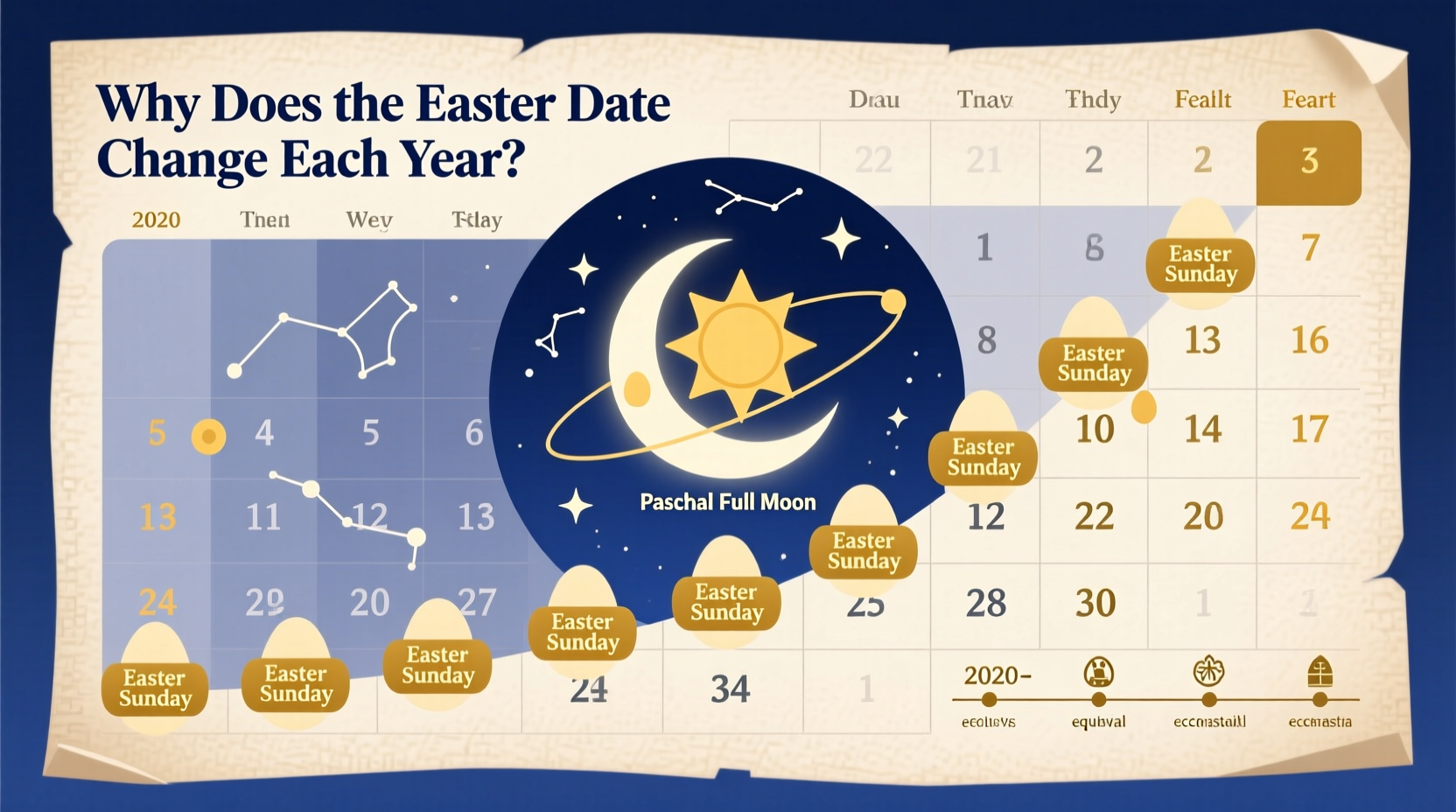
The date of Easter changes every year because it is determined by a combination of solar and lunar calendars, specifically tied to the first Sunday after the first full moon following the spring equinox. This system, rooted in ancient ecclesiastical traditions, explains why does the Easter date change and ensures that Easter remains symbolically aligned with the Jewish festival of Passover and the beginning of spring in the Northern Hemisphere. Unlike fixed holidays such as Christmas, which always falls on December 25, Easter is a moveable feast—its timing shifts annually between March 22 and April 25 in the Gregorian calendar used by most Western Christian churches.
Understanding the Ecclesiastical Rules Behind Easter’s Date
Easter’s variable date stems from early Christian decisions made during the First Council of Nicaea in 325 CE. Church leaders sought to standardize the celebration of Christ’s resurrection while maintaining its connection to the Hebrew calendar and the timing of Passover. They established that Easter would fall on the first Sunday after the Paschal Full Moon—the ecclesiastical approximation of the first astronomical full moon on or after March 21, which marks the vernal (spring) equinox.
This method combines elements of both the solar year (March 21 as the fixed equinox) and the lunar cycle (the phases of the moon). Because lunar months do not align perfectly with the solar calendar, the full moon can occur on different dates each year, causing Easter to shift accordingly. For example, if the first full moon after March 21 occurs on March 23, then Easter will be observed the following Sunday, March 30. But if the full moon falls on March 20, the next one—usually in April—determines the date, pushing Easter into late April.
Astronomical vs. Ecclesiastical Calculations
An important distinction lies between actual astronomical events and the church’s calculated equivalents. While modern astronomy can pinpoint the exact moment of the full moon and equinox, the ecclesiastical system uses predetermined tables rather than real-time observations. The Gregorian calendar, adopted in 1582 by Pope Gregory XIII, refined these calculations for greater accuracy, but some Eastern Orthodox Churches still use the older Julian calendar, leading to different Easter dates.
For instance, in 2026, Western Christians will celebrate Easter on March 29, based on the Gregorian calculation. However, many Orthodox communities will observe it on April 5 due to their later equinox and lunar reckoning. This divergence highlights how tradition, calendar systems, and regional practices contribute to the variability of Easter's date across cultures and denominations.
Historical Origins of the Moveable Feast
The roots of Easter’s changing date trace back to early Christianity’s desire to distinguish its observances from Jewish festivals while preserving theological connections. In the 2nd century, some Christian communities celebrated Easter on Nisan 14—the date of Passover—regardless of the day of the week. Others insisted it should always be on a Sunday, commemorating the resurrection. This conflict, known as the Quartodeciman controversy, was resolved at the Council of Nicaea, which affirmed the Sunday observance and introduced the lunar-solar formula still in use today.
Over centuries, various methods were developed to compute Easter, including complex algorithms like the computus. Monks and scholars maintained detailed tables predicting Easter dates decades in advance. These computations became part of medieval science and influenced the development of both liturgical calendars and early astronomy.
Regional Differences in Easter Dating
Today, the primary difference in Easter dating lies between Western Christianity (Catholic and Protestant) and Eastern Orthodoxy. Most Western churches follow the Gregorian calendar for all liturgical purposes, resulting in Easter typically falling between March 22 and April 25. Eastern Orthodox Churches, however, continue using the Julian calendar to determine the equinox and full moon, even when they otherwise use the Gregorian calendar for civil dates.
As a result, Orthodox Easter often occurs one to five weeks later than Western Easter. Occasionally, the two coincide—for example, in 2025, both East and West will celebrate Easter on April 20. But more commonly, there is a gap. In 2027, Western Easter falls on March 28, while Orthodox Easter occurs on April 4. These variations affect not only religious services but also public holidays, school breaks, and retail activity in predominantly Christian countries.
| Year | Western Easter Date | Orthodox Easter Date |
|---|---|---|
| 2025 | April 20 | April 20 |
| 2026 | March 29 | April 5 |
| 2027 | March 28 | April 4 |
| 2028 | April 16 | April 16 |
| 2029 | April 1 | April 8 |
Which Countries Celebrate Easter?
Easter is widely observed around the world, particularly in nations with strong Christian traditions. In Europe, countries such as Italy, Spain, France, Germany, and the United Kingdom hold both religious and cultural celebrations. In Latin America, nations like Mexico, Brazil, and Guatemala feature processions, reenactments, and family gatherings. The United States observes Easter with church services, egg hunts, and symbolic meals.
In Australia and New Zealand, Easter includes public holidays, sporting events like the Melbourne Cup Carnival (though not on Easter itself), and community festivals. Even in non-Christian-majority countries, Easter has gained recognition through globalization—Japan and South Korea, for example, see increased chocolate sales and themed promotions during the season, though primarily as a commercial event.
It's worth noting that government-recognized Easter holidays vary. Some countries grant Good Friday and Easter Monday as official days off; others only recognize Easter Sunday. Travelers and businesses should consult local schedules, especially in multinational corporations or international tourism sectors where operations may differ by region.
Common Misconceptions About Easter’s Date
One widespread misunderstanding is that Easter is randomly assigned or arbitrarily chosen. In fact, its date follows precise mathematical and calendrical rules. Another myth is that Easter always falls in April—it doesn’t. It can occur as early as March 22, though this is rare (last occurring in 1818 and next in 2285).
Some believe that Easter must directly follow Passover, but the link is symbolic rather than chronological. Due to differences in calendar systems, Easter sometimes precedes the start of Passover, especially under the Gregorian calculation. Additionally, people often assume all Christians celebrate Easter on the same day, overlooking the significant split between Eastern and Western observances.
How to Predict Future Easter Dates
Because Easter’s calculation follows a repeating cycle, it's possible to predict future dates accurately. The sequence repeats every 5.7 million years under the Gregorian system, but for practical purposes, tables are available up to the year 2100. You can calculate Easter using algorithms such as Gauss's Easter algorithm, which applies modular arithmetic to determine the correct Sunday.
Alternatively, numerous online tools and ecclesiastical calendars provide verified dates. Religious institutions, schools, and event planners often publish multi-year calendars showing upcoming Easter Sundays. For personal planning—such as scheduling vacations, family reunions, or retail campaigns—it’s advisable to check authoritative sources like the U.S. Naval Observatory, Vatican publications, or national almanacs.
Implications for Retailers, Schools, and Event Planners
The shifting nature of Easter impacts industries significantly. Retailers must adjust marketing timelines for seasonal products like chocolate eggs, greeting cards, and spring apparel. Since Easter can fall anywhere from late March to late April, promotional strategies need flexibility. A March Easter compresses the shopping window, requiring earlier inventory placement compared to an April date.
Schools and universities plan academic breaks around Easter, particularly in Catholic and Anglican systems. In the UK, for example, the spring term ends just before Easter and resumes after Easter Monday. Similarly, employers may offer holiday pay or adjusted hours depending on local customs and labor laws.
Event organizers should account for potential overlaps with other holidays or sports seasons. In the U.S., Easter sometimes coincides with Major League Baseball opening games or NCAA basketball tournaments, affecting attendance and media coverage. Internationally, Holy Week processions in Spain or Palm Sunday parades in the Philippines require extensive coordination with local authorities.
Tips for Observing or Preparing for Easter
- Check your denomination’s calendar: Confirm whether your church follows the Gregorian or Julian system, especially if you belong to an Orthodox or Eastern Rite congregation.
- Plan travel early: Easter weekend is a peak travel time in many countries. Book accommodations and transportation well in advance, particularly if attending services abroad.
- Review local holiday schedules: Verify whether Good Friday or Easter Monday is a public holiday in your area, as this affects banking, postal services, and business hours.
- Adjust retail or marketing plans: If running a business, analyze past sales data relative to Easter’s position in March or April to optimize inventory and advertising spend.
- Educate children about the calendar: Use Easter’s changing date as a teaching opportunity about astronomy, history, and religious traditions.
Frequently Asked Questions
When is Easter in 2026?
Easter Sunday in 2026 falls on March 29 for Western Christians. Orthodox Christians will celebrate on April 5.
Why doesn’t Easter have a fixed date like Christmas?
Easter is linked to the lunar cycle and the spring equinox, unlike Christmas, which is fixed to the solar calendar. This reflects its historical connection to Passover and early Christian efforts to maintain seasonal symbolism.
Do all countries celebrate Easter on the same day?
No. Western and Eastern Christian churches often observe Easter on different dates due to their use of different calendars—Gregorian versus Julian—for calculating the equinox and full moon.
Can Easter ever fall in May?
No. Under both the Gregorian and Julian systems, Easter cannot occur later than April 25 in the Western tradition or May 8 in the Orthodox tradition, though the latter corresponds to April 25 on the Gregorian calendar.
How far in advance can Easter dates be predicted?
Easter dates can be calculated centuries ahead using established formulas. Official tables exist listing Easter Sundays up to the year 2100 and beyond.





 浙公网安备
33010002000092号
浙公网安备
33010002000092号 浙B2-20120091-4