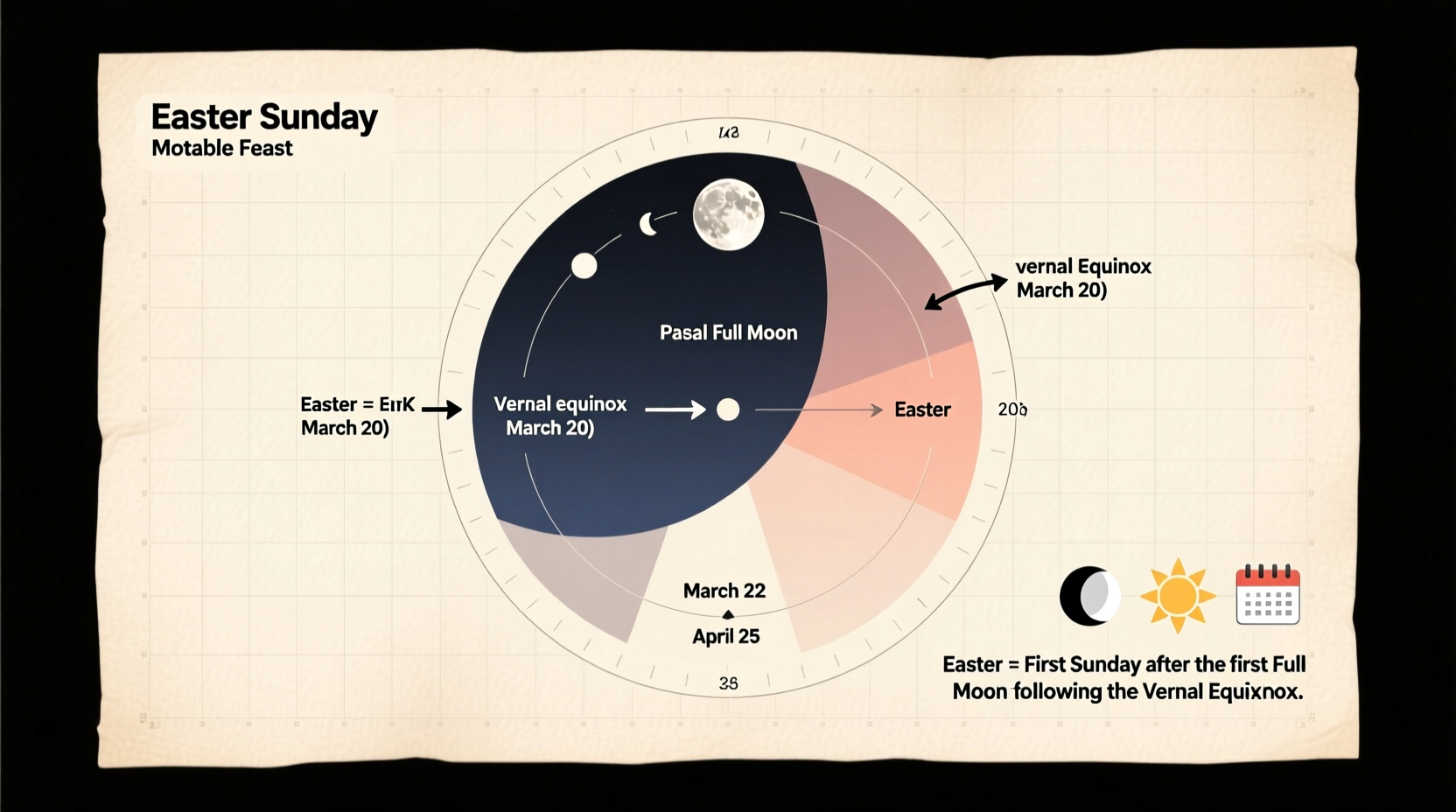
Easter moves each year because its date is determined by a unique combination of lunar cycles and the spring equinox, rather than a fixed point on the Gregorian calendar. This means that why does Easter move can be answered by understanding its deep-rooted connection to both astronomical events and early Christian tradition. Specifically, Easter Sunday falls on the first Sunday after the first full moon following the vernal (spring) equinox in the Northern Hemisphere. Because the lunar calendar does not align perfectly with the solar-based Gregorian calendar, the timing of this full moon shifts from year to year, causing Easter to fall anywhere between March 22 and April 25. This intricate system explains why Easter is considered a moveable feast, unlike holidays such as Christmas, which occur on the same calendar date annually.
The Historical Origins of Easter’s Movable Date
The reason why Easter moves dates back to the early centuries of Christianity and the effort to standardize religious observances across diverse regions. The celebration of Jesus Christ’s resurrection—the central event commemorated by Easter—was originally linked to the Jewish festival of Passover, which itself follows the lunisolar Hebrew calendar. Early Christians celebrated Easter around the same time as Passover, but disagreements arose over whether the holiday should always fall on a Sunday or coincide directly with the Jewish calendar’s Nisan 14, the day of the Passover sacrifice.
To resolve these disputes, the First Council of Nicaea convened in 325 CE under the Roman Emperor Constantine. One of its key decisions was to establish a uniform method for calculating Easter’s date across all Christian churches. The council decreed that Easter would be observed on the first Sunday after the first ecclesiastical full moon occurring on or after the vernal equinox, which was fixed at March 21 for computational purposes—even though the actual astronomical equinox may vary slightly. This compromise allowed Easter to remain independent of the Hebrew calendar while still preserving its seasonal and symbolic ties to spring and renewal.
How Is the Date of Easter Calculated?
Understanding why does Easter move requires a closer look at the calculation process. The formula used today is known as the computus, a complex algorithm developed over centuries by astronomers and theologians. Here are the key components:
- Vernal Equinox: Fixed at March 21 in church calculations, regardless of the true astronomical equinox.
- Ecclesiastical Full Moon: Not necessarily the actual full moon visible in the sky, but a calculated 'paschal full moon' based on historical lunar tables.
- First Sunday After: Easter must always fall on a Sunday, so the date is set for the Sunday immediately following the paschal full moon.
For example, if the paschal full moon occurs on March 20, Easter will be the following Sunday, April 1. But if the full moon falls on a Sunday (say, March 24), Easter is delayed until the next Sunday (March 31), ensuring it always comes after the full moon.
This system results in Easter moving within a 35-day window—from March 22 (if the full moon is on March 21 and that day is a Saturday) to April 25 (if the full moon falls just before April 19 and the next Sunday is April 25).
Eastern vs. Western Easter: Why Are Dates Sometimes Different?
Another factor contributing to confusion about why does Easter move is the difference between Eastern Orthodox and Western Christian traditions. While both follow the same general rule—first Sunday after the paschal full moon following the vernal equinox—they use different calendars and lunar calculations.
Western churches (Catholic and Protestant) use the Gregorian calendar, introduced in 1582 to correct drift in the Julian calendar. However, many Eastern Orthodox churches continue to use the older Julian calendar for liturgical purposes. As a result, the vernal equinox and full moon dates differ between the two systems, often placing Orthodox Easter one to five weeks later than Western Easter.
Additionally, Orthodox tradition requires that Easter must come after the Jewish Passover, adding another layer of complexity. In some years, such as 2025, both East and West will celebrate Easter on the same day (April 20), but in others, like 2026, they diverge—Western Easter falls on April 5, while Orthodox Easter occurs on April 12.
| Year | Western Easter | Orthodox Easter |
|---|---|---|
| 2024 | March 31 | May 5 |
| 2025 | April 20 | April 20 |
| 2026 | April 5 | April 12 |
| 2027 | March 28 | May 2 |
| 2028 | April 16 | April 16 |
Common Misconceptions About Easter’s Date
Several myths persist about why does Easter move. One common misunderstanding is that Easter is randomly assigned or decided by the Pope each year. In reality, the date is computed using standardized rules and mathematical tables that have been in place for centuries. The Vatican does not choose the date—it is derived from established algorithms.
Another misconception is that Easter could eventually fall in May. While rare, this has occurred historically, but modern calculations prevent it due to the fixed ecclesiastical equinox and lunar models. The latest possible date remains April 25.
Some also believe that Easter’s movability makes it harder to plan school breaks or public holidays. While this is true in practice, the flexibility reflects its theological significance as a celebration tied to natural cycles of light, darkness, death, and rebirth—central themes in Christian belief.
Regional Observances and Public Life Around Easter
Because Easter moves annually, countries that observe it as a public holiday adjust their schedules accordingly. In nations like the United States, Canada, Australia, Germany, and the United Kingdom, Good Friday and Easter Monday are often recognized as official holidays, though practices vary.
In the U.S., only about half the states recognize Good Friday as a state holiday, and federal offices remain open. Retailers may alter hours—some close entirely on Good Friday or Easter Sunday, especially in more religious regions. For example, stores in the Bible Belt may reduce operating times, while those in urban centers stay open. Shoppers planning ahead should check individual retailer websites or call local branches to confirm hours during the Easter period.
In contrast, Catholic-majority countries like Italy, Spain, and the Philippines typically shut down for several days around Easter, with businesses, schools, and government offices closed. In Scandinavia, Easter includes unique customs like witches and bonfires, blending pagan and Christian elements, yet the date still follows the same ecclesiastical rules.
How to Prepare for a Moving Holiday Like Easter
Given that why does Easter move affects travel, retail, and family planning, here are practical tips for staying prepared:
- Mark the Date Early: Since Easter changes yearly, add it to your calendar as soon as the new year begins. Many digital calendars automatically include movable feasts.
- Plan Travel in Advance: Spring break often overlaps with Easter, making flights and accommodations competitive. Booking early ensures better rates and availability.
- Check School and Work Schedules: Confirm when children are off school and whether your employer observes any Easter-related holidays.
- Verify Retail and Service Hours: Pharmacies, grocery stores, and restaurants may operate on reduced hours. Use store locators online to find updated holiday schedules.
- Understand Religious Services: Churches often hold special services from Palm Sunday through Easter Sunday. Check local parishes for exact times, especially if attending less familiar denominations.
Will Easter Ever Become a Fixed Holiday?
There have been periodic discussions about fixing Easter to a specific Sunday—such as the second or third Sunday in April—to simplify scheduling for schools, businesses, and international coordination. Proposals were considered by Christian leaders in the 20th century, including during ecumenical dialogues in the 1990s and again in 2016.
However, no consensus has emerged. Eastern Orthodox churches generally oppose a fixed date without agreement on calendar reform, while others argue that changing the tradition would disconnect Easter from its astronomical and scriptural roots. As of now, the current system remains intact, preserving the ancient link between the resurrection, the moon, and the arrival of spring.
Frequently Asked Questions
- Why doesn’t Easter have a fixed date like Christmas?
- Easter is tied to the lunar cycle and the spring equinox, reflecting its historical connection to Passover. Christmas, in contrast, was placed on December 25 as a fixed celebration of Christ’s birth, possibly aligned with winter solstice festivals.
- What is the earliest and latest Easter can be?
- The earliest Easter can occur is March 22; the latest is April 25. These extremes depend on the alignment of the paschal full moon and the following Sunday.
- Does Easter always fall after Passover?
- In Western Christianity, not necessarily. But in Eastern Orthodoxy, Easter must come after Passover, which sometimes causes a delay in their celebration.
- Who decides the date of Easter each year?
- No single person decides it. The date is calculated using centuries-old rules based on the ecclesiastical full moon and equinox. Astronomers and church authorities publish the dates well in advance.
- Can Easter ever fall in May?
- No, under the current system, the latest possible date is April 25. Although in the distant past there were variations, modern calculations cap the date in April.





 浙公网安备
33010002000092号
浙公网安备
33010002000092号 浙B2-20120091-4