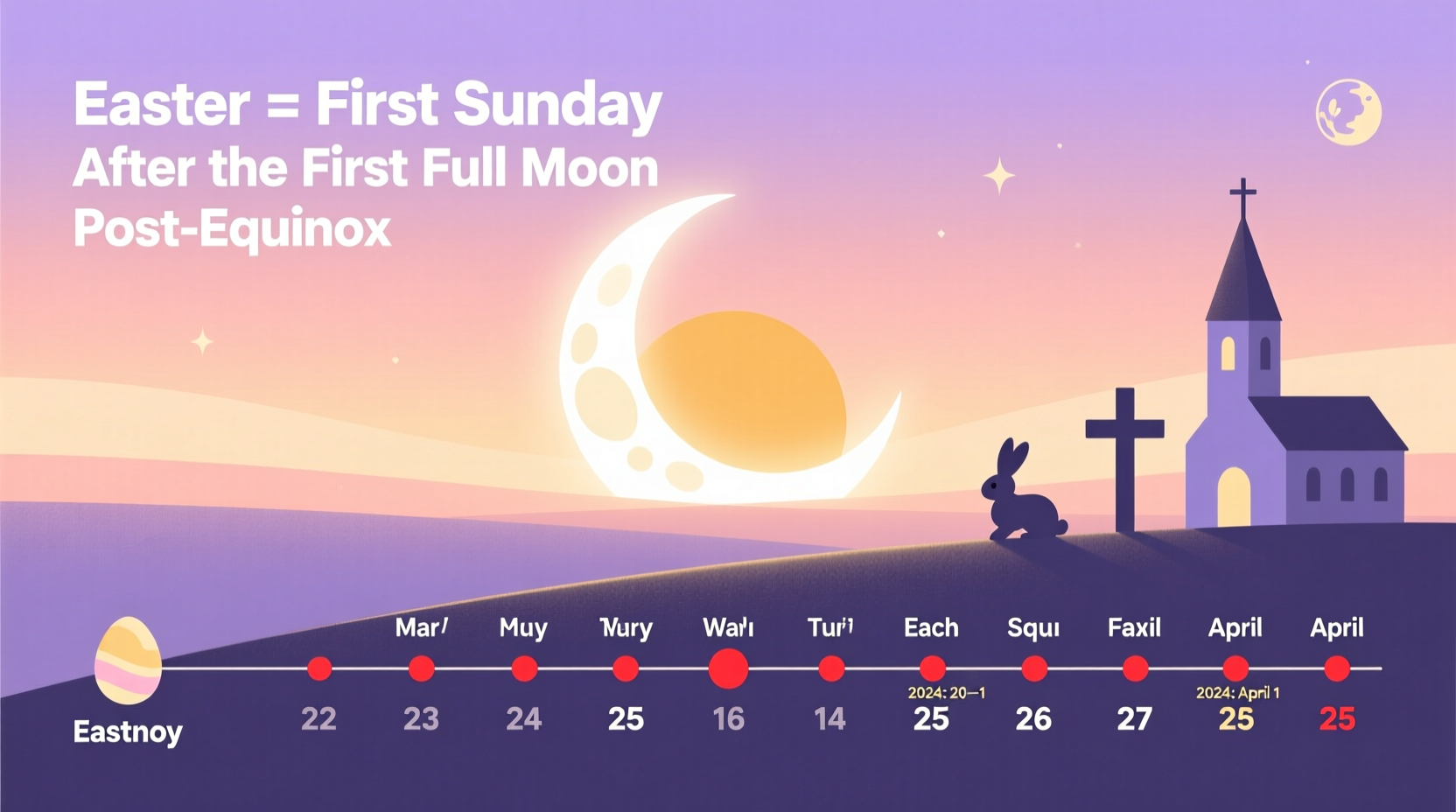
Easter moves around each year because it is determined by a combination of the solar calendar, the lunar cycle, and the vernal (spring) equinox—a calculation known as the computus. Unlike fixed holidays such as Christmas, which always falls on December 25, Easter is set as the first Sunday after the first full moon following the spring equinox in the Northern Hemisphere. This means Easter can occur as early as March 22 or as late as April 25, depending on astronomical events. The reason Easter moves around is rooted in early Christian efforts to align the celebration of Christ’s resurrection with Jewish Passover, which also follows a lunisolar calendar. As a result, the date shifts annually, creating variability that impacts school breaks, retail schedules, and religious observances worldwide.
Historical Origins of the Moving Date
The tradition of calculating Easter based on lunar phases dates back to the First Council of Nicaea in 325 CE. At that time, church leaders sought to standardize the date of Easter across all Christian communities. Prior to this council, different regions celebrated Easter on varying dates, sometimes even on weekdays, leading to confusion and disunity within the Church. The council decided that Easter should be celebrated uniformly as the first Sunday after the Paschal Full Moon—the ecclesiastical approximation of the first full moon after the vernal equinox, set at March 21 regardless of actual astronomical observation.
This decision linked Easter to both the solar year (via the equinox) and the lunar month (via the full moon), making it a moveable feast. The term moveable feast refers to any holiday whose date changes from year to year, and Easter is the most prominent example in the Christian liturgical calendar. Other moveable feasts, such as Ash Wednesday and Pentecost, are calculated relative to Easter’s shifting date.
How the Calculation Works: A Step-by-Step Breakdown
To understand why Easter moves around, it helps to break down the calculation process:
- Vernal Equinox: Fixed at March 21 for ecclesiastical purposes, though astronomically it can fall between March 19 and 21.
- Full Moon After Equinox: The next full moon after March 21 determines the Paschal Full Moon. However, the Church uses a standardized lunar calendar rather than real-time astronomical data.
- First Sunday After: Easter Sunday is the first Sunday following the Paschal Full Moon. If the full moon falls on a Sunday, Easter is the next Sunday.
For example, in 2026, the ecclesiastical full moon after March 21 occurs on Saturday, April 4. Therefore, Easter Sunday will be April 5. In contrast, in 2025, the full moon falls on March 20 (before the equinox), so the next full moon—April 18—determines the date, placing Easter on April 20.
| Year | Vernal Equinox | Paschal Full Moon | Easter Sunday |
|---|---|---|---|
| 2024 | March 21 | March 25 | March 31 |
| 2025 | March 21 | April 18 | April 20 |
| 2026 | March 21 | April 4 | April 5 |
| 2027 | March 21 | March 23 | March 28 |
| 2028 | March 21 | April 12 | April 16 |
Differences Between Western and Eastern Christianity
Another reason why Easter moves around differently across regions lies in the use of separate calendars. Most Western Christian churches (Catholic and Protestant) follow the Gregorian calendar, introduced by Pope Gregory XIII in 1582 to correct inaccuracies in the Julian calendar. Eastern Orthodox Churches, however, continue using the older Julian calendar for liturgical purposes.
Because the Julian calendar is currently 13 days behind the Gregorian, the vernal equinox is observed later, and the ecclesiastical full moons differ. As a result, Orthodox Easter often falls one to five weeks after Western Easter. For instance, in 2026, while Western Easter is on April 5, Orthodox Easter will be on April 12. In some years, like 2025, both East and West celebrate on the same day—April 20—due to alignment in their respective calculations.
This divergence leads to variations in public holidays, school closures, and cultural festivities in countries with large Orthodox populations, such as Greece, Russia, Ukraine, and Serbia.
Global Observance: Which Countries Celebrate Easter?
Easter is observed in over 100 countries around the world, either as a religious holiday, a cultural event, or a national public holiday. While its significance varies, common observances include church services, family meals, egg decorating, and symbolic traditions like the Easter Bunny.
In predominantly Christian nations such as the United States, Canada, Australia, the United Kingdom, Germany, and Brazil, Easter is widely celebrated with both religious and secular customs. Many schools and government offices close for Good Friday and Easter Monday (in Commonwealth countries), allowing families time for reflection and celebration.
In Latin America, Holy Week (Semana Santa) is marked by processions, reenactments of the Passion, and fasting. In the Philippines, millions participate in penitential rituals, including crucifixions in some rural areas. In Scandinavian countries, children dress as witches and go door-to-door for candy—a blend of pagan and Christian traditions.
Even in non-Christian-majority countries, Easter has cultural presence. Japan and South Korea see increased chocolate sales and themed café events, influenced by Western media. In China, while not a public holiday, expatriate communities and international schools may hold Easter egg hunts and brunches.
Impact on Retail and Business Schedules
The fact that Easter moves around each year presents challenges for retailers, travel companies, and event planners. Unlike fixed holidays, businesses must adjust marketing campaigns, inventory, and staffing annually based on Easter’s changing date.
Retailers typically begin promoting Easter products—chocolate eggs, greeting cards, decorations, and spring clothing—as early as February. Sales peak in the two weeks leading up to Easter Sunday. Because the holiday can fall in March or April, the timing affects第一季度 (Q1) earnings reports. An early Easter (e.g., March 23) may shift consumer spending into Q1, while a late Easter (e.g., April 21) benefits Q2 revenues.
Supermarkets, bakeries, and florists experience high demand for traditional items like hot cross buns, lamb roasts, and lilies. Some grocery chains open reduced hours or close entirely on Good Friday, especially in Catholic countries like Ireland and Malta. In the U.S., major retailers like Walmart and Target remain open but may operate on holiday schedules.
Travel operators promote “Easter getaways,” particularly in Europe and the Caribbean. Families often plan vacations around school breaks, which are scheduled according to Easter’s date. In the UK, for example, spring half-term holidays are timed to precede Easter, creating a surge in domestic and international travel.
Common Misconceptions About Easter’s Date
Several myths persist about why Easter moves around. One common misconception is that Easter is randomly assigned. In reality, its date follows precise mathematical and astronomical rules developed over centuries. Another myth is that Easter always falls in April; however, it can occur in March, as it did in 2016 (March 27) and will again in 2029 (March 25).
Some believe that climate or regional customs influence the date, but Easter’s timing is strictly governed by the ecclesiastical formula, not weather or geography. Additionally, people often assume all Christians celebrate on the same day, overlooking the split between Gregorian and Julian calendar users.
How to Prepare for a Shifting Holiday
Given that Easter moves around, individuals and organizations benefit from planning ahead. Here are practical tips:
- Check Local Calendars: Verify school holidays, bank closures, and public transport schedules, which vary by country and region.
- Monitor Retail Trends: Shoppers can save money by buying seasonal items after Easter, when prices drop significantly.
- Plan Travel Early: Book accommodations and flights months in advance, especially if traveling during peak Holy Week periods in countries like Spain or Italy.
- Religious Observances: Churches often publish Lenten calendars and Holy Week service times online; reviewing these helps families coordinate participation.
- Business Forecasting: Companies should analyze past Easter sales data and adjust inventory and staffing based on the current year’s date.
Efforts to Fix Easter’s Date
In recent decades, there have been proposals to fix Easter on a permanent date, such as the second or third Sunday in April. Proponents argue that a fixed date would simplify planning for schools, governments, and businesses. It could also promote unity among Christian denominations.
In 1997, the World Council of Churches proposed a common framework during a consultation in Aleppo, Syria, suggesting a revised astronomical method that could harmonize Eastern and Western dates. However, no binding agreement was reached, and implementation remains unlikely without consensus among major churches.
The Vatican and Orthodox patriarchates have expressed reluctance, emphasizing the theological and historical significance of maintaining traditional calculations. Until such agreement emerges, Easter will continue to move around the calendar, preserving its ancient link to lunar rhythms and seasonal renewal.
Frequently Asked Questions
When is Easter in 2026?
Easter Sunday in 2026 falls on April 5 in Western Christianity. Orthodox Easter will be on April 12.
Why does Easter change dates every year?
Easter changes because it is based on the first Sunday after the first full moon following the spring equinox, linking it to both solar and lunar cycles.
Do all countries celebrate Easter on the same day?
No. Western churches use the Gregorian calendar, while many Eastern Orthodox churches use the Julian calendar, resulting in different dates.
Can Easter ever fall in March?
Yes. Easter can fall as early as March 22, though this is rare. The last time was in 1818; the next occurrence will be in 2285.
Is Good Friday a public holiday everywhere?
No. While it is a national holiday in countries like Australia, Germany, and the UK, it is not federally recognized in the United States, though some states observe it.





 浙公网安备
33010002000092号
浙公网安备
33010002000092号 浙B2-20120091-4