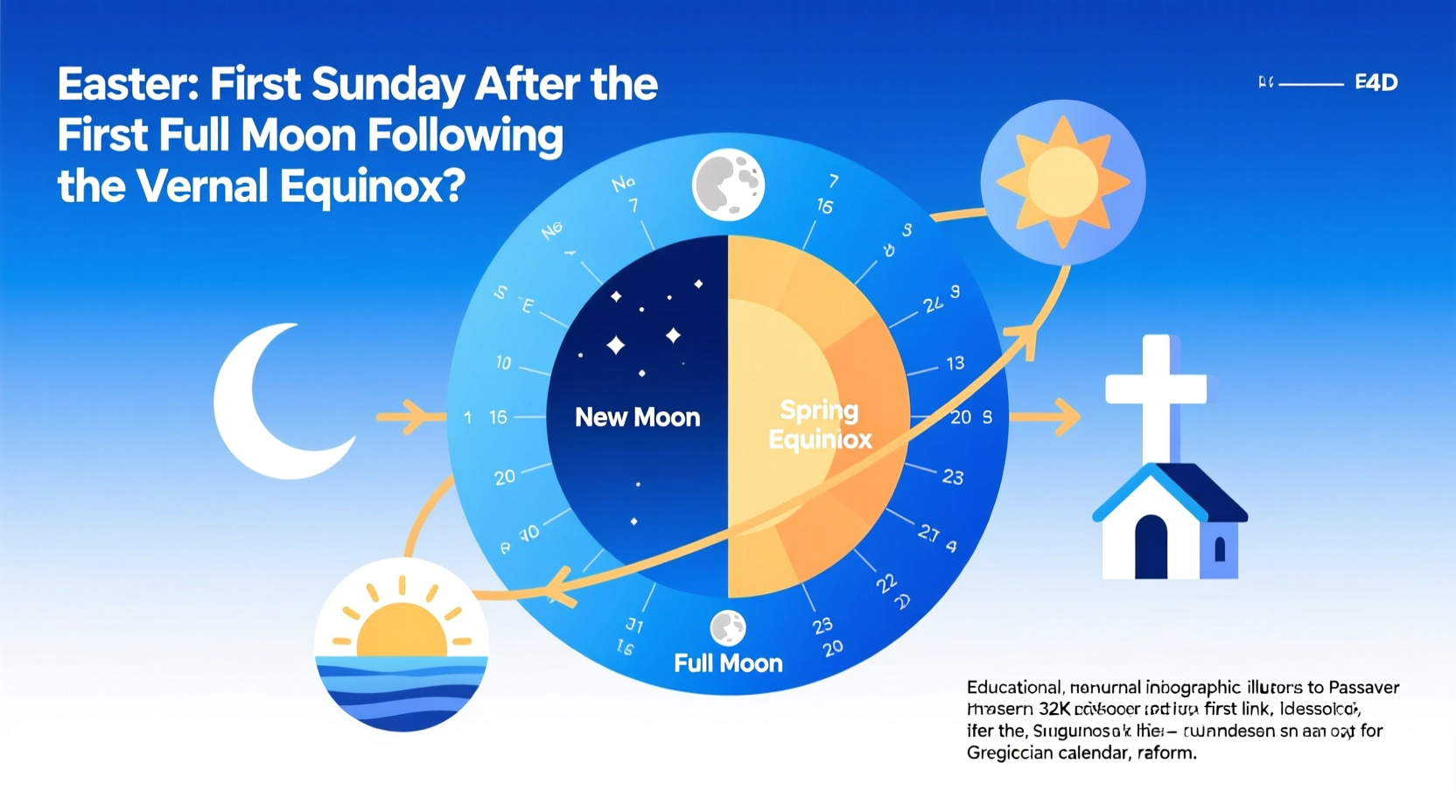
Why does Easter change every year? Unlike fixed holidays such as Christmas, Easter falls on a different Sunday each year—typically between March 22 and April 25. This variation stems from its deep connection to the lunar calendar and the timing of the spring equinox, a tradition established by early Christian councils. The long-standing question of why does Easter move annually is best answered by understanding its ecclesiastical roots, astronomical dependencies, and cultural adaptations across countries.
The Astronomical and Religious Basis for Easter's Date
Easter’s floating date is determined by a combination of solar and lunar cycles. Officially, Easter Sunday is defined as the first Sunday after the first full moon that occurs on or after the vernal (spring) equinox. This rule was formalized during the First Council of Nicaea in 325 CE, when church leaders sought to standardize the celebration of Christ’s resurrection across all Christian communities.
The vernal equinox is fixed on March 21 in ecclesiastical calculations, regardless of the actual astronomical event, which can vary slightly. The 'ecclesiastical full moon' also differs from the astronomical full moon; it’s based on pre-calculated tables known as the Ecclesiastical Full Moon (EFM) cycle. Because the lunar month (approximately 29.5 days) doesn’t align perfectly with the solar calendar, the timing of this full moon shifts each year—thus affecting when Easter is observed.
This system ensures that Easter remains linked to both the Jewish Passover (which also follows a lunisolar calendar) and the symbolic renewal of spring, reinforcing themes of rebirth and resurrection central to Christian theology.
How the Calculation Works: A Step-by-Step Explanation
To understand why does Easter change dates every year, consider this simplified process used by most Western Christian churches (those following the Gregorian calendar):
- Establish the vernal equinox: Set at March 21, regardless of the true astronomical date.
- Determine the next full moon: Use ecclesiastical tables to find the first full moon on or after March 21.
- Find the following Sunday: Easter is always the first Sunday after this full moon. If the full moon falls on a Sunday, Easter is the next Sunday.
For example:
- In 2025, the first full moon after March 21 is on April 13 (Sunday). Since Easter must follow the full moon, it will be celebrated on April 20.
- In 2026, the full moon occurs on March 21 (the equinox), falling on a Saturday. Therefore, Easter is held the next day, March 22—the earliest possible date.
- In 2027, the full moon is April 17 (Saturday), so Easter falls on April 18.
Eastern Orthodox churches often celebrate Easter on a different date because they use the older Julian calendar for liturgical purposes, which currently runs 13 days behind the Gregorian calendar. Additionally, they require that Easter fall after the Jewish Passover, adding another layer of complexity.
Historical Origins: Why Was This System Chosen?
The reason why does Easter shift each year goes back to early Christianity’s effort to distinguish itself while honoring its Jewish roots. Jesus’ crucifixion and resurrection occurred during Passover, a festival tied to the first full moon of spring. Early Christians wanted Easter to remain symbolically aligned with this timing but also sought independence from direct reliance on Jewish calendar announcements.
Before the Council of Nicaea, various regions celebrated Easter on different dates, sometimes even on weekdays. The council unified observance under a single set of rules: Easter would be celebrated universally on a Sunday, separate from Passover, yet still connected to the same lunar cycle.
This compromise preserved theological symbolism while promoting unity within the growing Church. Over centuries, refinements were made to improve accuracy, especially after the Gregorian calendar reform in 1582 corrected drift in the Julian calendar.
Regional Differences in Observing Easter
While nearly 100 countries recognize Easter in some form, the date of celebration varies between Western and Eastern Christianity. Below is a comparison of key differences:
| Aspect | Western Churches (Catholic/Protestant) | Eastern Orthodox Churches |
|---|---|---|
| Calendar Used | Gregorian | Julian (for religious dates) |
| Earliest Possible Date | March 22 | April 4 (Gregorian equivalent) |
| Latest Possible Date | April 25 | May 8 (Gregorian equivalent) |
| Relation to Passover | No strict requirement | Easter must come after Passover |
| Example: 2025 | April 20 | April 20 (coincides this year) |
| Example: 2026 | March 22 | April 12 |
Countries like Greece, Russia, Ukraine, and Serbia follow the Orthodox date, while the U.S., Canada, Germany, France, and most of Latin America observe the Western date. In nations with mixed populations—such as Finland or Lebanon—both dates may be recognized officially or culturally.
Common Misconceptions About Easter’s Timing
Several myths persist about why Easter moves annually. One common misunderstanding is that Easter is entirely random or based solely on the weather. In reality, its date follows precise mathematical and calendrical rules developed over centuries.
Another myth is that Easter always occurs in April. While it often does, it can fall as early as March 22 (next occurring in 2285) or as late as April 25 (last seen in 1943, next in 2038).
Some believe that Easter should be fixed on a specific Sunday (e.g., second or fourth Sunday in April). Proposals for a fixed Easter have been discussed since the early 20th century, including by the World Council of Churches, but no consensus has emerged due to theological, cultural, and denominational differences.
How Retailers and Schools Plan Around a Moving Holiday
Because Easter changes each year, businesses, schools, and governments must adjust schedules accordingly. In many countries, Good Friday and Easter Monday are public holidays, though practices vary:
- United States: No federal holiday, but many states close schools and some government offices. Retailers often run sales starting the week before Easter.
- Australia: Good Friday and Easter Monday are national public holidays. Major retailers typically close or operate limited hours.
- Germany: Strict 'quiet laws' (Ruhetag) apply on Good Friday and Easter Sunday—no loud activities, shopping, or sports permitted.
- Canada: Federal employees get Good Friday and Easter Monday off. Provincial rules differ slightly.
Consumers planning travel, dining, or shopping should verify local regulations and store hours through official websites or municipal announcements, as regional exceptions exist.
Preparing for Easter: Tips Based on the Annual Shift
Given that why does Easter change every year affects personal and community planning, here are practical tips:
- Mark your calendar early: Easter dates are predictable using algorithms. You can find dates up to 2050 online via church or astronomical sources.
- Plan religious services in advance: Churches often publish Holy Week schedules weeks ahead. Confirm times for Maundy Thursday, Good Friday, and Easter Vigil.
- Schedule family gatherings strategically: Since Easter Sunday shifts, coordinate with relatives early—especially if travel is involved.
- Shop smart: Grocery stores peak on the Thursday and Friday before Easter. Consider shopping earlier in the week to avoid crowds.
- Monitor school breaks: Many districts align spring break with Easter, but not all. Check academic calendars, especially if homeschooling or coordinating childcare.
Will Easter Ever Have a Fixed Date?
The idea of fixing Easter to a permanent Sunday—such as the second or fourth Sunday in April—has gained occasional support. Advocates argue it would simplify planning for education, business, and transportation sectors.
However, opposition remains strong among theologians who emphasize the holiday’s intentional link to the lunar cycle and Passover. Any change would require agreement across Catholic, Protestant, and Orthodox traditions—an unlikely scenario given current divisions.
In 1997, an international group convened by the World Council of Churches proposed setting Easter on the second Sunday in April, but implementation stalled. For now, the traditional method prevails.
Conclusion: Embracing the Rhythm of a Moving Feast
The answer to why does Easter change every year lies in a rich blend of astronomy, theology, and history. Its shifting nature reflects deeper spiritual meanings tied to renewal, freedom, and divine timing. While modern life favors predictability, Easter’s variability preserves a sense of anticipation and connection to ancient rhythms.
Whether you’re observing religious traditions, hosting a family meal, or simply enjoying a long weekend, understanding the reasons behind Easter’s changing date enhances appreciation for this globally significant holiday.
Frequently Asked Questions
- Why isn't Easter on the same date every year like Christmas?
- Easter follows a lunisolar calculation tied to the spring equinox and full moon, unlike Christmas, which is fixed to the solar calendar.
- When is Easter in 2026?
- In 2026, Easter Sunday falls on March 22—the earliest possible date—for Western Christian churches.
- Why do Orthodox churches celebrate Easter on a different date?
- They use the Julian calendar for religious observances and require Easter to follow the Jewish Passover, leading to later dates.
- Can Easter ever fall in March?
- Yes. Easter can occur as early as March 22, though this is rare. The last time was in 1818; the next will be in 2285.
- Is there a formula to calculate Easter’s date?
- Yes. Mathematicians like Carl Friedrich Gauss developed algorithms to compute Easter’s date for any year using modular arithmetic.





 浙公网安备
33010002000092号
浙公网安备
33010002000092号 浙B2-20120091-4