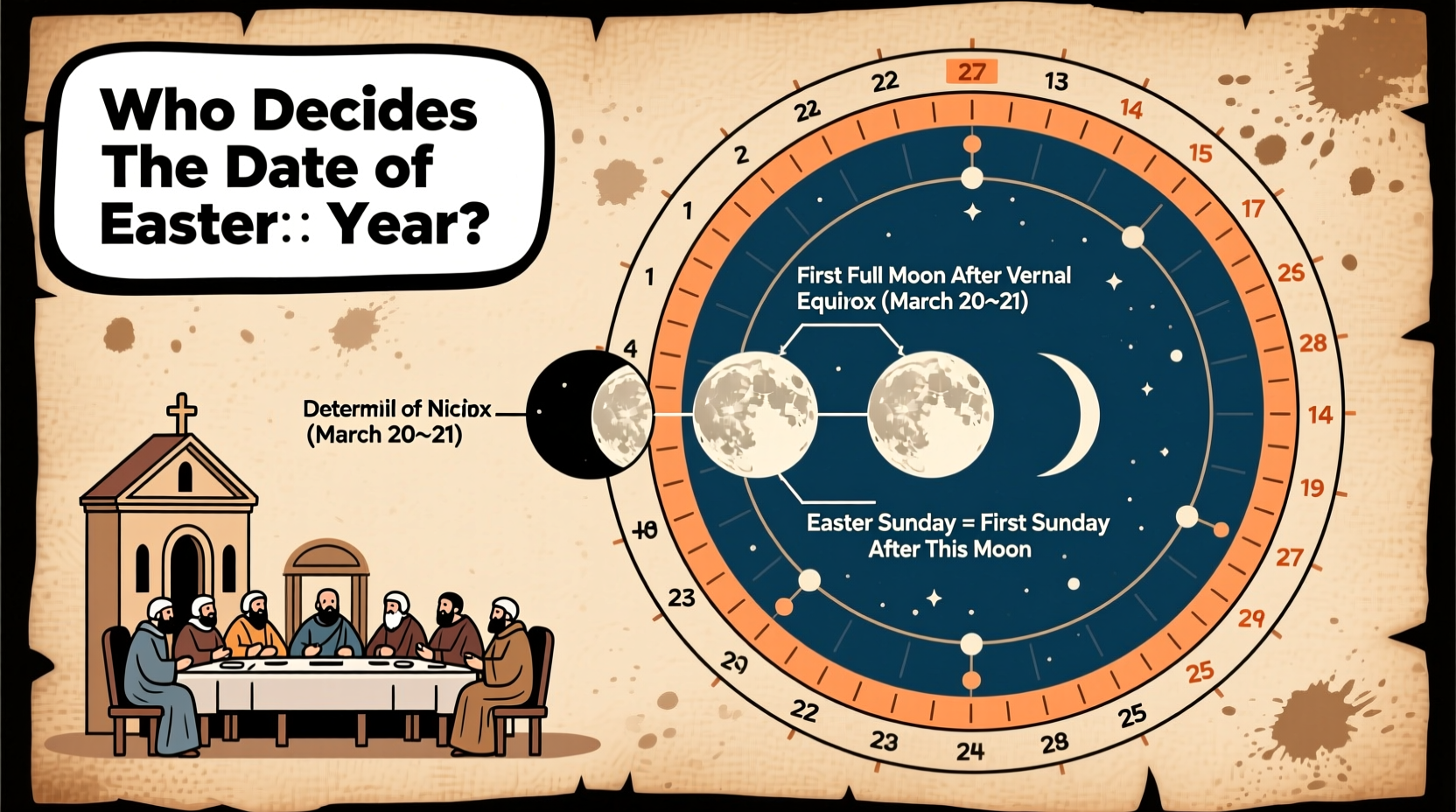
The date of Easter each year is decided by a complex but well-established formula rooted in both astronomy and ecclesiastical tradition. Specifically, Easter falls on the first Sunday after the Paschal full moon, which is the first full moon occurring on or after the spring equinox (fixed as March 21 in the calculation). This means that Easter can occur as early as March 22 or as late as April 25 in the Gregorian calendar used by most Western Christian churches. The authority behind this decision lies with the rules established by the First Council of Nicaea in 325 CE, which sought to standardize the celebration of Easter across all Christian communities. While no single modern institution 'announces' the date each year, it is calculated in advance using these ancient guidelines, making the process both predictable and consistent. For example, those searching for how the date of Easter is determined annually will find that it hinges on this lunar-solar interplay defined centuries ago.
Historical Origins: The Council of Nicaea and the Standardization of Easter
The question of who decides the Easter date traces back to one of the most influential gatherings in early Christian history—the First Council of Nicaea, convened in 325 CE under the Roman Emperor Constantine I. Before this council, different regions celebrated Easter on varying dates, often influenced by local interpretations of the Jewish Passover calendar. Some Christian communities observed Easter on the same day as Passover (the 14th of Nisan), regardless of the day of the week, while others insisted it must always fall on a Sunday to commemorate the resurrection of Jesus Christ.
To resolve this inconsistency, the Council of Nicaea decreed that Easter should be celebrated uniformly across Christendom on the first Sunday following the first full moon after the vernal (spring) equinox. This removed dependence on the Hebrew calendar and placed Easter on a fixed astronomical framework instead. By fixing the equinox at March 21—regardless of the actual astronomical event—and defining the 'ecclesiastical full moon' through tables rather than direct observation, the Church created a predictable system that could be calculated decades or even centuries in advance.
Why Doesn't Easter Have a Fixed Calendar Date?
Unlike holidays such as Christmas (December 25), Easter does not have a fixed position on the Gregorian calendar because its timing is tied to lunar phases and seasonal changes. This reflects its origins in biblical accounts linking the crucifixion and resurrection of Jesus to the Jewish festival of Passover, which itself follows a lunisolar calendar. Because the lunar month is approximately 29.5 days long, and twelve lunar months total about 354 days—11 days shorter than the solar year—the dates of lunar-based festivals shift each year relative to the solar calendar.
As a result, Easter remains a moveable feast. Its variability serves as a reminder of its deep historical and theological roots. Understanding why Easter's date changes every year helps clarify why it can sometimes seem unpredictable compared to other major holidays.
Differences Between Western and Eastern Christianity
One of the most common sources of confusion around the Easter date involves the difference between Western (Roman Catholic and Protestant) and Eastern Orthodox celebrations. Although both follow the Nicene formula, they use different calendars and methods for calculating the equinox and full moon.
- Western Churches: Use the Gregorian calendar, introduced in 1582 by Pope Gregory XIII to correct drift in the Julian calendar. They rely on standardized ecclesiastical moon tables to determine the Paschal full moon.
- Eastern Orthodox Churches: Continue to use the older Julian calendar for liturgical purposes, which currently runs 13 days behind the Gregorian calendar. Additionally, they often apply stricter rules regarding the alignment with Passover, requiring Easter to fall after the Jewish holiday ends.
Because of these differences, Orthodox Easter frequently occurs one, four, or even five weeks later than Western Easter. In some years, however, the two coincide—for example, in 2025, both Western and Orthodox Easters fall on April 20.
How Far in Advance Is the Easter Date Set?
The date of Easter is not arbitrarily chosen each year; it is mathematically predetermined. Using the established algorithm based on the Metonic cycle—a 19-year cycle that approximates the relationship between solar years and lunar months—churches and calendar compilers can calculate Easter dates hundreds of years into the future.
For instance, here are upcoming Easter dates in the Western Church:
| Year | Western Easter Date | Orthodox Easter Date |
|---|---|---|
| 2024 | March 31 | May 5 |
| 2025 | April 20 | April 20 |
| 2026 | April 5 | April 12 |
| 2027 | March 28 | May 2 |
| 2028 | April 16 | April 16 |
This predictability allows religious institutions, schools, governments, and businesses to plan accordingly. Those asking when is Easter in 2026 can confidently reference these calculations without waiting for an official announcement.
Modern Implications: School Breaks, Retail, and Travel
Because Easter influences public holidays, school schedules, and commercial activity in many countries, knowing how the date is decided has practical significance beyond religious observance. In nations like the United States, the UK, Australia, and Canada, Good Friday and Easter Monday are often recognized as public or school holidays, though practices vary regionally.
Retailers also prepare months in advance for the Easter shopping season, particularly for candy, greeting cards, clothing, and home decor. Chocolate manufacturers, for example, begin production cycles based on projected demand tied directly to the known Easter date. Similarly, travel companies see increased bookings for spring getaways, especially when Easter falls in late March or early April.
Consumers interested in what time Easter starts each year should note that while there is no universal 'start time,' churches typically hold services at sunrise, 9 AM, or 11 AM local time. These times are set independently by individual parishes, so checking specific church bulletins is recommended.
Common Misconceptions About How Easter's Date Is Chosen
Several myths persist about who decides the Easter date and how it’s calculated:
- Myth: The Pope personally chooses the date each year.
Fact: The Pope does not decide the date; it is computed according to fixed rules adopted in 325 CE. - Myth: Easter must always occur after Passover.
Fact: While historically linked, Western Christianity does not require this; only Orthodox traditions generally enforce it. - Myth: Astronomers officially announce the full moon used for Easter.
Fact: The 'ecclesiastical full moon' is derived from mathematical tables, not real-time observations.
How to Verify Easter Dates for Your Region
While the general rule applies globally, local customs may affect how Easter is observed. To ensure accuracy:
- Check official church websites (e.g., Vatican, Anglican Communion, Orthodox Patriarchates) for liturgical calendars.
- Consult national government sites for public holiday declarations (e.g., gov.uk for the UK).
- Review school district calendars if planning family activities.
- Use reputable online calendar tools like timeanddate.com or calendar-365.com, which clearly distinguish between Western and Eastern dates.
Could the Date of Easter Ever Be Fixed?
In recent decades, there have been discussions among Christian leaders about establishing a fixed date for Easter—such as the second Sunday in April—to simplify scheduling and promote unity between East and West. Proposals were considered in the 20th century by both the World Council of Churches and the Vatican, but no consensus has emerged.
Challenges include theological resistance to altering a tradition dating back to Nicaea, disagreements over which fixed date to choose, and the difficulty of achieving global agreement among diverse denominations. As of now, the traditional method remains unchanged, meaning who decides the Easter date continues to rest with the inherited logic of medieval computus rather than any contemporary governing body.
Frequently Asked Questions
When is Easter in 2026?
In 2026, Western Easter will be celebrated on Sunday, April 5. Orthodox Easter will follow one week later on April 12.
Do all countries celebrate Easter on the same day?
No. While many Western nations observe Easter on the same Sunday, Eastern Orthodox countries like Russia, Greece, and Ukraine often celebrate on a different date due to their use of the Julian calendar.
Which countries recognize Easter as a public holiday?
Over 100 countries worldwide recognize Easter or related days (Good Friday, Easter Monday) as public holidays, including the United States, Germany, France, Brazil, South Africa, and New Zealand. However, observance varies—some countries close schools and banks, while others maintain regular business hours.
Is the Easter date based on the actual full moon?
No. The date uses the 'ecclesiastical full moon,' a calculated approximation based on historical tables, not the astronomical full moon observed in the sky.
Can Easter ever fall in March?
Yes. Easter can occur as early as March 22, though this is rare. The last time was in 1818, and it won’t happen again until 2285. More commonly, early Easters fall on March 23 or March 31, as in 2024.





 浙公网安备
33010002000092号
浙公网安备
33010002000092号 浙B2-20120091-4