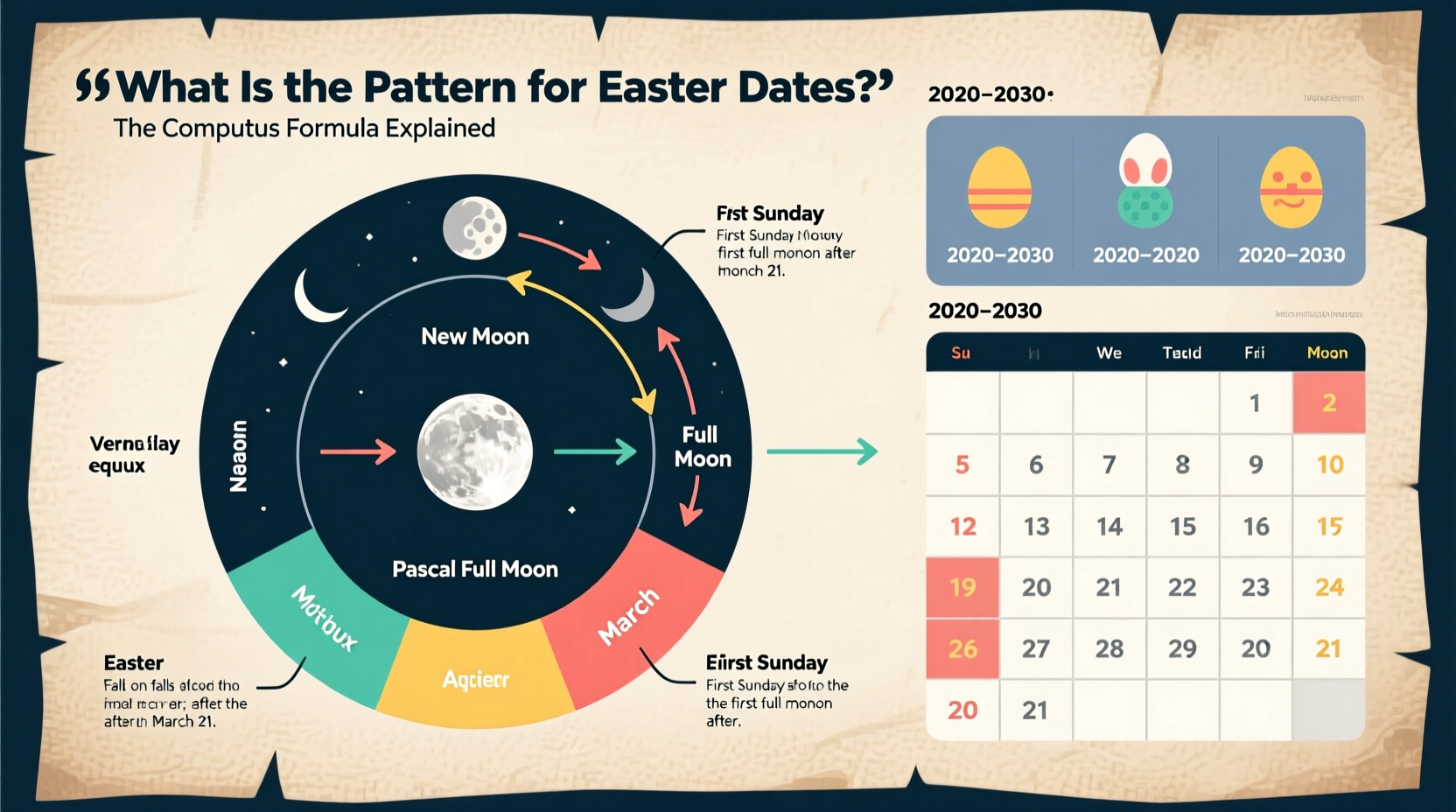
The pattern for Easter follows a predictable yet variable rule: it is always celebrated on the first Sunday after the first full moon that occurs on or after the vernal (spring) equinox, which usually falls on March 20 or 21 in the Northern Hemisphere. This ecclesiastical calculation, rooted in both lunar cycles and solar positioning, explains why the date of Easter shifts each year between March 22 and April 25 in the Gregorian calendar used by most Western Christian churches. Understanding what is the pattern for Easter reveals how astronomy, ancient tradition, and religious doctrine intersect to determine one of Christianity’s most important holidays.
Why Does Easter’s Date Change Every Year?
Unlike fixed holidays such as Christmas (December 25), Easter is a moveable feast. Its date varies because it is tied to the lunar calendar rather than the solar one. The decision was formalized at the First Council of Nicaea in 325 CE, where church leaders agreed that Easter should be celebrated uniformly across Christendom on the first Sunday after the Paschal Full Moon—the ecclesiastical approximation of the first astronomical full moon after the vernal equinox.
This system ensures that Easter aligns with Jewish Passover, during which the crucifixion and resurrection of Jesus occurred, according to the New Testament. However, instead of relying directly on astronomical observations, the church uses a set of mathematical tables known as the ecclesiastical moon to calculate the date. This means the Paschal Full Moon may not always coincide exactly with the actual astronomical full moon.
How the Calculation Works: A Step-by-Step Breakdown
To understand the pattern behind Easter’s shifting date, consider these key components:
- Vernal Equinox: Fixed at March 21 in church calculations, regardless of the actual astronomical equinox.
- Paschal Full Moon: The first ecclesiastical full moon on or after March 21.
- First Sunday After: Easter Sunday is the first Sunday following this full moon.
For example, if the Paschal Full Moon falls on a Sunday, Easter will be the following Sunday. If it falls on a Monday, Easter is the next Sunday—seven days later.
This method results in Easter occurring anywhere from March 22 (if the full moon is on March 21 and the next day is Sunday) to April 25 (if the full moon falls just after March 21 and the following Sunday lands late in April).
Easter Date Range and Recent/Future Examples
Easter can fall on any Sunday between March 22 and April 25. Below are examples illustrating the variability based on the pattern:
| Year | Easter Date (Western) | Vernal Equinox | Paschal Full Moon |
|---|---|---|---|
| 2024 | March 31 | March 20 | March 25 |
| 2025 | April 20 | March 20 | April 13 |
| 2026 | April 5 | March 20 | March 29 |
| 2027 | March 28 | March 20 | March 22 |
| 2028 | April 16 | March 20 | April 13 |
As shown, even small shifts in the timing of the ecclesiastical full moon can push Easter earlier or later within its possible range. These dates apply to Western Christianity (Catholic and Protestant denominations) using the Gregorian calendar.
Eastern vs. Western Easter: Why Are Dates Different?
One common source of confusion is that Eastern Orthodox churches often celebrate Easter on a different date than Western churches. This discrepancy arises because many Orthodox churches use the older Julian calendar to calculate the vernal equinox and full moon, rather than the modern Gregorian calendar.
The Julian calendar currently runs 13 days behind the Gregorian, so their March 21 equinox corresponds to April 3 in the Gregorian system. Additionally, they rely on the same ecclesiastical moon tables but applied within the Julian framework. As a result, Orthodox Easter (also called Pascha) typically falls one to five weeks after Western Easter, though occasionally it coincides.
For instance, in 2025, Western Easter is on April 20, while Orthodox Easter falls on April 20 as well—rare alignment due to overlapping lunar calculations. In contrast, in 2026, Western Easter is April 5, but Orthodox Easter is May 3.
Historical Origins of the Easter Dating System
The current pattern for Easter dates back to early Christian efforts to standardize worship practices. Before the Council of Nicaea, some Christian communities celebrated Easter on the same date as Passover (the 14th of Nisan in the Hebrew calendar), while others insisted it must always be on a Sunday. To unify practice and distance Easter from direct dependence on Jewish calendrical computations, the council established the Sunday-after-the-full-moon rule.
This compromise preserved the connection to Passover’s timing while emphasizing the resurrection on a Sunday. Over centuries, refinements were made to the lunar tables, particularly during the Gregorian calendar reform of 1582, when Pope Gregory XIII introduced more accurate astronomical models to prevent drift over time.
Common Misconceptions About the Easter Pattern
Several myths persist about how Easter’s date is determined:
- Misconception 1: “Easter is based on the actual full moon.” While inspired by astronomy, the church uses a calculated, not observed, full moon.
- Misconception 2: “Easter can never be before March 21.” Actually, Easter can fall as early as March 22, since the equinox is fixed at March 21 in ecclesiastical terms.
- Misconception 3: “All Christians celebrate Easter on the same day.” Due to calendar differences, global unity in celebration remains elusive.
- Misconception 4: “The date is randomly assigned.” Far from random, it follows a strict algorithm repeated every 19 years—the Metonic cycle—which approximates the relationship between lunar months and solar years.
Regional and Cultural Variations in Observance
While the pattern for Easter is mathematically defined, its observance varies widely around the world. Countries with strong Christian traditions—such as Italy, Spain, the Philippines, Poland, and Brazil—often treat Easter as a major public holiday with religious processions, special meals, and family gatherings.
In contrast, in countries like Japan or China, where Christianity is a minority religion, Easter is largely commercialized or unrecognized as a public holiday, though some urban areas host egg hunts or themed events aimed at children.
In the United States, Easter Monday is not a federal holiday, but schools and businesses may close regionally. Canada recognizes Easter Monday only in Quebec. Australia and New Zealand observe Good Friday and Easter Monday as public holidays nationwide.
How to Predict Future Easter Dates
You don’t need complex tools to estimate future Easter dates. Here’s a simple approach:
- Note that the ecclesiastical vernal equinox is always March 21.
- Consult published tables or online calculators for the Paschal Full Moon for the given year.
- Find the first Sunday after that date.
Alternatively, use algorithms like the Gauss Easter Algorithm, which computes the date using modular arithmetic. Many programming languages include built-in functions to return Easter dates for any year.
For practical planning—such as scheduling travel, church services, or retail promotions—reliable sources include:
- TimeandDate.com
- United States Naval Observatory data
- Official Catholic liturgical calendars
- Government holiday lists by country
Implications for Retail, Travel, and Religious Planning
The variable nature of Easter affects industries significantly. Because Easter can fall in March or April, retail seasons for spring merchandise, confectionery (especially chocolate eggs and bunnies), and apparel shift annually. Retailers often begin Easter sales six to eight weeks in advance, adjusting based on the holiday’s position in the calendar.
Similarly, airlines and vacation planners see spikes in demand around Easter weekend, especially in Europe and Latin America, where Holy Week (Semana Santa) is a peak travel period. Churches must coordinate Lenten programs, Holy Week services, and Easter liturgies months in advance, relying on pre-published liturgical calendars.
Efforts Toward a Fixed Easter Date
There have been periodic discussions among Christian leaders about establishing a fixed date for Easter—such as the second Sunday in April—to simplify planning and promote global unity. Proposals gained traction in the 20th century and were revisited by ecumenical bodies including the World Council of Churches.
However, agreement has remained out of reach due to theological, cultural, and calendrical differences between denominations and traditions. Until consensus emerges, the traditional lunar-based pattern will continue to govern Easter’s observance.
Frequently Asked Questions
- When is Easter 2026?
- Easter Sunday in 2026 falls on April 5 for Western Christian churches.
- Why does Easter change but Christmas doesn’t?
- Christmas is fixed to the solar calendar (December 25), while Easter is linked to the lunar cycle and spring equinox, making it a moveable feast.
- Do all countries celebrate Easter on the same day?
- No. Western churches follow the Gregorian calendar; most Eastern Orthodox churches use the Julian calendar, leading to different dates in most years.
- Can Easter ever fall in March?
- Yes. The earliest possible date for Easter is March 22. The most recent occurrence was in 1818, and the next will be in 2285.
- Is there a 19-year cycle for Easter dates?
- Yes. Due to the Metonic cycle, the sequence of Easter dates repeats approximately every 19 years, though not perfectly due to calendar reforms and leap year rules.




 浙公网安备
33010002000092号
 浙B2-20120091-4