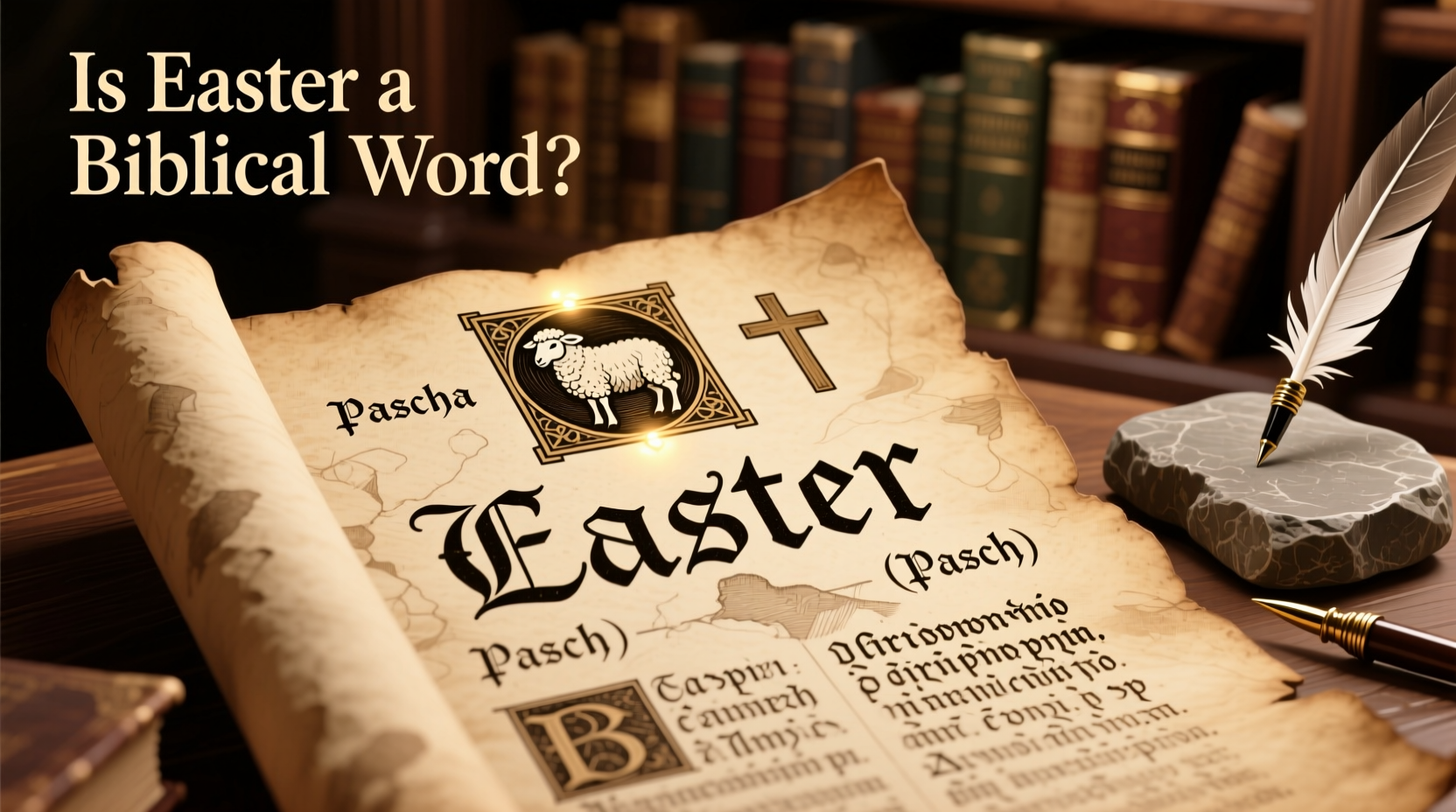
The word Easter is not explicitly found in most ancient biblical manuscripts, and is Easter a biblical word largely depends on the Bible translation being referenced. In the original Greek and Hebrew texts, the term associated with the resurrection of Jesus is rooted in Pascha, derived from the Hebrew word for Passover. While modern English Bibles typically use 'Passover' consistently, the King James Version (KJV) mentions 'Easter' once in Acts 12:4, where scholars agree the intended meaning is actually 'Passover.' Therefore, while Easter as a celebration of Christ's resurrection aligns with biblical events, the word itself is not originally biblical but rather a later cultural and linguistic development.
Origins of the Word 'Easter'
The etymology of the word Easter traces back to Old English Eastrun, a term linked to the pagan spring festival honoring Eostre, a Germanic goddess of dawn and fertility. This connection was noted by the Venerable Bede, an 8th-century English monk, who wrote that the month corresponding to April was called Eosturmonath, named after the goddess. As Christianity spread across Europe, early church leaders often adapted existing pagan festivals into Christian observances to ease conversion. Thus, the celebration of Jesus’ resurrection was synchronized with the spring equinox celebrations, adopting both timing and some symbolic elements—like eggs and rabbits—associated with rebirth and fertility.
However, in most non-English-speaking Christian traditions, the term used for Easter derives from Pascha, which comes directly from the Hebrew Pesach, meaning Passover. This reflects the deep theological link between the Jewish festival of Passover and the crucifixion and resurrection of Jesus, whom Christians believe is the Paschal Lamb fulfilling Old Testament prophecies (Exodus 12; 1 Corinthians 5:7).
Biblical References and Translations
When exploring is Easter a biblical word, one must examine Bible translations closely. The only appearance of the word 'Easter' in any mainstream Bible is in the 1611 King James Version (KJV) of Acts 12:4:
'And when he had apprehended him, he put him in prison, and delivered him to four quaternions of soldiers to keep him; intending after Easter to bring him forth to the people.'
In this context, the original Greek word is Pascha, which universally means 'Passover.' Nearly all modern translations—including the NIV, ESV, NASB, and CSB—correctly translate this as 'Passover,' recognizing that Herod would not have been referencing a Christian holiday (which did not yet exist as a formal observance) but the Jewish feast. Therefore, the use of 'Easter' in the KJV here is considered a mistranslation or at least an anachronism, reflecting the translators’ cultural context rather than historical accuracy.
This single instance does not validate 'Easter' as a biblically original term. Instead, it highlights how language evolves and how cultural influences shape religious terminology. The absence of 'Easter' in other scriptural passages—even those describing the resurrection (Matthew 28, Mark 16, Luke 24, John 20)—further confirms that the event is commemorated without using that specific label.
Theological Significance vs. Terminology
While the word Easter may not be biblical, the event it represents—the resurrection of Jesus Christ—is central to Christian faith. The New Testament repeatedly emphasizes the importance of Christ rising from the dead:
- 1 Corinthians 15:17: 'And if Christ has not been raised, your faith is futile; you are still in your sins.'
- Romans 6:9: 'We know that since Christ was raised from the dead, he cannot die again; death no longer has mastery over him.'
- Matthew 28:6: 'He is not here; he has risen, just as he said.'
These verses underscore that the resurrection is not merely a historical footnote but the foundation of Christian hope and salvation. So, while is Easter a biblical word yields a negative answer linguistically, the substance of Easter is undeniably biblical. The celebration, though named differently across cultures, honors a core doctrine revealed in Scripture.
Cultural Evolution of Easter Celebrations
Easter today encompasses both religious and secular customs. For many Christians, Easter Sunday includes sunrise services, church liturgies, communion, and hymns celebrating the resurrection. These practices are deeply rooted in biblical teachings and early church tradition. However, popular symbols like the Easter bunny and Easter eggs have no direct biblical basis and originate in pre-Christian European customs.
The egg, a universal symbol of new life, was incorporated into Christian symbolism to represent the empty tomb and spiritual rebirth. Similarly, the rabbit—known for its fertility—was associated with springtime long before Christianity. Over time, these symbols were reinterpreted within a Christian framework, allowing families to engage in festive activities while teaching children about resurrection through metaphor.
Despite these syncretic elements, major Christian denominations—including Catholic, Orthodox, Anglican, Lutheran, and many Protestant churches—observe Easter as the pinnacle of the liturgical year. The season of Lent, which precedes Easter, involves fasting, prayer, and reflection, mirroring Jesus’ 40 days in the wilderness and preparing believers spiritually for the joy of resurrection Sunday.
Regional Differences in Observance and Terminology
The question is Easter a biblical word also invites comparison across global Christian communities. In most languages, the term for Easter is derived from Pascha:
| Language | Term for Easter | Linguistic Root |
|---|---|---|
| Latin | Passover | Pascha |
| Spanish | Pascua | Pascha |
| Italian | Pasqua | Pascha |
| German | Ostern | Related to Eostre (similar to English 'Easter') |
| Russian | Пасха (Paskha) | Pascha |
| Greek | Πάσχα (Pascha) | Pascha |
This table illustrates that only a few languages—primarily Germanic ones—use terms unrelated to Passover. Even in Germany, where 'Ostern' is used, the religious significance remains tied to the resurrection. This divergence in terminology underscores how translation and cultural adaptation influence religious expression, even when the underlying theology remains consistent.
Modern Debates and Misconceptions
Some critics argue that because 'Easter' has pagan roots, its celebration is unbiblical or idolatrous. However, this view overlooks the broader principle of redeeming cultural symbols for Christian use—a practice seen throughout Scripture. For example, Paul repurposed an altar 'to an unknown god' in Athens as a platform to preach about Jesus (Acts 17:23). Likewise, early Christians transformed Roman festivals and symbols to proclaim the gospel in culturally relevant ways.
Moreover, the date of Easter is determined by a complex calculation based on the lunar calendar and the spring equinox, ensuring it aligns roughly with the timing of Passover. This further reinforces the theological continuity between the Old and New Testaments. The Council of Nicaea (AD 325) standardized the observance to occur on the first Sunday after the first full moon following the vernal equinox, emphasizing unity among believers.
How to Approach Easter Biblically
For believers seeking to honor the true meaning of the resurrection, several practical steps can help ground the celebration in Scripture:
- Focus on Scripture readings: Read the Gospel accounts of the resurrection (Matthew 28, Mark 16, Luke 24, John 20–21) during family gatherings or personal devotion.
- Participate in church services: Attend Good Friday and Easter Sunday services to engage with the full narrative of Christ’s death and resurrection.
- Teach the difference between symbols and substance: Explain to children that while bunnies and eggs are fun, the real reason for Easter is Jesus’ victory over sin and death.
- Avoid consumerism: Resist over-commercialization by limiting excessive gift-giving and focusing on worship and fellowship.
- Study the Passover connection: Explore how Jesus fulfilled the Passover as the Lamb of God (John 1:29), linking Old Testament prophecy with New Testament fulfillment.
Conclusion: Is 'Easter' a Biblical Word?
To directly answer is Easter a biblical word: No, the term 'Easter' does not appear in the original biblical languages and is absent from most Bible translations. It appears only once in the KJV due to a translation choice now widely regarded as inaccurate. The biblical term is Pascha (Passover), which connects Jesus’ sacrifice and resurrection to the Exodus story. However, while the word may not be biblical, the event it commemorates is profoundly scriptural and essential to Christian belief.
Understanding the history behind the word allows believers to celebrate Easter with informed faith—appreciating both its cultural journey and its unchanging theological core. Whether called 'Easter,' 'Pascha,' or 'Resurrection Sunday,' the message remains the same: Christ is risen, and through Him, there is eternal life.
Frequently Asked Questions
Why does the King James Bible say 'Easter' in Acts 12:4?
The KJV translators used 'Easter' likely due to the influence of English liturgical language at the time. However, the original Greek word is Pascha, meaning 'Passover,' and modern translations correct this for accuracy.
Is celebrating Easter considered sinful because of its pagan origins?
No. The incorporation of cultural symbols does not make a practice sinful if the focus remains on biblical truth. The resurrection of Jesus is well-documented in Scripture and worth celebrating regardless of the term used.
What is the correct biblical name for Easter?
The closest biblical term is 'Passover' (Pesach in Hebrew, Pascha in Greek), which Jesus observed before His crucifixion. Early Christians referred to the resurrection celebration as the 'Feast of the Resurrection' or 'Pascha.'
Do all Christians celebrate Easter on the same day?
No. Western Christians (Catholic, Protestant) follow the Gregorian calendar, while Eastern Orthodox churches use the Julian calendar, leading to different dates in most years.
Can I use the word 'Easter' as a Christian?
Yes. Language evolves, and 'Easter' has become the common term in English for the resurrection celebration. What matters most is the heart behind the observance and fidelity to biblical teaching.




 浙公网安备
33010002000092号
 浙B2-20120091-4