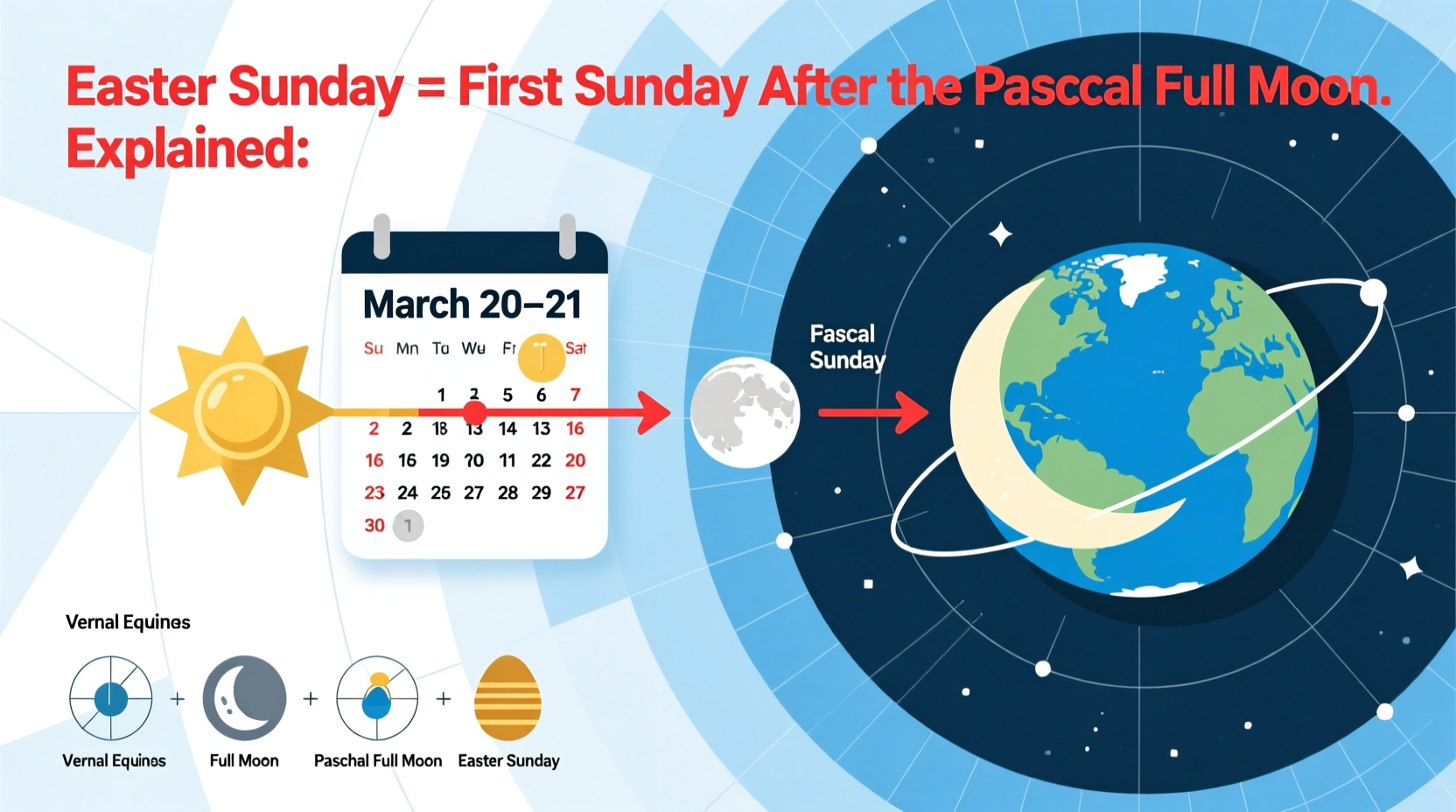
Easter Sunday does not fall on the same calendar date each year because its timing is based on a combination of solar and lunar cycles. Specifically, how Easter gets its date is determined by the first Sunday after the Paschal Full Moon, which is the first full moon occurring on or after the spring equinox—officially set as March 21 in ecclesiastical calculations. This system links Easter to both astronomical events and religious tradition, resulting in a movable feast that can occur anywhere between March 22 and April 25 in Western Christianity. Understanding how does Easter get its date reveals the interplay between astronomy, church doctrine, and historical decisions made centuries ago.
Why Easter’s Date Changes Every Year
Unlike fixed holidays such as Christmas (December 25), Easter is a moveable feast. Its variability stems from its roots in both the Jewish Passover and early Christian efforts to align worship with natural celestial events. The decision to base Easter’s timing on the lunar cycle was formalized at the First Council of Nicaea in 325 CE. Church leaders sought to standardize the celebration of Christ’s resurrection across all Christian communities, ensuring unity while respecting the connection between Passover and the crucifixion.
The key factors in determining Easter’s date are:
- The vernal (spring) equinox in the Northern Hemisphere
- The phases of the moon
- The following Sunday
Because the lunar month (approximately 29.5 days) doesn’t align perfectly with the solar calendar, the full moon shifts from year to year relative to the Gregorian calendar. This causes Easter to move accordingly.
The Ecclesiastical Rules Behind Easter’s Calculation
To maintain consistency without relying on actual astronomical observations every year, the Christian churches use a method called the ecclesiastical full moon, which is based on a calculated approximation rather than real-time moon sightings. This system uses a 19-year Metonic cycle—a period after which the phases of the moon recur on the same dates. By referencing this cycle, churches can predict future Easter dates decades in advance.
In Western Christianity (Catholic and Protestant traditions), Easter falls on the first Sunday after the first ecclesiastical full moon on or after March 21. Even if the astronomical equinox occurs earlier (e.g., March 19 or 20), the church uses March 21 as a fixed reference point.
For example:
- In 2025, the Paschal Full Moon is on April 13, so Easter is celebrated on April 20.
- In 2026, the Paschal Full Moon is on April 2, making Easter Sunday April 5.
- In 2027, the full moon is on March 22, but since it’s before the equinox, the next full moon (April 20) determines Easter, placing it on April 25—the latest possible date.
Eastern vs. Western Easter: Why Dates Often Differ
One common source of confusion about how Easter gets its date is the frequent discrepancy between Eastern Orthodox and Western Christian celebrations. While Western churches follow the Gregorian calendar for these calculations, most Orthodox churches use the older Julian calendar, which currently runs 13 days behind.
This means that even when both traditions observe the same astronomical conditions, their liturgical calendars place the equinox and full moons on different dates. As a result, Orthodox Easter often occurs later—sometimes weeks after Western Easter—and occasionally coincides, typically when the full moon and Sunday alignment overlap under both systems.
For instance, in 2025, Western Easter is on April 20, while Orthodox Easter falls on April 20 as well due to rare alignment. However, in 2026, Western Easter is April 5, whereas Orthodox Easter will be on April 12.
| Year | Western Easter | Orthodox Easter | Difference |
|---|---|---|---|
| 2024 | March 31 | May 5 | 35 days |
| 2025 | April 20 | April 20 | Same day |
| 2026 | April 5 | April 12 | 7 days |
| 2027 | April 25 | April 25 | Same day |
| 2028 | April 16 | April 23 | 7 days |
Historical Origins: The Council of Nicaea and the Standardization of Easter
The question of how does Easter get its date traces back to early Christian debates over whether to celebrate Easter independently of the Jewish calendar or remain tied to Passover. Some early Christians, known as Quartodecimans, observed Easter on the 14th of Nisan (the date of Passover), regardless of the day of the week. Others insisted it should always be on a Sunday to commemorate the resurrection.
To resolve this dispute, Emperor Constantine convened the First Council of Nicaea in 325 CE. The council decided that Easter should be celebrated uniformly on a Sunday and independently of the Hebrew calendar, though still symbolically linked to the spring equinox and full moon. This decision laid the foundation for the computus—the complex calculation used to determine Easter’s date.
Over time, different Christian traditions developed slightly varying methods for computing Easter, leading to the current division between Western and Eastern practices.
Modern Implications: School Holidays, Retail, and Travel
Because Easter’s date changes annually, governments, schools, and businesses must adjust schedules accordingly. In many countries, Good Friday and Easter Monday are public holidays, affecting operations in retail, transportation, and education.
For example:
- In the United Kingdom, banks and government offices close on both Good Friday and Easter Monday.
- In the United States, only Good Friday is a federal holiday in some territories (e.g., Puerto Rico); however, many states give employees time off.
- Retailers often plan major sales around Easter, particularly for seasonal items like chocolate, clothing, and home decor.
Travel patterns also shift depending on when Easter falls. When Easter occurs early (like March 24 in 2024), it may conflict with school spring breaks in certain regions. Conversely, a late Easter (such as April 25) might extend holiday shopping seasons or affect tax filing deadlines in some countries.
Common Misconceptions About How Easter Gets Its Date
Despite its long-standing rules, several myths persist about how Easter’s date is set:
Misconception 1: “Easter is based on the actual full moon.”
While rooted in lunar cycles, the church uses an ecclesiastical table, not real-time astronomy. So even if a full moon appears on March 20 astronomically, the church still uses March 21 as the earliest possible starting point.
Misconception 2: “All Christians celebrate Easter on the same day.”
Due to calendar differences (Gregorian vs. Julian), Eastern and Western churches often celebrate on different Sundays. Only occasionally do they coincide.
Misconception 3: “The date of Easter affects Christmas.”
Christmas is fixed on December 25. However, the date of Easter influences other moveable feasts, such as Ash Wednesday, Palm Sunday, Ascension Day, and Pentecost—all counted backward or forward from Easter Sunday.
How to Predict Future Easter Dates
You don’t need advanced math to find upcoming Easter dates. Several reliable resources provide official listings:
- Time and Date offers a comprehensive Easter calculator showing past and future dates worldwide.
- The U.S. Naval Observatory publishes ecclesiastical tables used by astronomers and historians.
- Many church websites, including those of the Vatican and Orthodox patriarchates, publish liturgical calendars years in advance.
If you want to calculate it manually, here’s a simplified approach:
- Determine the date of the ecclesiastical spring equinox (March 21).
- Find the next full moon using the Metonic cycle tables.
- Select the following Sunday.
Note: There are algorithms (like the Gauss Easter Algorithm) that compute Easter mathematically, but they require modular arithmetic and are more suited for programming applications.
Regional Variations in Easter Observance
While how Easter gets its date follows standardized rules within each tradition, local customs influence how the holiday is observed. For example:
- In Greece and Russia, Orthodox Easter includes midnight services, fireworks, and red-dyed eggs.
- In Spain, Semana Santa (Holy Week) features elaborate processions.
- In Sweden, children dress as witches and go door-to-door for candy, blending pagan and Christian elements.
- In the U.S., the White House hosts an annual Easter Egg Roll on the Monday after Easter Sunday.
These cultural expressions highlight how the same calendrical system gives rise to diverse traditions shaped by history, climate, and national identity.
Efforts to Fix Easter’s Date
In recent decades, there have been proposals to establish a fixed date for Easter—such as the second or third Sunday in April—to simplify planning for schools, businesses, and international travel. Proponents argue that a fixed date would reduce confusion and promote global unity among Christians.
However, resistance remains strong. Any change would require agreement among Catholic, Protestant, and Orthodox leaders—an unlikely prospect given theological and liturgical sensitivities. Additionally, moving away from the lunar-based system would break a nearly 1,700-year-old tradition tied to biblical symbolism and agricultural rhythms.
As of now, no major denomination has adopted a permanent date, and the current system remains in place.
Frequently Asked Questions
- When is Easter in 2026?
- Western Easter in 2026 falls on Sunday, April 5. Orthodox Easter is on April 12.
- Why doesn’t Easter have a fixed date?
- Easter is linked to the lunar cycle and spring equinox, following ancient Christian tradition established at the Council of Nicaea in 325 CE.
- Do all countries celebrate Easter on the same day?
- No. Western and Eastern Christian churches often celebrate on different dates due to calendar differences (Gregorian vs. Julian).
- What is the earliest and latest possible date for Easter?
- In Western Christianity, Easter can fall as early as March 22 and as late as April 25.
- Is Easter always after Passover?
- Not necessarily. Because the church uses a calculated full moon rather than the actual Hebrew calendar, Easter sometimes precedes Jewish Passover, especially in Western Christianity.




 浙公网安备
33010002000092号
浙公网安备
33010002000092号 浙B2-20120091-4