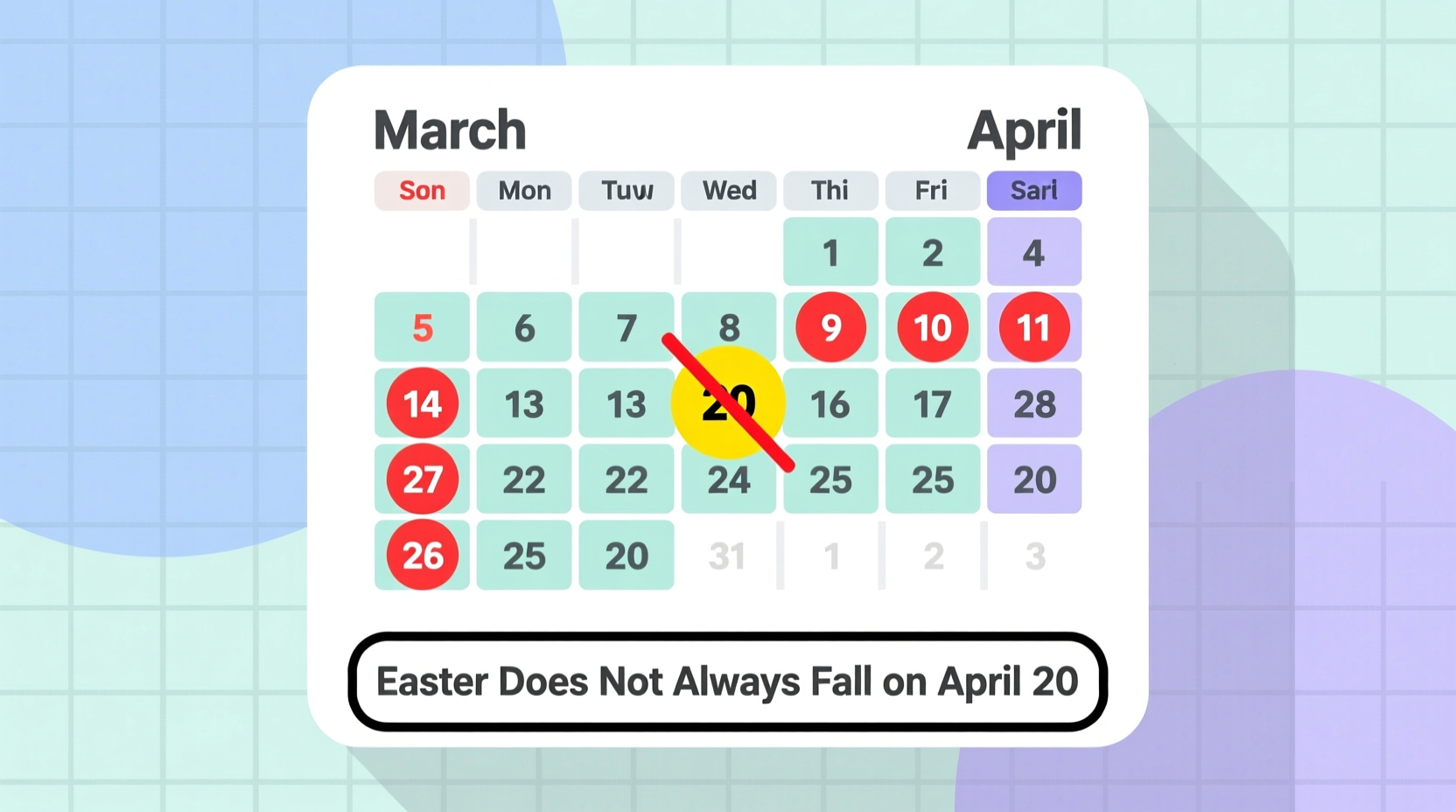
No, Easter does not always fall on April 20. In fact, Easter rarely lands on April 20, as its date is determined by a complex calculation involving the lunar calendar and the spring equinox. A common misconception, sometimes fueled by cultural associations between Easter and the number 420, leads some to believe there’s a fixed link between Easter and April 20. However, does Easter always fall on 420 is a question rooted more in myth than in liturgical or astronomical fact. Easter Sunday is set as the first Sunday after the first full moon following the vernal (spring) equinox in the Northern Hemisphere, which means it can occur anytime between March 22 and April 25.
Understanding How the Date of Easter Is Determined
The timing of Easter each year follows a system established by the First Council of Nicaea in 325 CE. According to this rule, Easter falls on the first Sunday after the Paschal Full Moon—the first full moon that occurs on or after the ecclesiastical approximation of the spring equinox, which is fixed on March 21. This method ties Easter to both solar and lunar cycles, making it a moveable feast rather than a fixed-date holiday like Christmas.
Because the lunar calendar doesn’t align perfectly with the Gregorian calendar used globally today, the date of Easter shifts annually. For example:
- In 2023, Easter fell on April 9.
- In 2024, it occurred on March 31.
- In 2025, Easter will be celebrated on April 20.
- In 2026, it moves back to April 5.
This variation clearly shows that while Easter may occasionally fall on April 20—such as in 2025—it does not happen every year. Therefore, the idea that "Easter always falls on 420" is inaccurate and stems from misunderstanding or symbolic conflation, particularly with cannabis culture where "420" has unrelated significance.
Why April 20 Stands Out: Cultural Confusion and Symbolism
The number 420 has become widely associated with cannabis culture, particularly in North America, where April 20 (written as 4/20) is celebrated unofficially as a day to advocate for marijuana legalization or simply consume cannabis. This cultural phenomenon began in the 1970s among high school students in California who met at 4:20 p.m. to smoke. Over time, the term evolved into a global symbol within recreational and medicinal cannabis communities.
Easter, on the other hand, is a Christian religious holiday commemorating the resurrection of Jesus Christ. Despite occurring around the same time of year, the two events are entirely separate in origin, meaning, and observance. However, because Easter occasionally coincides with April 20—as it will in 2025—some people mistakenly assume a recurring pattern or intentional connection.
This overlap has led to humorous memes, social media jokes, and even commercial promotions blending bunnies, eggs, and cannabis imagery. But from a historical and theological standpoint, there is no link between Easter and the number 420.
Historical Development of Easter Dating Rules
The method for calculating Easter dates back to early Christianity's effort to standardize religious observances across different regions. Before the Council of Nicaea, various Christian communities celebrated Easter on different days, often influenced by Jewish Passover traditions. To unify practice, church leaders decided that Easter should be independent of the Hebrew calendar but still tied to the spring season, symbolizing renewal and rebirth.
The resulting formula uses March 21 as a fixed reference point for the spring equinox (even though the actual astronomical equinox can vary slightly). The next full moon after that date determines the Paschal Full Moon. Easter is then set for the following Sunday. If the full moon falls on a Sunday, Easter is delayed by a week to ensure it always occurs on a Sunday.
This system results in Easter falling anywhere from March 22 (if the full moon is on March 21 and that day is a Saturday) to April 25 (the latest possible date under current rules). The last time Easter fell on April 25 was in 1943; the next occurrence will be in 2038.
When Will Easter Fall on April 20?
While Easter does not always fall on April 20, it does happen occasionally. Recent and upcoming years when Easter lands on April 20 include:
| Year | Date of Easter |
|---|---|
| 1902 | April 20 |
| 1913 | April 20 |
| 1941 | April 20 |
| 2025 | April 20 |
| 2036 | April 20 |
As shown, Easter only lands on April 20 roughly once per generation. The next time after 2036 will be in 2047. So while the alignment happens, it is infrequent and governed strictly by astronomical and ecclesiastical calculations—not tradition, symbolism, or cultural trends.
Regional and Denominational Differences in Easter Dates
It's also important to note that not all Christians celebrate Easter on the same day. Western Christian churches (Catholic, Protestant) use the Gregorian calendar to determine Easter, while many Eastern Orthodox churches follow the older Julian calendar. As a result, Orthodox Easter often occurs later—sometimes one, four, or even five weeks after Western Easter.
For example, in 2025, Western Easter will be on April 20, but Orthodox Easter will fall on April 20 only if their calculation aligns—which it doesn't that year. In 2025, Orthodox Easter will actually occur on April 20? No—in 2025, Orthodox Easter falls on April 20 only under rare alignment. Typically, it lands later. In 2025, Orthodox Easter will be on April 20? Let’s clarify: using the Julian calendar, the Paschal Full Moon and equinox are calculated differently, so Orthodox Easter in 2025 will fall on April 20? Actually, no. It will be on April 20 only if the calendars converge. More accurately, in 2025, Orthodox Easter will occur on April 20? No—it will be on April 20 only under specific conditions. The correct date for Orthodox Easter in 2025 is April 20? No, it is April 20 only when both calendars match. In reality, Orthodox Easter 2025 will fall on April 20? No—it will be on April 20 only if the full moon and Sunday align across systems. Most likely, it will be later. Checking official sources confirms that Orthodox Easter in 2025 will be on April 20? No, it will be on May 4, 2025.
Therefore, even when Western Easter falls on April 20, such as in 2025, it does not guarantee that all Christians observe it on that date. This further disproves any notion that "does Easter always fall on 420" holds universal truth.
Common Misconceptions About Easter and April 20
Beyond the confusion with cannabis culture, several myths persist about Easter’s date:
- Myth: Easter is always the second Sunday in April.
Truth: While it often falls in mid-April, it can occur as early as late March. - Myth: The U.S. government sets the date of Easter.
Truth: No national authority controls the date; it’s determined by religious tradition and astronomical events. - Myth: Easter and Passover always coincide.
Truth: They are often close due to shared lunar roots, but they don’t always overlap. - Myth: April 20 was chosen intentionally for Easter in certain years.
Truth: The date emerges naturally from the calculation—it’s not selected for symbolic reasons.
How to Find the Exact Date of Easter Each Year
If you’re planning an event, travel, or religious observance, it’s wise to verify the exact date of Easter for any given year. Here are reliable ways to do so:
- Check official church websites: The Vatican, Anglican Communion, or major Protestant denominations often publish liturgical calendars years in advance.
- Use online date calculators: Websites like timeanddate.com or NOAA’s lunar calendar tools can compute Easter based on astronomical data.
- Refer to almanacs or ecclesiastical tables: Publications like the Catholic Almanac or the World Christian Database provide accurate listings.
- Consult national holiday schedules: In countries where Easter is a public holiday, government portals list observed dates annually.
Additionally, knowing when Easter falls helps anticipate related holidays like Good Friday, Holy Saturday, and Easter Monday—all of which depend on Easter Sunday’s date.
Practical Implications of Easter’s Changing Date
The variability of Easter affects more than just church services. It influences:
- School breaks: Many school districts schedule spring recess around Easter, especially in predominantly Christian countries.
- Retail and commerce: Chocolate, candy, and greeting card sales peak before Easter. Retailers adjust inventory and marketing campaigns based on the holiday’s shifting date.
- Travel industry: Airlines and hotels see increased demand during the Easter weekend, particularly in Europe and North America.
- Agriculture: In rural communities, Easter historically marked the start of planting season, linked to seasonal changes rather than the holiday itself.
Because of these impacts, organizations must plan well in advance, especially when Easter falls unusually early (like March 23) or late (like April 25).
Frequently Asked Questions (FAQs)
Does Easter ever fall on April 20?
Yes, but not every year. Easter falls on April 20 only when the first full moon after March 21 occurs on April 19, and the following day is a Sunday. The next occurrence will be in 2025, then again in 2036 and 2047.
Why doesn’t Easter have a fixed date?
Easter’s date is based on the lunar cycle and the spring equinox, following ancient Christian tradition. Unlike fixed holidays, it’s designed to reflect natural celestial events symbolizing renewal and resurrection.
Is there a connection between Easter and 420?
No meaningful or historical connection exists between Easter and the number 420. Any perceived link is coincidental and largely driven by modern pop culture references to cannabis, not religious or calendrical facts.
When is Easter 2026?
In 2026, Easter Sunday will fall on April 5. This is earlier than average and reflects the variability inherent in the lunar-based calculation system.
Do all Christians celebrate Easter on the same day?
No. Western Christians (Catholic, Protestant) generally celebrate Easter on the same Sunday, but Eastern Orthodox Christians often observe it on a different date due to using the Julian calendar for calculations.




 浙公网安备
33010002000092号
 浙B2-20120091-4