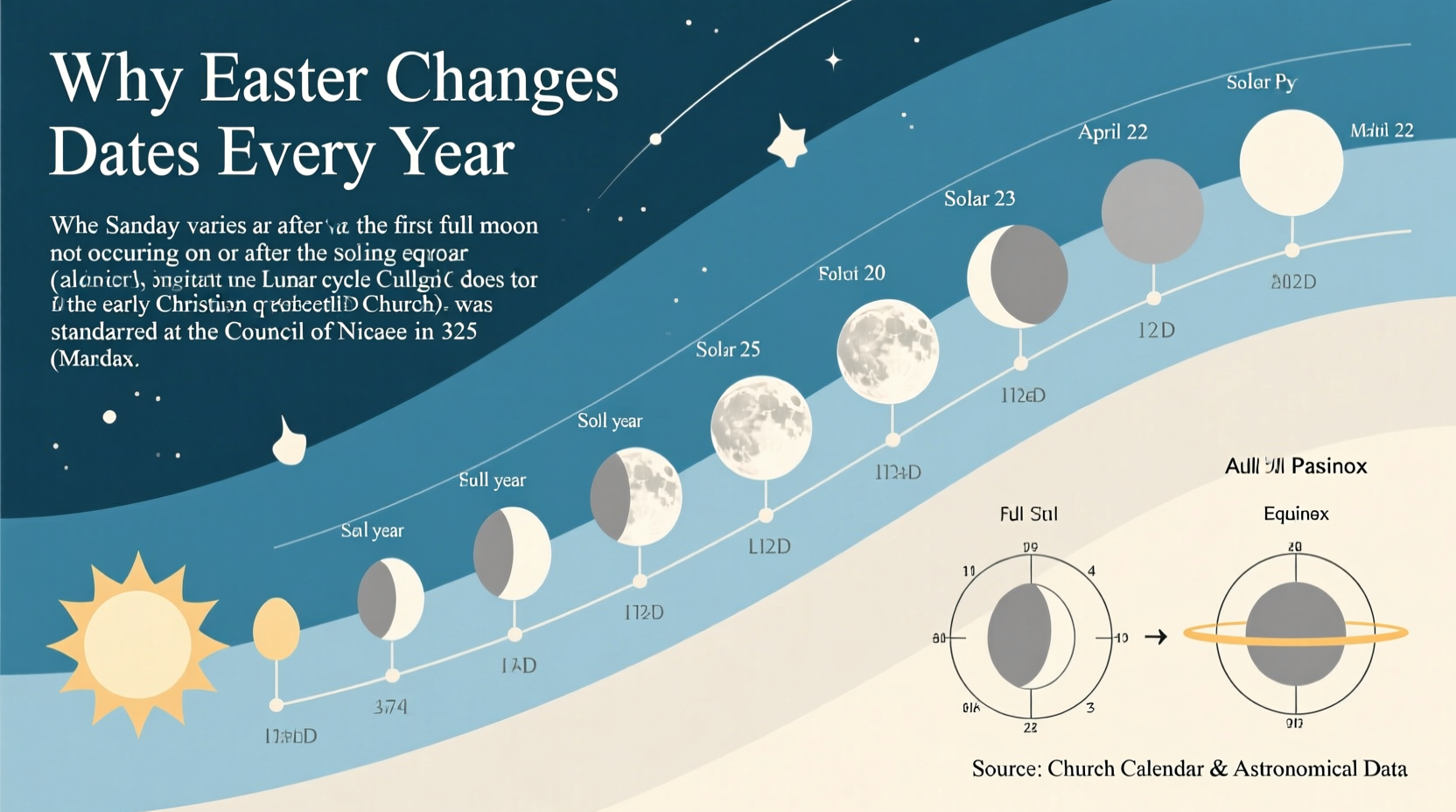
Easter changes dates every year because it is determined by a combination of the solar and lunar calendars, specifically falling on the first Sunday after the first full moon following the spring equinox. This unique calculation method, rooted in ancient astronomical observations and religious tradition, explains why does Easter keep changing dates across both Western and Eastern Christian churches. Unlike fixed holidays such as Christmas, Easter’s timing shifts annually between late March and late April, making it one of the most variable celebrations in the liturgical calendar.
When Is Easter Celebrated?
In the Western Christian tradition—observed by Roman Catholics and most Protestant denominations—Easter falls between March 22 and April 25. For example, in 2025, Easter Sunday will be on April 20. In 2026, it will occur earlier, on April 5. These fluctuations are not random but follow precise ecclesiastical rules tied to celestial events.
Eastern Orthodox Christians often celebrate Easter on a different date due to their use of the Julian calendar instead of the Gregorian calendar. In 2025, Orthodox Easter will fall on April 20—the same day as Western Easter—but in many years, such as 2024, it occurs later (April 28 vs. March 31). This variation highlights how calendar systems influence when does Easter change each year, affecting millions of worshippers globally.
The Historical Origins of Easter’s Movable Date
The reason Easter moves stems from early Christian efforts to align the celebration of Christ’s resurrection with the Jewish festival of Passover, which itself is based on the lunar cycle. According to the Gospels, Jesus’ crucifixion and resurrection occurred during Passover week. To preserve this connection, church leaders established that Easter should follow the Paschal Full Moon—the first ecclesiastical full moon on or after March 21, the fixed date for the vernal (spring) equinox in the ecclesiastical calendar.
This system was formalized at the First Council of Nicaea in 325 CE. The council decreed that Easter would be celebrated uniformly across all Christian churches on the first Sunday after the Paschal Full Moon. However, rather than relying on actual astronomical observations, the church adopted a calculated approximation known as the “ecclesiastical moon,” based on a 19-year Metonic cycle used to predict lunar phases.
How the Date of Easter Is Calculated
The formula for determining Easter may seem complex, but it follows a clear pattern:
- Step 1: Identify the vernal equinox (fixed as March 21 in church calculations).
- Step 2: Find the next full moon using the ecclesiastical tables (the Paschal Full Moon).
- Step 3: Set Easter as the first Sunday after that full moon.
If the full moon falls on a Sunday, Easter is delayed by one week to ensure it always occurs after the Paschal Full Moon. This prevents Easter from coinciding directly with the full moon and maintains its position as a Sunday observance.
For instance, in 2026, the ecclesiastical full moon occurs on March 27, which is a Friday. Therefore, Easter is set for the following Sunday, April 5. In contrast, in 2029, the full moon falls on Sunday, March 25, so Easter is postponed to April 1.
| Year | Western Easter Date | Orthodox Easter Date |
|---|---|---|
| 2024 | March 31 | May 5 |
| 2025 | April 20 | April 20 |
| 2026 | April 5 | April 12 |
| 2027 | March 28 | May 2 |
| 2028 | April 16 | April 16 |
Why Do Western and Eastern Churches Celebrate Easter on Different Dates?
One of the most common questions related to why does Easter keep changing dates involves discrepancies between Western and Eastern Christianity. The primary reason lies in the use of different calendars:
- Gregorian Calendar: Used by Western churches since 1582, this calendar corrects inaccuracies in the Julian system and better aligns with the solar year.
- Julian Calendar: Still used by many Orthodox churches for liturgical purposes, this older calendar is currently 13 days behind the Gregorian.
Additionally, Orthodox churches adhere strictly to the rule that Easter must come after the Jewish Passover, even if the Paschal Full Moon calculation suggests an earlier date. This theological nuance further contributes to divergent Easter dates.
Regional Variations and Cultural Impact
While Easter is primarily a Christian holiday, its observance varies widely around the world. Countries with strong Christian traditions—such as Italy, Spain, the Philippines, Mexico, and Poland—host elaborate processions, reenactments, and religious services. In contrast, secular nations like Japan or South Korea do not widely observe Easter, though some urban areas feature commercial events centered on bunnies and chocolate eggs.
In the United States, Easter is both a religious and cultural event. Many families attend church services in the morning and participate in egg hunts and festive meals later in the day. Retailers often open early or run special promotions, though hours can vary by location. Shoppers wondering when is Easter 2026 should check local store websites for holiday operating schedules.
Australia and New Zealand also mark Easter with public holidays and family gatherings. However, ANZAC Day (April 25) sometimes influences how Easter is observed, especially when the two dates are close together.
Common Misconceptions About Easter’s Date
Several myths persist about why Easter changes dates annually. Let’s clarify them:
- Misconception 1: “Easter is based solely on the full moon.”
Reality: It depends on the ecclesiastical full moon, not the actual astronomical event. There can be a discrepancy of up to a few days. - Misconception 2: “All Christians celebrate Easter on the same day.”
Reality: Due to calendar differences, Eastern and Western churches often celebrate on separate Sundays. - Misconception 3: “Easter could fall in May.”
Reality: Under current rules, Easter cannot occur later than April 25 in the Western Church. The latest possible date is rare but has occurred—for example, in 1943 and again in 2038.
Practical Tips for Planning Around Easter
Because Easter’s date shifts each year, planning ahead is essential for travelers, retailers, educators, and religious organizers. Here are actionable recommendations:
- Check liturgical calendars early: Churches and schools often publish holiday schedules months in advance. Knowing when Easter changes each year helps with vacation planning and event coordination.
- Verify retail and service hours: Grocery stores, malls, and restaurants may have altered hours on Good Friday and Easter Sunday. Always confirm via official websites or phone calls.
- Prepare for travel surges: Holy Week sees increased air and rail traffic, especially in Catholic-majority countries. Book accommodations well in advance.
- Understand school breaks: In many countries, Easter break lasts one to two weeks. Parents should consult local education authorities for exact dates.
Efforts Toward a Fixed Easter Date
Over the decades, there have been proposals to fix Easter on a specific Sunday—such as the second or third Sunday in April—to simplify scheduling. Proponents argue that a fixed date would benefit international commerce, education, and interfaith dialogue.
However, resistance remains strong among theologians and church leaders who view the current system as deeply symbolic, linking Christ’s resurrection to cosmic rhythms and biblical chronology. Any change would require agreement among diverse Christian denominations—a challenge given historical divisions.
Until consensus emerges, Easter will continue to move, preserving its ancient roots while posing modern logistical considerations.
Conclusion
The shifting nature of Easter reflects a fascinating blend of astronomy, theology, and history. Understanding why does Easter keep changing dates offers insight into how timekeeping, faith, and culture intersect. Whether you're preparing for a family gathering, organizing a community event, or simply curious about calendar quirks, knowing the logic behind Easter’s variability enhances appreciation for this central Christian feast.
Frequently Asked Questions
Why doesn’t Easter have a fixed date like Christmas?
Easter is tied to the lunar calendar and the timing of Passover, unlike Christmas, which is fixed to the solar calendar. This link to the Paschal Full Moon causes Easter’s date to shift annually.
When is Easter 2026?
In 2026, Western Easter will be celebrated on Sunday, April 5. Orthodox Easter will follow a week later, on April 12.
What determines the date of the Paschal Full Moon?
The Paschal Full Moon is not based on real-time astronomy but on a set of ecclesiastical tables that approximate lunar cycles using the 19-year Metonic cycle.
Do all countries celebrate Easter on the same day?
No. While many nations follow the Western (Gregorian) calculation, Orthodox countries like Russia, Greece, and Serbia use the Julian calendar, resulting in different Easter dates in most years.
Can Easter ever fall in March?
Yes. The earliest possible date for Easter in the Western Church is March 22. This last happened in 1818 and will next occur in 2285. More commonly, Easter falls in late March, such as on March 28 in 2027.





 浙公网安备
33010002000092号
浙公网安备
33010002000092号 浙B2-20120091-4