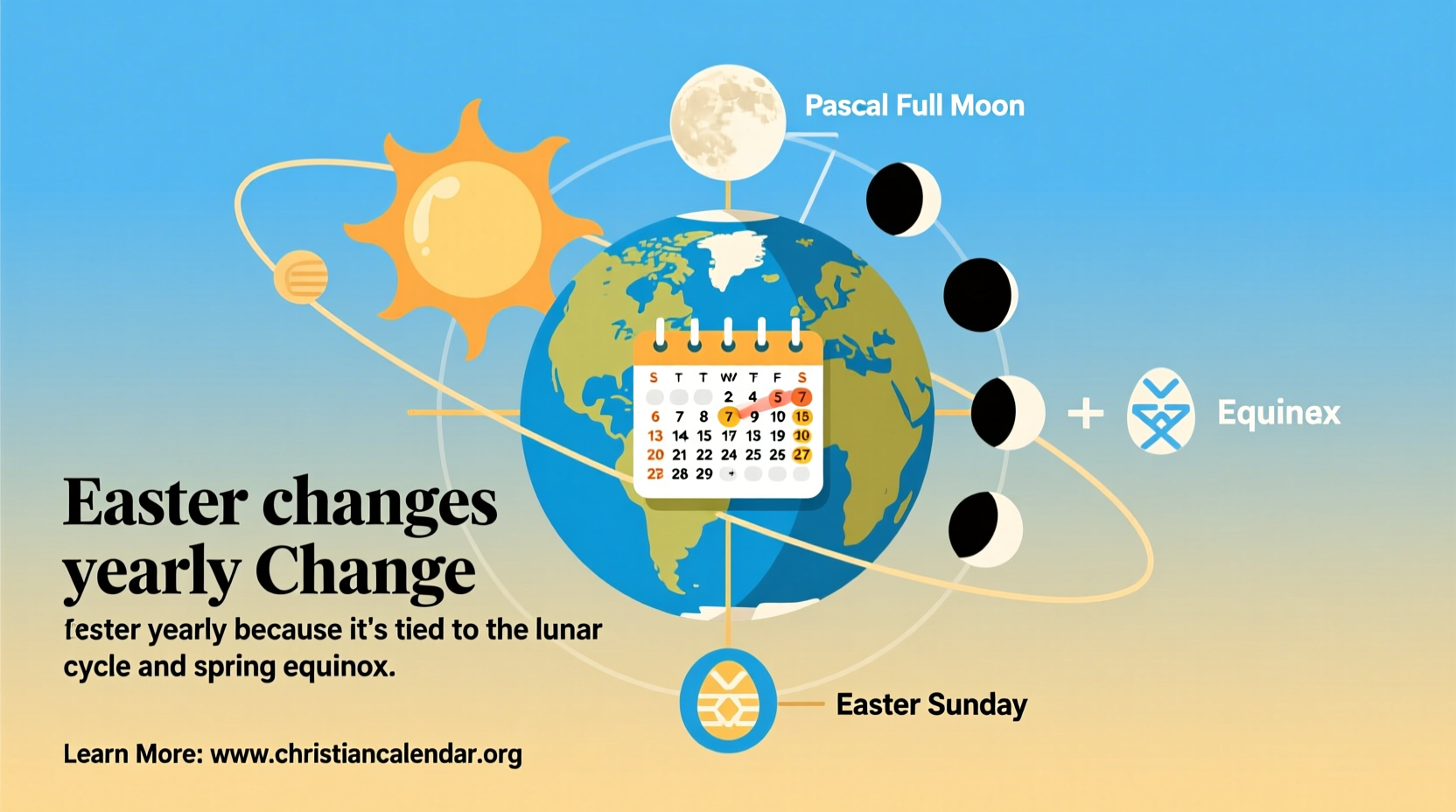
Easter changes every year because it is calculated based on a combination of solar and lunar calendars, specifically tied to the first Sunday after the first full moon following the spring equinox. This method, rooted in ancient ecclesiastical traditions, explains why does Easter change so much from year to year, typically falling between March 22 and April 25 in Western Christianity. Unlike fixed holidays such as Christmas, Easter’s date shifts annually to align with astronomical events and religious observances, creating variability that affects school breaks, retail schedules, and cultural celebrations worldwide.
Understanding the Calendar System Behind Easter
The reason why does Easter change so much lies in its unique dating system, which blends astronomy, religious doctrine, and historical precedent. While most modern holidays follow the Gregorian calendar—a solar calendar—Easter relies on both solar and lunar cycles. The Council of Nicaea in 325 CE established the rule: Easter would be celebrated on the first Sunday after the Paschal Full Moon, which is the first ecclesiastical full moon occurring on or after March 21, regardless of actual lunar observations.
This means Easter isn't tied to a specific day like January 1 or December 25 but instead floats according to these celestial markers. Because the lunar cycle (approximately 29.5 days) doesn’t align perfectly with the solar year (about 365.25 days), the timing of the full moon shifts each year, causing Easter’s date to vary significantly.
Historical Origins of Easter’s Movable Date
To fully grasp why does Easter change so much, one must explore its historical roots. Early Christians wanted to commemorate Jesus Christ’s resurrection in alignment with the Jewish festival of Passover, which itself follows a lunisolar calendar. Passover begins on the 15th day of Nisan, a month in the Hebrew calendar that starts with the new moon closest to the spring equinox.
Since Jesus’ crucifixion and resurrection occurred during Passover, early church leaders sought to maintain this connection. However, disagreements arose over whether Easter should always fall on a Sunday (to honor the resurrection day) or coincide directly with Passover, even if it fell midweek. The decision at the Council of Nicaea standardized Easter as a Sunday observance independent of the exact Hebrew calendar date, thus creating the movable feast we know today.
Differences Between Western and Eastern Easter Dates
Another key factor in understanding why does Easter change so much is the divergence between Western (Roman Catholic and Protestant) and Eastern Orthodox churches. While both use the same principle—first Sunday after the first full moon after the spring equinox—they apply different calendars.
Western Christianity uses the Gregorian calendar, introduced by Pope Gregory XIII in 1582 to correct drift in the Julian calendar. Eastern Orthodoxy continues to use the older Julian calendar for liturgical purposes, which currently runs 13 days behind the Gregorian. Additionally, Orthodox churches often rely on fixed ecclesiastical full moons rather than astronomical ones, leading to further discrepancies.
As a result, Eastern Orthodox Easter frequently occurs later than Western Easter—sometimes by several weeks. For example, in 2026, Western Easter falls on March 29, while Orthodox Easter will be celebrated on April 5. In some years, however, the dates align, such as in 2025 when both fall on April 20.
How to Calculate Easter’s Date Each Year
For those curious about predicting future dates and better understanding why does Easter change so much, there are mathematical methods and algorithms available. One well-known formula is the Gauss algorithm, developed by mathematician Carl Friedrich Gauss in 1800, which calculates Easter Sunday for any given year in the Gregorian or Julian calendar.
While complex, simplified tools exist online where users can input a year and receive the corresponding Easter date. These calculators account for leap years, lunar cycles, and calendar rules automatically. Knowing how to find upcoming dates helps families plan vacations, schools schedule breaks, and retailers prepare for seasonal demand.
| Year | Western Easter | Orthodox Easter |
|---|---|---|
| 2024 | March 31 | May 5 |
| 2025 | April 20 | April 20 |
| 2026 | March 29 | April 5 |
| 2027 | March 28 | April 11 |
| 2028 | April 16 | April 16 |
Regional Variations and Cultural Impact
The shifting nature of Easter influences more than just religious services—it affects public life across many countries. In nations where Easter is a major holiday, such as the United States, Canada, Australia, Germany, and the UK, government offices, banks, and schools often close for Good Friday and Easter Monday. Retailers adjust operating hours, especially on Good Friday, though policies vary by region.
In contrast, countries like Japan or China do not widely observe Easter, despite growing commercial interest in chocolate bunnies and egg hunts. Meanwhile, in predominantly Orthodox countries—including Russia, Greece, and Serbia—Easter (known locally as Pascha) is the most important religious celebration, surpassing even Christmas in significance.
Because why does Easter change so much impacts national calendars differently, travelers should verify local customs and business operations when visiting abroad during the season. Checking official government websites or contacting local embassies can help avoid confusion.
Common Misconceptions About Easter’s Date
Despite its long-standing tradition, several myths persist around why does Easter change so much. One common misconception is that Easter follows the full moon seen in a particular location. In reality, the Church uses an “ecclesiastical” full moon—a calculated approximation—not dependent on geographic visibility.
Another myth is that Easter could eventually fall in May. Under current rules, this is impossible; the latest possible date is April 25 in the West. Some believe a unified Easter date is imminent, but efforts to standardize it have stalled due to theological and calendrical differences between denominations.
Additionally, people often assume all Christians celebrate Easter simultaneously. As shown in the table above, this is not true. Awareness of these nuances helps clarify confusion and fosters interfaith understanding.
Practical Tips for Planning Around a Moving Holiday
Given that why does Easter change so much affects travel, shopping, and family gatherings, here are actionable tips for staying prepared:
- Check annual dates early: Bookmark a reliable Easter date calculator or subscribe to calendar updates.
- Verify retailer hours: Major stores may close on Good Friday in Christian-majority regions. Visit official websites before planning last-minute purchases.
- Plan school breaks accordingly: Many districts schedule spring recess around Easter. Confirm dates with your local school board.
- Book travel in advance: Flights and hotels spike in price during peak Easter periods, especially in Europe and Australia.
- Understand regional differences: If you live near international borders or work with global teams, recognize that colleagues may observe different dates.
Efforts Toward a Fixed Easter Date
In recent decades, discussions have emerged about establishing a fixed date for Easter—such as the second Sunday in April—to eliminate annual fluctuations. Proponents argue this would simplify scheduling for education, commerce, and international coordination.
However, resistance remains strong among religious authorities who view the lunar connection as essential to Easter’s spiritual meaning. Any change would require consensus among Catholic, Protestant, and Orthodox leaders—an unlikely scenario given historical divisions.
Until then, the variable date stands as a reminder of how religion, science, and culture intersect in shaping our calendar traditions. Understanding why does Easter change so much enriches appreciation for this deeply symbolic holiday.
Frequently Asked Questions (FAQs)
When is Easter in 2026?
Western Easter in 2026 falls on Sunday, March 29. Orthodox Easter occurs on Sunday, April 5.
Why doesn’t Easter have a fixed date like Christmas?
Easter is linked to the lunar cycle and Passover, whereas Christmas was set on a fixed solar date (December 25) to align with winter solstice festivals.
Do all countries celebrate Easter on the same day?
No. Western Christian countries generally follow the Gregorian calendar date, while Eastern Orthodox nations often celebrate a week or more later using the Julian calendar.
Can Easter ever fall in March?
Yes. The earliest possible date for Western Easter is March 22, though it rarely occurs that early. In 2026, Easter falls on March 29.
How is the date of Passover related to Easter?
Easter was originally timed to follow Passover, as Jesus' crucifixion occurred during the Passover festival. Though now calculated independently, the two holidays often overlap.





 浙公网安备
33010002000092号
浙公网安备
33010002000092号 浙B2-20120091-4