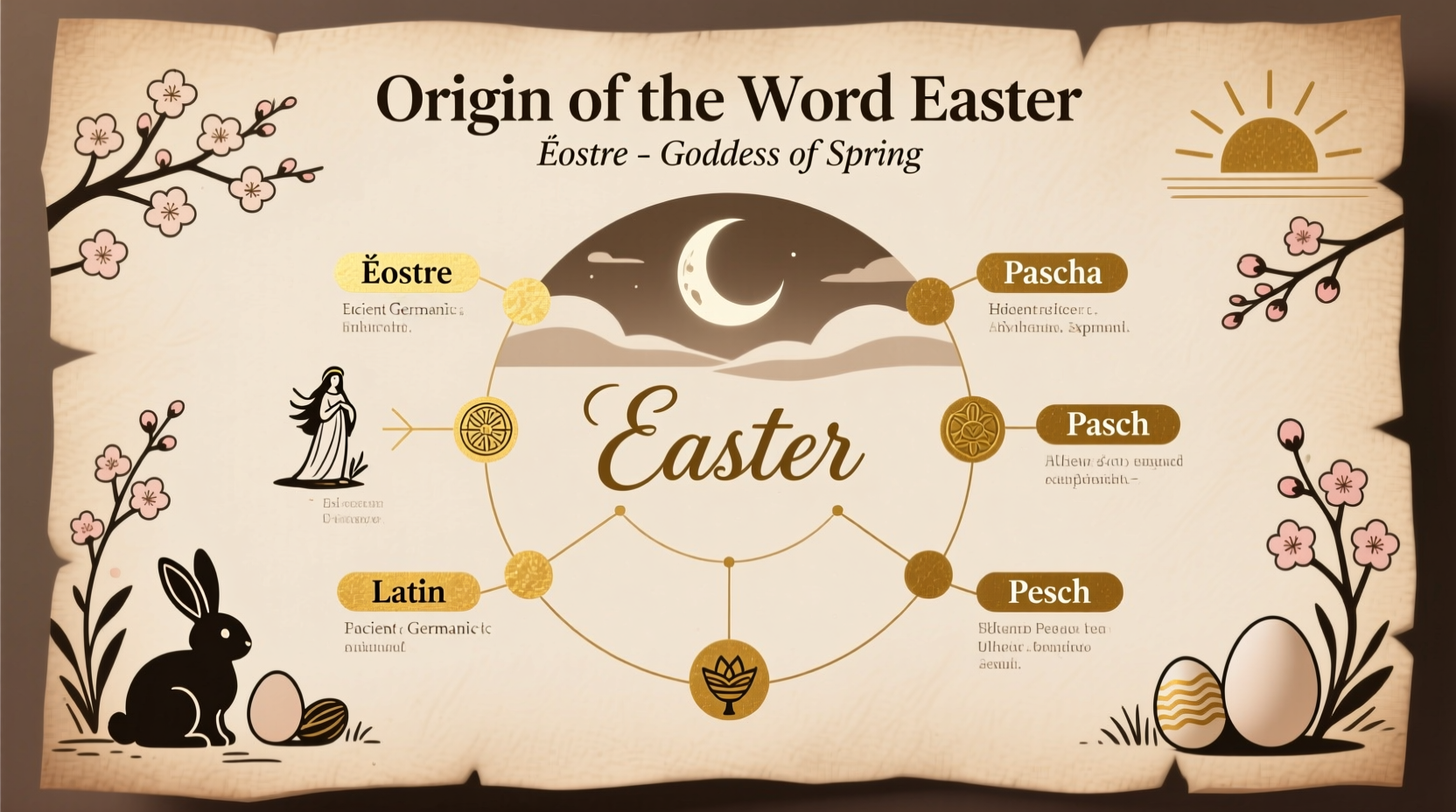
The word Easter originates from the Old English term Eastre or Eostre, a festival name linked to a Germanic goddess of spring and dawn. This etymology of Easter reveals deep cultural and linguistic roots that predate Christianity in Northern Europe. The connection between the ancient spring celebration and the modern Christian holiday highlights how religious traditions often absorb and transform earlier customs. Understanding where the word Easter comes from offers insight into the evolution of one of the most significant holidays in the Western world, blending linguistic history, mythology, and theology in a single term.
Historical Origins of the Term 'Easter'
The earliest recorded use of the word 'Easter' appears in Old English texts as Eostre or Eastrun, referring to a month in the Anglo-Saxon calendar roughly corresponding to April. The Venerable Bede, an 8th-century English monk and historian, is the primary source for this information. In his work De Temporum Ratione (The Reckoning of Time), Bede explains that the month of Eosturmonath—the 'month of opening' or 'month of blossoms'—was named after a goddess called Eostre, whom he claims the pagan Anglo-Saxons honored with festivals during the vernal equinox.
Bede’s account remains the only direct reference to the goddess Eostre in early medieval literature, which has led some scholars to question her existence. However, linguistic evidence supports the idea that a deity associated with dawn and fertility may have been worshipped across Germanic cultures. The name Eostre is linguistically related to other Indo-European dawn goddesses, such as the Roman Aurora and the Greek Eos, suggesting a shared mythological heritage.
Linguistic Roots and Comparative Mythology
To fully understand where the word Easter comes from, it's essential to explore its Proto-Indo-European roots. Scholars trace the name back to the reconstructed root *h₂aus-, meaning 'to shine' or 'dawn.' This root gave rise to various dawn-related deities and words across Indo-European languages:
- Ausṓs – Proto-Indo-European dawn goddess
- Eos – Greek goddess of the dawn
- Aurora – Roman equivalent
- Ushas – Vedic goddess in ancient Indian tradition
- Eostre – Proposed Germanic counterpart
This pattern suggests that Eostre was likely part of a broader pantheon of dawn deities venerated by early agricultural societies that celebrated the return of light and warmth in spring. Over time, these seasonal rituals were absorbed into Christian practice, with the resurrection of Jesus Christ symbolizing spiritual renewal—mirroring the physical rebirth seen in nature.
Christian Adoption and Liturgical Evolution
As Christianity spread throughout Europe, church leaders often repurposed existing festivals to ease conversion. The timing of Easter—based on the first Sunday after the first full moon following the spring equinox—coincided closely with many pre-Christian spring celebrations. Rather than erasing these traditions, the Church integrated them, giving new meaning to old symbols.
While most European languages use variations of the Hebrew-derived word Pascha (from Pesach, meaning Passover) for the holiday—such as Pâques in French, Pasqua in Italian, and Paskha in Russian—English and German (Ostern) retain names derived from the dawn goddess tradition. This linguistic divergence underscores the unique cultural path of the Anglo-Saxon and Germanic peoples in adopting Christianity.
The adoption of the term 'Easter' instead of 'Pascha' in English-speaking regions reflects not only linguistic evolution but also the selective preservation of native traditions within a Christian framework. Bunnies, eggs, and sunrise services—all now associated with Easter—have layered meanings rooted in both fertility symbolism and theological significance.
Regional Variations in the Name and Celebration of Easter
The global diversity in how Easter is named and observed highlights the complex interplay between language, religion, and culture. A comparative look at different languages reveals two dominant naming patterns:
| Language | Holiday Name | Etymological Origin |
|---|---|---|
| English | Easter | Old English Eostre, Germanic goddess |
| German | Ostern | Related to Eostre, dawn goddess |
| French | Pâques | From Latin Pascha, ultimately Hebrew Pesach |
| Spanish | Pascua | Same root as above |
| Italian | Pasqua | Derived from Passover |
| Russian | Пасха (Paskha) | Slavic adaptation of Paschal tradition |
| Greek | Πάσχα (Pascha) | Direct link to Jewish Passover |
This table illustrates that English and German are outliers in using a non-Paschal name. Most Christian traditions emphasize the connection between Christ’s resurrection and the Jewish Passover, when God delivered the Israelites from slavery. In contrast, the English term emphasizes seasonal renewal and local mythology, reflecting a distinct cultural trajectory.
Modern Interpretations and Scholarly Debate
While Bede’s explanation of the origin of the word Easter has long been accepted, some modern scholars challenge the historicity of the goddess Eostre. Because no other contemporary sources mention her, a few researchers suggest that Bede may have inferred her existence based on the name of the month rather than from active worship.
Despite this debate, the linguistic continuity between Eostre, east, and dawn remains strong. Even if Eostre was not widely worshipped, the symbolic association of springtime, light, and rebirth was undoubtedly central to pre-Christian European cultures. The Christian celebration of Easter—occurring around the same time as the spring equinox—naturally aligned with these themes.
Today, many historians view the naming of Easter not as a direct survival of paganism, but as an example of cultural syncretism—the blending of different religious and cultural practices. Symbols like the Easter egg and hare (later bunny) likely originated in folk traditions celebrating fertility and new life, later reinterpreted through a Christian lens.
Symbols and Traditions: From Pagan Rituals to Modern Customs
Understanding where the word Easter comes from also involves examining the evolution of its associated symbols. Many of today’s popular traditions have roots that predate Christianity:
- Easter Eggs: Decorating eggs has been a spring ritual in many cultures for thousands of years. Ancient Persians, Egyptians, and Greeks exchanged colored eggs as symbols of life and regeneration. Early Christians adopted this practice, interpreting the egg as a symbol of the empty tomb and resurrection.
- Easter Bunny: The hare was a sacred animal associated with Eostre in some interpretations. Folk tales described the goddess accompanied by a hare, symbolizing fertility and vigilance. German immigrants brought the tradition of the Osterhase (Easter Hare) to America in the 18th century, which evolved into the modern Easter Bunny.
- Sunrise Services: These reflect both the biblical account of women visiting Christ’s tomb at dawn and the ancient reverence for the rising sun as a symbol of renewal.
These traditions demonstrate how the etymology of Easter extends beyond mere linguistics—it encompasses a rich tapestry of evolving beliefs, seasonal rhythms, and communal identity.
Common Misconceptions About the Origin of Easter
Several myths persist about where the word Easter comes from and what it represents:
- Myth: Easter is purely a pagan holiday. While it incorporates pre-Christian elements, Easter as practiced today is fundamentally a Christian celebration of the resurrection of Jesus Christ. The date is calculated using ecclesiastical rules tied to the lunar calendar and Passover.
- Myth: The name Easter comes from Ishtar, a Mesopotamian goddess. This claim, popularized online, lacks scholarly support. The pronunciation similarity between 'Ishtar' and 'Easter' is coincidental; there is no linguistic or historical link between the two.
- Myth: All Christians call it Easter. As shown in the table above, most languages use a form of 'Pascha,' emphasizing the holiday’s connection to Passover and the Last Supper.
Critical evaluation of sources is essential when researching the etymology of Easter. Reliable references include academic studies in historical linguistics, early medieval manuscripts, and peer-reviewed journals in religious studies.
How to Learn More About Easter’s Cultural and Linguistic History
For those interested in deeper exploration of where the word Easter comes from, consider the following steps:
- Read Bede’s De Temporum Ratione in translation to understand early medieval views on time and festivals.
- Study Indo-European mythology to see parallels between dawn goddesses across cultures.
- Compare Easter traditions globally to observe how different cultures interpret the holiday.
- Consult linguistic databases like the Oxford English Dictionary or the Online Etymology Dictionary for detailed word histories.
- Visit museums or cultural centers during spring to see exhibits on seasonal festivals and their evolution.
By combining historical research with cultural observation, one gains a fuller appreciation of how language, belief, and tradition intertwine in holidays like Easter.
Frequently Asked Questions
What is the true origin of the word Easter?
The word Easter derives from the Old English Eostre, a goddess of spring and dawn mentioned by the Venerable Bede. It is linked to ancient celebrations of the vernal equinox and later adopted for the Christian festival of resurrection.
Is Easter a pagan holiday?
No, Easter is a Christian holy day commemorating the resurrection of Jesus Christ. While it incorporates some pre-Christian symbols and occurs near spring festivals, its theology and liturgy are distinctly Christian.
Why do English speakers say 'Easter' while others say 'Pascha'?
English and German retained native terms related to spring and dawn, while most other European languages adopted forms of 'Pascha,' reflecting the holiday’s connection to the Jewish Passover and early Christian terminology.
Was the goddess Eostre real?
There is only one historical reference to Eostre, from Bede. While no archaeological evidence confirms her worship, the linguistic and mythological context makes it plausible that a dawn goddess was venerated in Germanic cultures.
Does the name 'Easter' appear in the Bible?
No, the word 'Easter' does not appear in the original biblical texts. In Acts 12:4 of the King James Version, 'Easter' is used, but most modern translations correctly render it as 'Passover,' reflecting the original Greek Pascha.




 浙公网安备
33010002000092号
浙公网安备
33010002000092号 浙B2-20120091-4