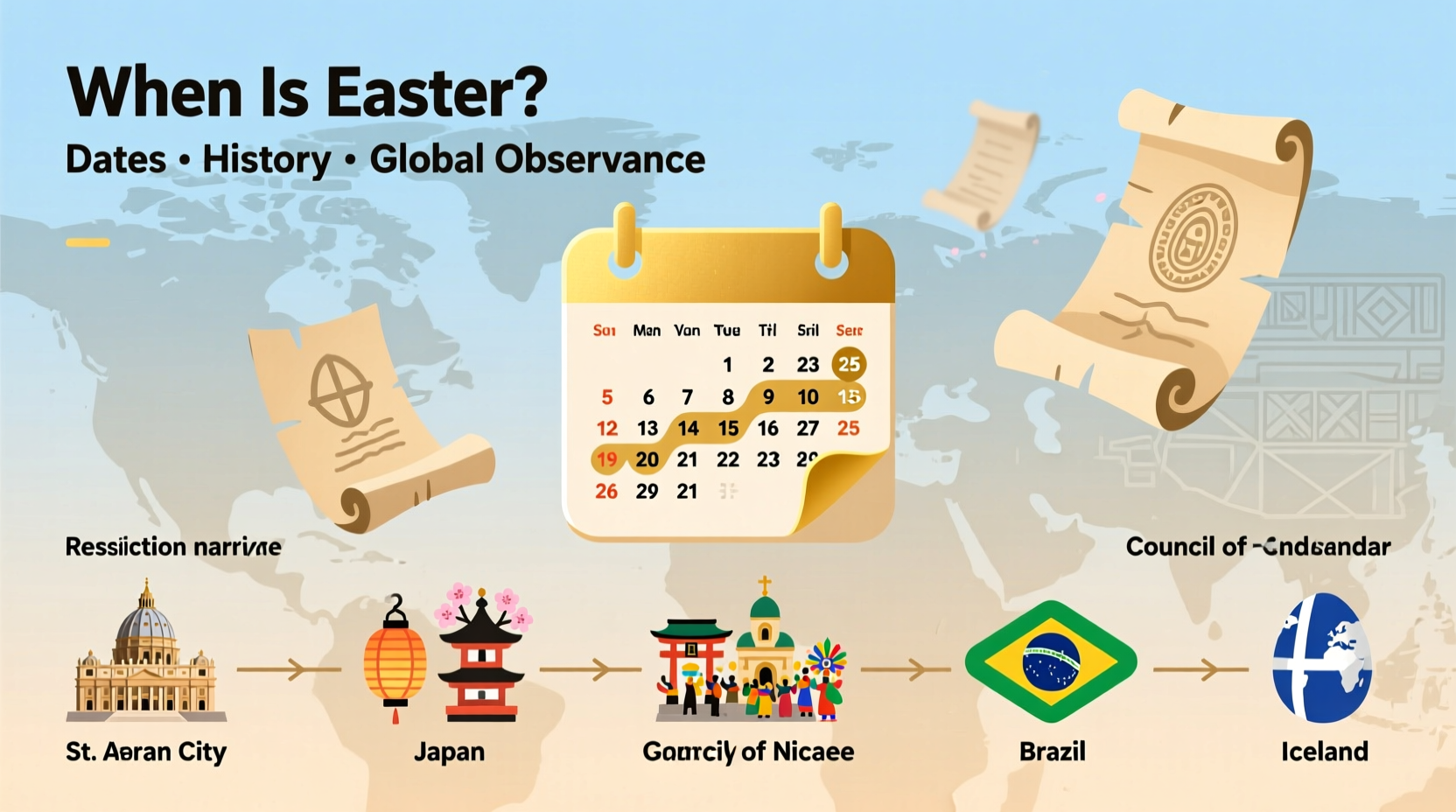
When is Easter in general? Easter Sunday does not fall on the same date each year, but it typically occurs between March 22 and April 25 in the Gregorian calendar. The exact timing of when Easter is celebrated each year depends on a combination of astronomical events and ecclesiastical rules established centuries ago. Specifically, Easter is observed on the first Sunday after the Paschal Full Moon, which is the first full moon occurring on or after the spring equinox (fixed as March 21 for calculation purposes). This system was formalized during the Council of Nicaea in 325 CE to standardize the celebration across Christian churches. Because of its lunar connection, the date of Easter varies annually, making it a moveable feast within the liturgical calendar.
Understanding the Calculation Behind Easter's Date
The method used to determine when Easter is celebrated each year combines solar and lunar cycles. While most holidays follow either the solar calendar (like Christmas on December 25) or the lunar calendar (like Islamic holidays), Easter uses a lunisolar system. The key factors are:
- The vernal (spring) equinox in the Northern Hemisphere, set at March 21 regardless of the actual astronomical event.
- The ecclesiastical full moon, also known as the 'ecclesiastical moon,' which approximates the real full moon using a 19-year Metonic cycle.
- The following Sunday after this calculated full moon becomes Easter Sunday.
This means that Easter can never occur before March 22 (if the full moon falls on March 21 and that day is a Saturday) or later than April 25 (if the full moon falls just after March 21 and the next Sunday pushes into late April).
For example, in 2026, Easter Sunday will fall on April 5. In 2025, it occurred on April 20, while in 2024, it was celebrated on March 31. These fluctuations reflect the dynamic interplay between celestial patterns and religious tradition.
Western vs. Eastern Christianity: Different Dates for Easter
One common source of confusion about when Easter is celebrated globally lies in the difference between Western (Roman Catholic and Protestant) and Eastern Orthodox Christian traditions. While both base their calculations on the same principle—first Sunday after the Paschal Full Moon—their calendars differ.
Western churches use the Gregorian calendar, introduced by Pope Gregory XIII in 1582 to correct drift in the Julian calendar. Most Eastern Orthodox churches, however, continue to use the older Julian calendar for liturgical purposes. Since the Julian calendar is currently 13 days behind the Gregorian, the spring equinox is observed on April 3 in the modern civil calendar, leading to a later Easter in most years.
As a result, Orthodox Easter often falls one to five weeks after Western Easter. For instance, in 2026, while Western Christians celebrate Easter on April 5, Orthodox Easter will be on April 12. In some rare cases—such as when the full moons align—both East and West may observe Easter on the same day, though this is increasingly uncommon.
| Year | Western Easter | Orthodox Easter |
|---|---|---|
| 2024 | March 31 | May 5 |
| 2025 | April 20 | April 20* |
| 2026 | April 5 | April 12 |
| 2027 | March 28 | May 2 |
| 2028 | April 16 | April 16* |
*In 2025 and 2028, both traditions coincide due to alignment of the full moon and Sunday following.
Which Countries Celebrate Easter?
Easter is observed in numerous countries around the world, both as a religious holiday and a cultural event. It is an official public holiday in many nations with significant Christian populations. Some of the major countries where Easter is widely celebrated include:
- United States: Easter Sunday and Good Friday are widely recognized, with church services, family meals, and egg hunts.
- Canada: A statutory holiday in most provinces; businesses may close or operate on reduced hours.
- Australia and New Zealand: Public holidays with community festivals, religious observances, and retail sales.
- United Kingdom: Bank holidays on Good Friday and Easter Monday (except in Scotland, where only Good Friday is official).
- Germany, France, Italy, Spain: Major Catholic and Protestant nations where Easter traditions run deep, including processions, special foods, and regional customs.
- Greece, Russia, Ukraine: Predominantly Orthodox countries celebrating Easter according to the Julian calendar, often with midnight services and elaborate feasts.
- Brazil, Mexico, Philippines: Strong Catholic traditions with vibrant Holy Week processions and celebrations.
Even in countries without large Christian populations, such as Japan or South Korea, Easter is sometimes acknowledged commercially through themed products or events, though not as a public holiday.
How Retailers and Services Operate During Easter
Business operations during the Easter weekend vary significantly by country and region. In the U.S., for example:
- Good Friday: Not a federal holiday, so most stores remain open, though some may reduce hours. Major retailers like Walmart and Target typically stay open.
- Easter Sunday: Many businesses, especially malls and non-essential services, are closed or operate on holiday schedules. Grocery stores may open briefly in the morning.
- Easter Monday: Not a public holiday in the U.S., so normal operations resume. However, in Canada and the UK, it is a bank holiday, leading to school and government office closures.
Travelers should verify local store hours via official websites or apps, as policies can vary even within the same chain depending on location. Airlines and public transit may run modified holiday schedules, particularly on Easter Sunday.
Common Misconceptions About When Easter Is Celebrated
Several myths persist regarding the timing and nature of Easter:
- Misconception 1: Easter is always in April. While it often falls in April, it can occur as early as March 22. The last time this happened was in 1818; the next will be in 2285.
- Misconception 2: The date is random. Though it changes yearly, the calculation follows precise mathematical and astronomical rules developed over centuries.
- Misconception 3: All Christians celebrate on the same day. As shown above, Eastern and Western churches frequently observe Easter on different Sundays due to calendar differences.
- Misconception 4: Easter’s date is based solely on the actual full moon. Instead, it relies on the 'ecclesiastical' full moon, which is a calculated approximation, not necessarily the real astronomical event.
Preparing for Easter: Tips for Families and Communities
Whether observing Easter religiously or culturally, preparation enhances the experience. Here are practical tips:
- Plan church attendance: Holy Week services (Palm Sunday, Maundy Thursday, Good Friday, Easter Vigil) often draw large crowds. Check times and reservations if required.
- Organize family activities: Egg decorating, baking hot cross buns, or planning an Easter brunch helps build meaningful traditions.
- Shop early: Popular items like chocolate eggs, lamb roasts, and spring decorations sell out quickly in the week before Easter.
- Verify travel plans: If visiting family, confirm transportation schedules, especially for Easter Sunday and Monday.
- Respect cultural variations: In multicultural settings, recognize that not everyone observes Easter—and that observance styles vary widely.
Historical Origins of Easter and Its Moveable Date
The roots of Easter trace back to early Christianity’s effort to commemorate Jesus Christ’s resurrection, described in the Gospels as occurring on the third day after his crucifixion during Passover week. Early Christians linked the event to the Jewish festival of Passover (Pesach), which itself follows a lunisolar calendar. Over time, disputes arose over whether Easter should always fall on a Sunday or on the 14th of Nisan (the date of Passover), regardless of the weekday.
The Council of Nicaea (325 CE) resolved this by decreeing that Easter must be celebrated on a Sunday, independent of the Hebrew calendar, to promote unity across the Church. This decision laid the foundation for the current calculation method still used today, despite evolving calendar systems.
Will Easter Ever Be Fixed on a Permanent Date?
In recent decades, there have been proposals to fix Easter on a specific Sunday (e.g., the second or third Sunday in April) to simplify planning for schools, businesses, and international coordination. Proponents argue that a fixed date would eliminate confusion and logistical challenges caused by the variable schedule.
However, such reforms face resistance from both Catholic and Orthodox leaders who view the current system as historically and theologically significant. Any change would require broad ecumenical agreement—an outcome that remains unlikely in the near term. Until then, Easter will remain a moveable feast, recalculated each year based on ancient yet enduring principles.
Frequently Asked Questions
- When is Easter in 2026?
- Easter Sunday in 2026 falls on April 5 for Western Christian churches. Orthodox Easter will be celebrated on April 12.
- Why does the date of Easter change every year?
- Easter’s date is based on the first Sunday after the ecclesiastical full moon following the spring equinox (March 21), resulting in annual variation between March 22 and April 25.
- Do all countries celebrate Easter on the same day?
- No. Western Christian countries generally observe Easter on the same Sunday, but Eastern Orthodox nations often celebrate one to five weeks later due to using the Julian calendar.
- Is Easter a public holiday worldwide?
- No. While it is a national holiday in many Christian-majority countries, others treat it as a regular day. Some secular nations recognize Good Friday or Easter Monday as official breaks.
- How far in advance can Easter dates be predicted?
- Easter dates can be calculated centuries in advance using established algorithms. The pattern repeats approximately every 5.7 million years, though practical tables usually cover several hundred years.





 浙公网安备
33010002000092号
浙公网安备
33010002000092号 浙B2-20120091-4