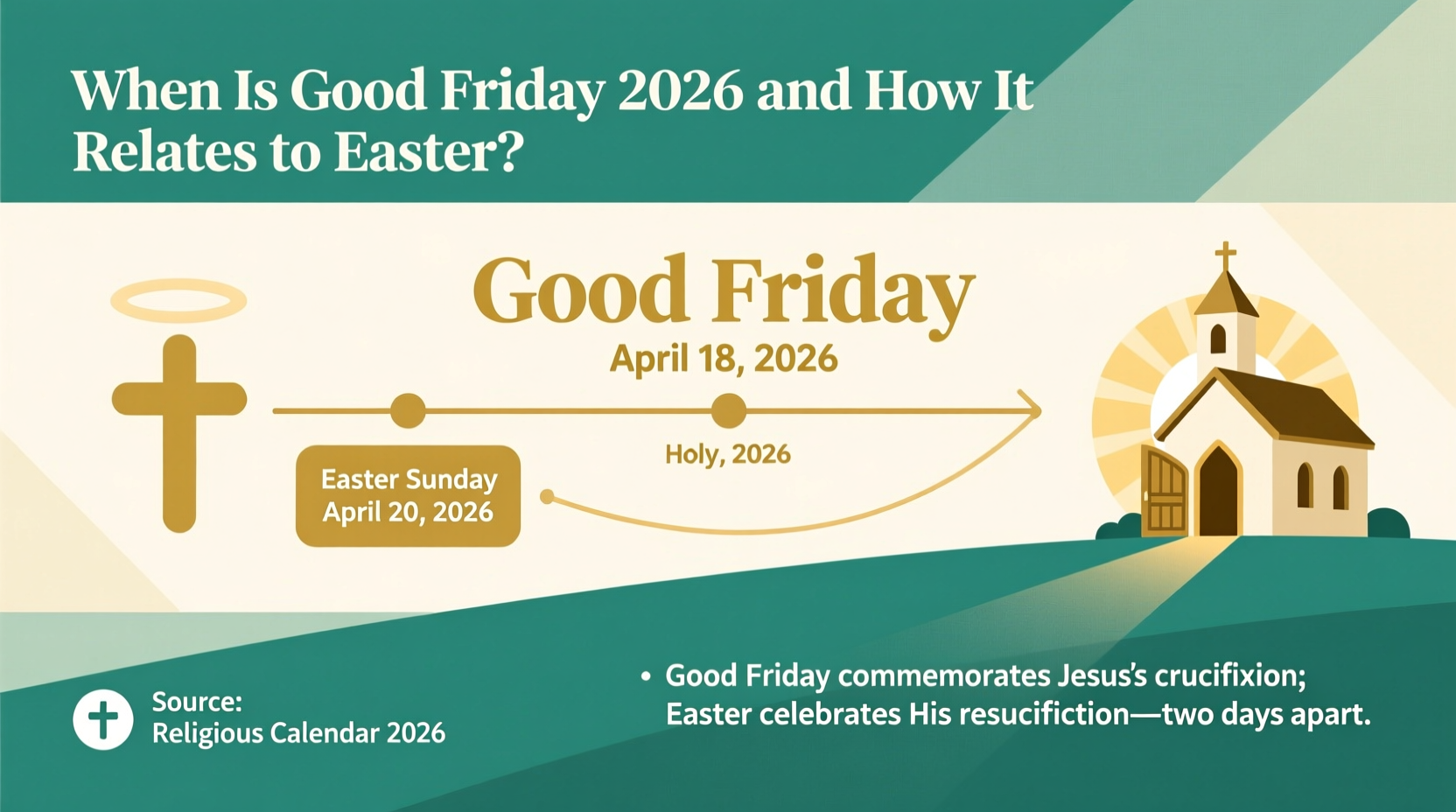
Good Friday 2026 will be observed on Friday, April 3, 2026. This date is directly tied to the liturgical calendar of Christianity and marks the day Jesus Christ was crucified according to the New Testament. As a pivotal point in Holy Week, when is Good Friday depends entirely on the timing of Easter Sunday, which in 2026 falls on April 5. Because Good Friday always occurs two days before Easter Sunday, determining the date of Easter is essential to knowing when Good Friday takes place. This relationship ensures that the calculation of when is Good Friday follows a predictable yet variable pattern based on astronomical events and ecclesiastical rules.
Understanding the Date of Good Friday
Good Friday does not have a fixed date on the Gregorian calendar. Instead, it shifts each year because it is based on the lunar calendar and the vernal equinox. The determination of when is Good Friday hinges on a centuries-old formula established by the First Council of Nicaea in 325 AD. According to this rule, Easter Sunday is set as the first Sunday after the first full moon following the spring equinox (March 21). Since Good Friday precedes Easter Sunday by exactly two days, once Easter’s date is known, Good Friday can be calculated with certainty.
For example:
- Easter Sunday 2026: April 5
- Therefore, Good Friday 2026: April 3
This system explains why when is Good Friday varies from year to year—sometimes falling in late March, other times in early to mid-April. In 2025, for instance, Good Friday occurs on April 18, while in 2027, it falls on March 26. These fluctuations reflect the interplay between solar and lunar cycles used in Christian tradition to determine holy days.
The Religious Significance of Good Friday
Good Friday is one of the most solemn days in the Christian liturgical year. Despite its name, "good" does not imply joy but rather refers to the spiritual benefit derived from Jesus’ sacrifice. It commemorates the crucifixion and death of Jesus at Calvary, an event central to Christian theology regarding salvation and redemption.
Church services on Good Friday are typically somber and reflective. Common practices include:
- Veneration of the Cross
- Reading of the Passion narrative from the Gospel of John
- Fasting and abstinence (especially in Catholic traditions)
- Silent prayer and meditation
In many denominations, including Roman Catholic, Anglican, Lutheran, Methodist, and some Reformed churches, Good Friday is considered a day of obligatory fasting and penance. The liturgy often lacks the Eucharist, though communion may be distributed using hosts consecrated on Maundy Thursday.
Regional Observances and Public Holidays
While Good Friday is universally recognized within Christianity, its status as a public holiday varies significantly across countries. Knowing when is Good Friday also involves understanding whether it is a government-recognized day off in a given region.
| Country | Is Good Friday a Public Holiday? | Notes |
|---|---|---|
| United States | No (federal), Yes (some states) | Not a federal holiday; state-level recognition varies |
| Canada | Yes | National statutory holiday except in Quebec (optional) |
| United Kingdom | Yes | Bank holiday across England, Wales, Scotland, Northern Ireland |
| Australia | Yes | National public holiday with retail closures |
| New Zealand | Yes | Full public holiday nationwide |
| Germany | Yes | Strict laws on quiet observance; entertainment restrictions apply |
| India | Yes (in some states) | Recognized in Goa, Kerala, and other Christian-majority areas |
| South Africa | Yes | National public holiday |
In nations where Good Friday is a public holiday, schools, government offices, and many businesses close. Retailers often suspend operations, particularly in traditionally observant regions like Germany or Australia. However, in the U.S., only 12 states officially recognize Good Friday as a state holiday, including Connecticut, Texas, and North Carolina. Even then, federal employees do not receive a paid day off unless designated locally.
Retail and Business Operations on Good Friday
Consumers often search for information about when is Good Friday to plan shopping, travel, or family activities. While banks and post offices generally remain closed in countries observing the holiday, private sector operations vary.
In the UK and Canada, most retail stores are legally required to stay closed, although pharmacies and convenience stores may operate under limited hours. In contrast, U.S. retailers such as Walmart, Target, and grocery chains typically remain open, albeit with reduced staffing. Online platforms continue normal service.
Travel considerations:
- Airports remain operational, but check-in counters may have fewer staff
- Public transportation often runs on a holiday schedule
- Restaurants in tourist areas may stay open, especially in urban centers
It's advisable to verify local business hours through official websites or municipal announcements, especially if planning essential errands or travel around when is Good Friday.
How the Date of Easter—and Thus Good Friday—is Calculated
The complexity behind when is Good Friday stems from the method used to calculate Easter. The formula combines astronomy and church tradition:
- The vernal (spring) equinox is fixed on March 21 in the ecclesiastical calendar, regardless of the actual astronomical equinox.
- The “ecclesiastical full moon” is determined using tables, not real-time observation.
- Easter Sunday is the first Sunday after this ecclesiastical full moon.
- Good Friday is always two days prior.
This results in Easter Sunday falling between March 22 and April 25. Consequently, Good Friday can occur anytime from March 20 to April 23.
Eastern Orthodox churches use the Julian calendar instead of the Gregorian, which often places their Easter—and therefore their Good Friday—later than Western churches. For example, in 2026, Orthodox Good Friday will fall on April 17, more than two weeks after the Western observance.
Common Misconceptions About Good Friday
Several myths persist about when is Good Friday and its significance:
- Misconception: Good Friday is always the same date.
Truth: It changes annually due to lunar calculations. - Misconception: All Christians celebrate it on the same day.
Truth: Western and Eastern churches often observe different dates. - Misconception: It’s a joyful celebration.
Truth: It’s a day of mourning and reflection, preceding the joy of Easter Sunday. - Misconception: It’s a federal holiday in the U.S.
Truth: It is not recognized federally; observance is state-dependent.
Preparing for Good Friday: Practical Tips
Whether you're observing Good Friday religiously or navigating its impact on daily life, here are practical steps:
- Check local holiday schedules: Confirm school closures, public transit changes, and business hours.
- Plan meals accordingly: In Catholic and Orthodox traditions, fasting is observed—limit meat and reduce portion sizes.
- Attend services: Many churches host special afternoon liturgies, often at 3 PM (the traditional hour of Christ’s death).
- Limit recreational activities: Out of respect, avoid loud celebrations or entertainment-heavy events.
- Educate children: Use age-appropriate resources to explain the meaning of the day.
Future Dates of Good Friday
To help with long-term planning, here are upcoming Good Friday dates:
- 2025: April 18
- 2026: April 3
- 2027: March 26
- 2028: April 14
- 2029: March 30
- 2030: April 19
These dates follow the standard Western Christian computation. Those following the Orthodox tradition should consult their respective ecclesiastical calendars for accurate observance dates.
Frequently Asked Questions
Why does the date of Good Friday change every year?
Because Good Friday is based on the lunar calendar and the timing of the spring equinox, its date shifts annually. It always falls two days before Easter Sunday, which is determined as the first Sunday after the first full moon following March 21.
Is Good Friday a federal holiday in the United States?
No, Good Friday is not a federal holiday in the U.S. However, some states, such as Connecticut and Texas, recognize it as a state holiday.
Do all Christian denominations observe Good Friday?
Most major Christian denominations—including Catholic, Protestant, and Orthodox—observe Good Friday, though practices and dates may differ, especially between Western and Eastern churches.
Can you work on Good Friday?
In most countries where Good Friday is a public holiday, non-essential workers are granted leave. In the U.S., employment policies vary by employer and state law. Private businesses may require employees to work.
What’s the difference between Good Friday and Easter Sunday?
Good Friday commemorates the crucifixion and death of Jesus Christ, while Easter Sunday celebrates his resurrection. Good Friday is a day of mourning; Easter Sunday is a joyful festival marking the cornerstone of Christian faith.





 浙公网安备
33010002000092号
浙公网安备
33010002000092号 浙B2-20120091-4