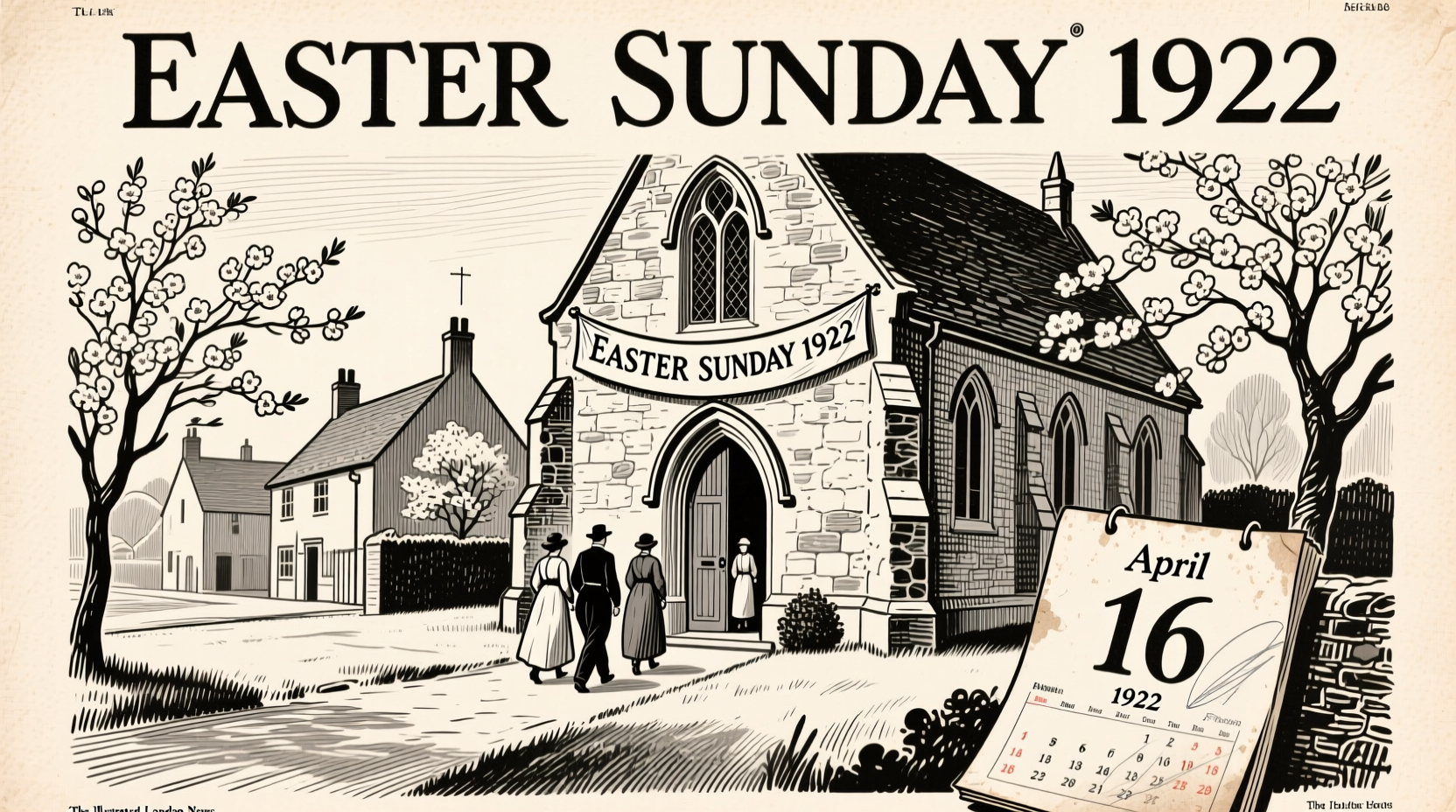
Easter Sunday in 1922 was observed on April 16. This date was determined by the ecclesiastical rules established centuries earlier to calculate when Easter would fall each year, specifically the first Sunday after the first full moon following the spring equinox. The long-standing tradition of determining when is Easter 1922 relies on a complex interplay between lunar cycles and the Gregorian calendar, which remains consistent across most Western Christian denominations. In 1922, this calculation led to a mid-April celebration, aligning with broader patterns seen throughout the early 20th century.
How Is the Date of Easter Determined?
The date of Easter is not fixed annually because it is based on a lunisolar calendar rather than the purely solar Gregorian calendar used in civil life. According to traditional Christian computation, Easter falls on the first Sunday after the Paschal Full Moon — the first full moon that occurs on or after the vernal (spring) equinox, which is fixed as March 21 in church calculations regardless of astronomical variations.
This system originated from the Council of Nicaea in 325 CE, where church leaders sought to standardize the celebration of Christ’s resurrection across all Christian communities. Before this decision, different regions celebrated Easter on varying dates, sometimes leading to confusion and disunity. By anchoring Easter to the lunar cycle relative to the equinox, a unified yet flexible framework was created.
In practice, the calculation involves both astronomical observation and mathematical approximation. Ecclesiastical tables, such as the Computus, are used to predict the timing of the Paschal Full Moon without requiring direct skywatching. These tables follow a 19-year Metonic cycle, which approximates the relationship between the solar year and lunar months. For 1922, these calculations placed the Paschal Full Moon on Saturday, April 15, making the following day — Sunday, April 16 — Easter Sunday.
Historical Context of Easter in 1922
The year 1922 occurred during a period of significant social and political transformation globally. World War I had ended just four years prior, and many nations were still recovering from its aftermath. In Europe, countries like Germany faced economic instability due to war reparations, while the United States experienced a cultural boom known as the Roaring Twenties.
Religiously, Easter remained a central observance for Christians worldwide. In 1922, churches across North America, Western Europe, Australia, and parts of Latin America held special services to commemorate the resurrection of Jesus Christ. The holiday also carried strong cultural significance, with families gathering for meals, children participating in egg hunts, and communities engaging in religious processions.
Notably, 1922 predates many modern commercial elements associated with Easter today. While chocolate bunnies and mass-produced candy existed in rudimentary forms, they were far less dominant than in later decades. Instead, traditions like decorating real eggs, attending sunrise services, and wearing new spring clothing were more prominent features of the celebration.
Differences Between Western and Eastern Easter Dates
It's important to note that not all Christians celebrate Easter on the same date. The determination of when is Easter 1922 differs between Western Christianity (primarily Roman Catholic and Protestant churches) and Eastern Orthodoxy.
Eastern Orthodox churches use the older Julian calendar to calculate Easter, rather than the Gregorian calendar adopted by most of the world. Additionally, they adhere strictly to the rule that Easter must follow the Jewish Passover, adding another layer of complexity. As a result, Orthodox Easter often falls one to five weeks after Western Easter.
In 1922, Orthodox Easter was celebrated on April 23 — one week after the Western date of April 16. This difference highlights how calendar systems and theological interpretations can lead to divergent liturgical schedules, even among Christians sharing the same core beliefs about the resurrection.
Regional Observances and Cultural Traditions in 1922
While the date of Easter was standardized within denominational frameworks, local customs varied widely in 1922. In rural areas of the United States and Canada, Easter might involve simple church gatherings followed by family dinners featuring ham or lamb. In contrast, urban centers saw growing commercialization, with department stores advertising Easter bonnets and confectioners promoting chocolate eggs.
In the United Kingdom, King George V reigned during this time, and royal Easter services at Windsor Castle drew public attention. Meanwhile, in Australia and New Zealand, where seasons are reversed, Easter occurred in autumn. Despite the seasonal difference, similar religious and familial traditions were upheld.
In predominantly Catholic countries like Italy, Spain, and France, Holy Week processions were major events. Statues of Christ and the Virgin Mary were paraded through towns, accompanied by solemn music and candlelight. These rituals reflected deep-rooted devotional practices that continue in modified forms today.
| Country/Region | Observed Easter Date (1922) | Primary Denomination | Notable Tradition |
|---|---|---|---|
| United States | April 16 | Protestant/Catholic | Egg rolling at White House (informal) |
| United Kingdom | April 16 | Anglican | Royal Maundy service |
| Germany | April 16 | Lutheran/Catholic | Osterbaum (Easter tree) |
| Russia (Orthodox) | April 23 | Orthodox | All-night vigil, kulich bread |
| Australia | April 16 | Anglican/Protestant | School holidays begin |
Common Misconceptions About Easter Dating
One frequent misunderstanding is that Easter’s date is chosen arbitrarily or changes randomly each year. In reality, the system is highly structured, though complex. Another misconception is that all Christians celebrate Easter on the same day. As shown in 1922, Orthodox believers celebrated a week later than their Western counterparts.
Some people assume that Easter always occurs in March or early April. However, the latest possible date for Western Easter is April 25, and the earliest is March 22. In 1922, falling on April 16 placed it toward the middle of the possible range.
Verifying Historical Dates: Tools and Resources
If you're researching historical dates like when is Easter 1922, several reliable tools exist. Ecclesiastical calendars published by religious institutions, digitized almanacs from libraries (such as those available via HathiTrust or Google Books), and online date calculators using the Gregorian Computus algorithm can confirm past Easter dates with high accuracy.
For academic or genealogical research, consulting church records, newspaper archives from March–April 1922, or municipal bulletins may provide additional context about how Easter was observed locally. Websites like TimeAndDate.com maintain verified historical data on holiday dates going back centuries.
Why Does the Date of Easter Matter Today?
Understanding when Easter occurred in previous years, such as 1922, helps historians, theologians, and cultural researchers trace patterns in religious observance, agricultural cycles, and societal rhythms. Many school breaks, public holidays, and retail marketing campaigns are still scheduled around Easter, making its variable date relevant for planning.
Moreover, the question when is Easter 1922 reflects broader curiosity about how time, religion, and nature intersect. It invites reflection on how ancient calendrical systems continue to influence modern life, even in an age of digital precision and global coordination.
Frequently Asked Questions
- Was Easter earlier or later in 1922 compared to other years?
- Easter on April 16, 1922, was slightly later than average. Over the 20th century, Easter most commonly fell on April 4 or April 11. April 16 is within the typical range but leans toward the later half of April.
- Did any countries celebrate Easter on a different date in 1922?
- Yes. Eastern Orthodox countries such as Russia, Greece, and Serbia celebrated Easter on April 23, 1922, using the Julian calendar for their calculations.
- How can I find out when Easter was in any given year?
- You can use online calculators like those on TimeAndDate.com or consult ecclesiastical tables based on the Gregorian Computus. Many historical almanacs also list past Easter dates.
- Is there a pattern to when Easter falls?
- Yes. Due to the 19-year Metonic cycle, Easter dates repeat approximately every 19 years, though adjustments in the Gregorian calendar cause slight deviations over long periods.
- What time did Easter start on April 16, 1922?
- Easter is observed as a full day, beginning at sundown on Saturday, April 15, in liturgical terms. Sunrise services typically started around 6:00 AM on April 16, depending on location.
In summary, answering when is Easter 1922 leads to deeper insights into history, astronomy, religion, and culture. Observed on April 16 by Western Christians and April 23 by Orthodox believers, Easter in 1922 exemplifies the enduring complexity and unity-in-diversity of one of the most important holidays in the Christian calendar.





 浙公网安备
33010002000092号
浙公网安备
33010002000092号 浙B2-20120091-4