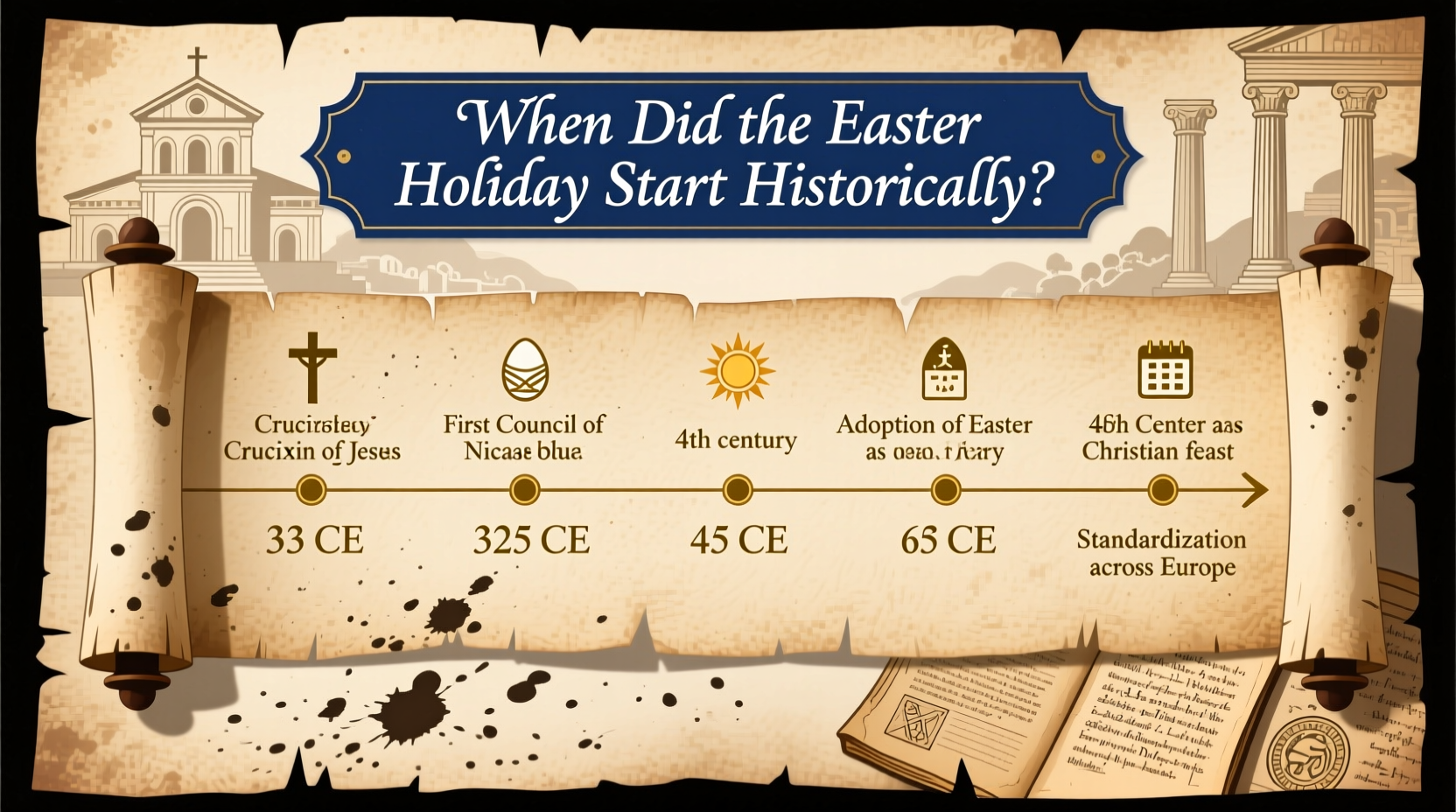
The Easter holiday began in the early centuries of Christianity as a way to commemorate the resurrection of Jesus Christ, with its observance dating back to at least the 2nd century AD. One of the earliest recorded references to the celebration of Easter—under various names such as pascha, derived from the Hebrew pesach (Passover)—appears in historical church documents from around 150–200 AD. The question of when did Easter holiday start both in terms of annual date calculation and historical roots reveals a rich tapestry of religious tradition, astronomical cycles, and ecclesiastical decision-making that continues to shape how millions observe this pivotal Christian festival today.
Origins of the Easter Celebration
Easter’s beginnings are deeply rooted in the New Testament narrative of Jesus’ crucifixion and resurrection, which Christians believe occurred during the Jewish Passover week. Early Christian communities in Jerusalem and Asia Minor began marking this event annually, aligning their observance with the timing of Passover, which falls on the 14th day of the Hebrew month of Nisan—a date determined by lunar cycles.
By the late 2nd century, divergent practices emerged. Some churches, particularly in Asia Minor (notably Smyrna), celebrated Easter on Nisan 14 regardless of the day of the week, following what was known as the Quartodeciman practice. Others, especially in Rome and the West, insisted on observing Easter on the Sunday following Nisan 14, emphasizing the resurrection’s occurrence on a Sunday.
This discrepancy led to one of the first major controversies in Christian history. Church leaders debated not only theological implications but also the importance of unity in worship. The issue came to a head at the Council of Nicaea in 325 AD, convened by Emperor Constantine I, which sought to standardize key aspects of Christian doctrine and practice—including the date of Easter.
The Council of Nicaea and the Standardization of Easter
The Council of Nicaea in 325 AD marked a turning point in answering the question: when did Easter holiday start as a uniformly calculated feast? The council established that Easter should be celebrated on the first Sunday after the first full moon occurring on or after the vernal (spring) equinox. The equinox was fixed at March 21 for computational purposes, even if the astronomical equinox varied slightly.
This decision aimed to separate the Christian celebration from the Jewish calendar while preserving its connection to spring and renewal. It also ensured that Easter would always fall on a Sunday, honoring the day of Christ’s resurrection. However, the council did not specify a method for calculating the full moon or equinox, leaving room for regional variations in computation.
Over time, different Christian traditions developed their own methods. The Julian calendar, used widely in Europe until the late 16th century, gradually drifted out of alignment with the solar year, causing discrepancies in the calculated date of Easter. This issue prompted Pope Gregory XIII to introduce the Gregorian calendar reform in 1582, which corrected the drift and refined the rules for determining Easter.
How Is the Date of Easter Determined Today?
Today, most Western Christian churches (including Roman Catholic and Protestant denominations) use the Gregorian calendar to calculate Easter. According to current rules:
- Easter falls on the first Sunday after the ecclesiastical full moon on or after March 21.
- The ecclesiastical full moon is based on tables rather than actual astronomical observations.
- As a result, Easter can occur as early as March 22 or as late as April 25 in the Gregorian system.
In contrast, many Eastern Orthodox churches continue to use the Julian calendar for liturgical purposes, which currently runs 13 days behind the Gregorian calendar. Consequently, Orthodox Easter often occurs later than Western Easter—sometimes by several weeks—and may fall between April 4 and May 8 in the modern Gregorian calendar.
| Year | Western Easter Date | Orthodox Easter Date |
|---|---|---|
| 2024 | March 31 | May 5 |
| 2025 | April 20 | April 20 |
| 2026 | April 5 | April 12 |
| 2027 | March 28 | May 2 |
| 2028 | April 16 | April 16 |
Historical Evolution of Easter Traditions
While the core purpose of Easter—to celebrate the resurrection—has remained constant, the ways it is observed have evolved significantly since the holiday started. In the early church, Easter was preceded by a period of fasting and preparation, which eventually developed into Lent. The 40-day season of Lent, symbolizing Jesus’ 40 days in the wilderness, became standardized by the 4th century.
Easter Vigil services, held on the night before Easter Sunday, trace their origins to early Christian practices of nighttime prayer and baptismal rites. These solemn gatherings emphasized spiritual rebirth and initiation into the faith community.
Over the centuries, cultural influences blended with religious observance. Elements such as decorated eggs, which symbolize new life, have roots in pre-Christian spring festivals but were adopted into Christian symbolism. Similarly, the figure of the Easter Bunny, popularized in German folklore, entered mainstream Western culture through immigration and commercialization in the 18th and 19th centuries.
Global Observance and Cultural Variations
The Easter holiday is now observed worldwide, though customs vary widely by region. Countries with strong Christian traditions—such as Italy, Spain, the Philippines, and Brazil—often hold elaborate processions, reenactments of the Passion, and special church services.
In the United States, Easter is both a religious and cultural event. Many attend sunrise services, participate in egg hunts, and enjoy family meals featuring ham or lamb. Retailers capitalize on the holiday with themed decorations, candies, and clothing, making Easter one of the largest consumer holidays after Christmas and Halloween.
In predominantly Orthodox countries like Greece, Russia, and Ukraine, Easter (known as Pascha) is the most important religious festival of the year. Customs include midnight liturgies, candlelight processions, and the sharing of red-dyed eggs to symbolize Christ’s blood and resurrection.
Common Misconceptions About When Easter Started
One common misunderstanding is that Easter has always been celebrated on a Sunday or that its date was divinely ordained in a fixed form. In reality, the debate over when did Easter holiday start each year was unresolved for centuries and required ecumenical councils and calendar reforms to harmonize.
Another misconception is that Easter is purely a Christian invention. While the theological meaning is distinctly Christian, scholars acknowledge that some Easter customs—like eggs and rabbits—have connections to pre-Christian fertility symbols associated with springtime celebrations. However, these elements were reinterpreted within a Christian framework rather than directly borrowed.
Some also assume that all Christians celebrate Easter on the same date. As shown in the table above, differences between the Gregorian and Julian calendars mean that Western and Eastern churches often observe Easter on different Sundays.
How to Prepare for Easter: Practical Tips
Whether observing Easter for religious or cultural reasons, preparation enhances the experience. Here are actionable suggestions:
- Check your church’s schedule: Many congregations offer special services during Holy Week, including Maundy Thursday and Good Friday observances.
- Plan family activities: Organize an Easter egg hunt, prepare traditional foods, or create handmade cards.
- Understand retail hours: Many businesses, especially grocery stores and malls, operate on reduced holiday schedules. Verify opening times online before shopping.
- Learn about local events: Parades, festivals, and community brunches are common in many areas.
- Respect religious significance: Even in secular settings, acknowledging Easter’s spiritual roots fosters inclusivity and understanding.
Regional Differences in Easter Dates and Practices
Geographic location affects not only when Easter is celebrated but also how. For example:
- In Germany, Ostern includes tree decorating with eggs and chocolates, similar to Christmas traditions.
- In Sweden, children dress as “Easter witches” and go door-to-door for candy, blending pagan folklore with Christian themes.
- In Australia, where rabbits are considered pests, the Easter Bilby—a native marsupial—has become a symbolic alternative to the Easter Bunny.
- In Latin America, Semana Santa (Holy Week) features somber processions and public penance rituals, reflecting deep Catholic devotion.
Future Trends and Calendar Reform Proposals
In recent decades, there have been discussions among Christian leaders about establishing a fixed date for Easter to end the annual variation and potential confusion. Proposed dates include the second or third Sunday in April. Such a change would require agreement across Catholic, Protestant, and Orthodox bodies—an unlikely prospect given historical divisions.
Nonetheless, efforts continue toward greater coordination. In 1997, the World Council of Churches proposed a formula using precise astronomical data (actual equinox and full moon) observed from Jerusalem. While not adopted, it reflects ongoing interest in resolving long-standing discrepancies.
Frequently Asked Questions (FAQs)
- When did the Easter holiday start historically?
- The Easter holiday began in the 2nd century AD as a Christian observance of Jesus’ resurrection, with formal standardization occurring at the Council of Nicaea in 325 AD.
- Why does the date of Easter change every year?
- Easter’s date is based on a lunisolar calendar—it follows the first Sunday after the first full moon on or after the spring equinox (March 21), causing annual variation.
- Do all Christians celebrate Easter on the same day?
- No. Most Western churches use the Gregorian calendar, while many Eastern Orthodox churches use the Julian calendar, resulting in different dates in most years.
- What is the earliest and latest possible date for Easter?
- In the Gregorian calendar, Easter can fall as early as March 22 and as late as April 25.
- Was Easter always called 'Easter'?
- No. The term 'Easter' is primarily used in English and German (Ostern). Most other languages use variants of Pascha, derived from the Hebrew 'Passover.'
In summary, the question of when did Easter holiday start encompasses both its ancient origins and its evolving calculation method. From its roots in early Christian worship to its current global observance, Easter remains a dynamic blend of theology, astronomy, and culture. Understanding its history helps deepen appreciation for one of the most significant holidays in the Christian year.




 浙公网安备
33010002000092号
 浙B2-20120091-4