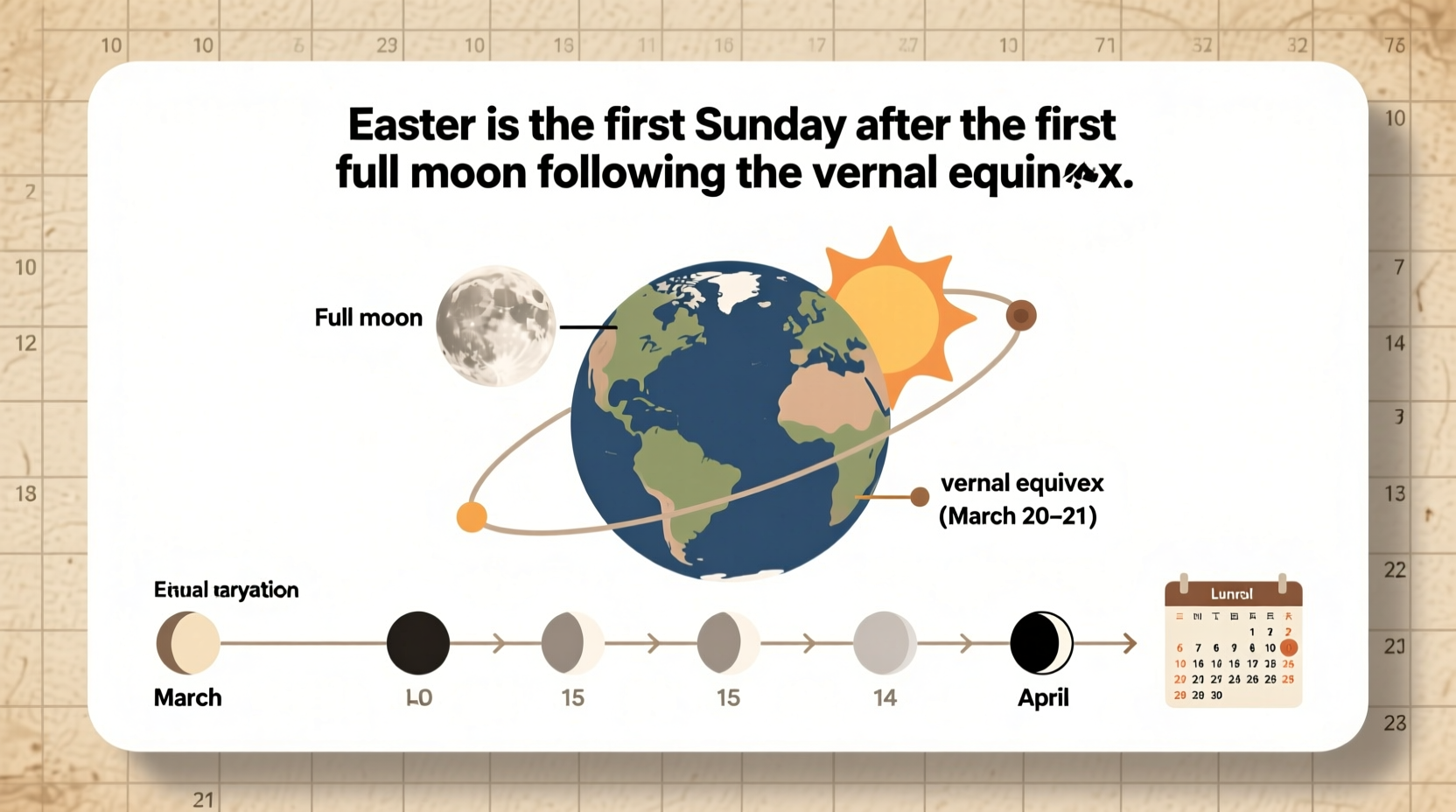
What makes Easter change dates every year is its dependence on the lunar calendar and the spring equinox. Unlike fixed holidays such as Christmas, Easter Sunday falls on the first Sunday after the first full moon following the vernal (spring) equinox in the Northern Hemisphere. This ecclesiastical rule, established by the Council of Nicaea in 325 CE, means that Easter can occur as early as March 22 or as late as April 25 in the Gregorian calendar. The variability stems from the combination of solar and lunar cycles, which do not align perfectly with our modern calendar. Understanding what makes Easter change dates helps clarify why it shifts annually and allows people to anticipate when Easter will occur in upcoming years.
Historical Origins of Easter’s Movable Date
The reason Easter does not have a fixed date lies deep in Christian tradition and early church history. At the First Council of Nicaea in 325 AD, church leaders sought to standardize the celebration of Easter across all Christian communities. Prior to this decision, some churches celebrated Easter on different days, often tied directly to the Jewish Passover, which follows the Hebrew lunar calendar. To create unity, the council decreed that Easter should be observed on the first Sunday after the Paschal Full Moon—the ecclesiastical approximation of the first full moon after the vernal equinox, set for March 21 regardless of astronomical observation.
This compromise separated Easter from direct dependence on the Hebrew calendar while still preserving its connection to lunar phases and the symbolism of renewal associated with spring. As a result, the calculation became independent of local observations and instead relied on a standardized table known as the ecclesiastical moon. Over centuries, these calculations were refined, particularly through the adoption of the Gregorian calendar reform in 1582, which corrected inaccuracies in the Julian calendar and improved alignment between the calendar year and astronomical events.
How the Date of Easter Is Calculated
The technical method behind determining Easter’s date combines astronomy, mathematics, and religious tradition. In Western Christianity (Catholic and Protestant denominations), Easter is calculated using the Gregorian calendar. The formula is:
- Easter Sunday = The first Sunday after the first ecclesiastical full moon on or after March 21.
Eastern Orthodox churches, however, use the older Julian calendar to calculate Easter, which often results in a different date—sometimes several weeks later than Western Easter. This difference persists because the Julian calendar currently runs 13 days behind the Gregorian calendar, and the Orthodox Church continues to follow traditional methods for computing the Paschal Full Moon.
To simplify the process without requiring real-time astronomical data, the church uses a predetermined cycle called the Metonic cycle—a 19-year pattern that approximates the relationship between the solar year and lunar months. Based on this system, a table known as the epact is used to determine the age of the moon on any given date, enabling consistent predictions decades in advance.
When Will Easter Occur in Upcoming Years?
Because of the cyclical nature of the calculation, Easter dates repeat in predictable patterns over time. Below is a table showing Easter Sunday dates for the next decade:
| Year | Western Easter Date | Orthodox Easter Date |
|---|---|---|
| 2024 | March 31 | May 5 |
| 2025 | April 20 | April 20 |
| 2026 | April 5 | April 12 |
| 2027 | March 28 | May 2 |
| 2028 | April 16 | April 16 |
| 2029 | April 1 | April 8 |
| 2030 | April 21 | April 28 |
| 2031 | April 13 | April 13 |
| 2032 | March 28 | May 2 |
| 2033 | April 17 | April 24 |
Note that in some years—such as 2025 and 2031—Western and Orthodox Easters coincide. These overlaps happen when the respective calendars and lunar computations align. For those planning religious observances, school breaks, or family gatherings, checking official ecclesiastical sources or reputable almanacs well in advance ensures accurate scheduling.
Regional Differences in Observing Easter
While the core religious significance of Easter remains consistent among Christians worldwide, the way it is observed—and even when it is celebrated—varies significantly by region. In predominantly Catholic and Protestant countries like the United States, Canada, Australia, Germany, and the UK, Easter is generally observed according to the Gregorian-based calculation. Public holidays are typically declared for Good Friday and Easter Monday, allowing for extended weekend celebrations.
In contrast, many Eastern European nations—including Russia, Ukraine, Serbia, and Greece—follow the Orthodox liturgical calendar. As a result, their Easter festivities often occur one to five weeks after Western Easter. During this period, unique traditions such as midnight liturgies, red-dyed eggs symbolizing Christ’s blood, and elaborate feasts featuring lamb and kulich (a type of sweet bread) are central to the celebration.
Some countries, like Finland and Sweden, blend solemn religious practices with folk customs involving children dressing as witches during Easter, reflecting pre-Christian spring fertility rites now integrated into Christian culture. Meanwhile, Latin American countries emphasize Passion plays and processions leading up to Easter Sunday, especially in Mexico, Guatemala, and Peru.
Common Misconceptions About Easter’s Changing Date
Several myths persist about why Easter moves each year. One common misunderstanding is that Easter is randomly assigned or chosen arbitrarily by church authorities. In reality, its date follows precise mathematical and calendrical rules developed over centuries. Another misconception is that Easter always occurs in April. While most frequently in April, Easter can fall in late March; for example, in 2024 and 2027, Western Easter occurred on March 31 and March 28, respectively.
Additionally, some believe that changes in climate or seasonal patterns affect Easter’s timing. However, the ecclesiastical equinox is fixed at March 21, irrespective of actual astronomical conditions. Even if the true spring equinox shifts slightly due to leap years or planetary motion, the church maintains this symbolic date for consistency.
Practical Tips for Planning Around Easter’s Variable Date
Given that Easter changes annually, individuals and organizations benefit from proactive planning. Here are several actionable recommendations:
- Check school and public holiday schedules early: Since Easter influences spring break timing in many countries, parents should consult academic calendars before booking travel.
- Verify retail and business hours: Stores may close on Good Friday or Easter Sunday, especially in traditionally Christian regions. Always confirm operating hours via official websites or local announcements.
- Prepare religious services in advance: Churches must coordinate special liturgies, music, decorations, and volunteer roles weeks ahead, particularly during Holy Week.
- Plan marketing campaigns strategically: Retailers selling Easter baskets, chocolate, clothing, or greeting cards should launch promotions at least four to six weeks prior, adjusting timing based on the year’s specific Easter date.
- Use digital calendar alerts: Subscribe to ecclesiastical calendars or add recurring reminders for key dates like Ash Wednesday (46 days before Easter) and Palm Sunday (one week before Easter).
Why Do Some Countries Not Celebrate Easter?
Although Easter is widely recognized in Christian-majority nations, it is not universally observed. In countries where Christianity is a minority religion—such as Japan, China, Thailand, or Saudi Arabia—Easter has limited cultural presence and is not a public holiday. In secular societies like France or the Netherlands, younger generations may treat Easter more as a commercial or family-oriented event rather than a religious one, focusing on egg hunts and chocolate gifts.
However, globalization has increased awareness of Western holidays. International schools, expatriate communities, and multinational corporations sometimes acknowledge Easter with themed activities, even in non-Christian contexts. Still, participation remains optional and culturally adapted.
The Future of Easter’s Date: Potential Reforms
In recent decades, there have been discussions among global Christian leaders about establishing a fixed date for Easter to eliminate confusion and economic disruption caused by its variability. Proposals include setting Easter on the second or third Sunday in April permanently. Such a reform would require agreement between Roman Catholic, Protestant, and Orthodox churches—an unlikely prospect given theological and traditional differences.
Nonetheless, occasional joint statements express interest in unifying the date. If achieved, it could streamline international scheduling for education, commerce, and interfaith dialogue. Until then, the current system endures as a testament to the intersection of faith, science, and history.
Frequently Asked Questions (FAQs)
- Why doesn’t Easter have a fixed date like Christmas?
- Easter is linked to the lunar cycle and the spring equinox, following ancient ecclesiastical rules designed to align with biblical accounts of Jesus’ resurrection. Christmas, in contrast, was assigned a fixed solar date (December 25) in the 4th century.
- What determines whether Easter is early or late in a given year?
- The timing depends on when the first full moon occurs after March 21. If it happens shortly after March 21 and the next day is a Sunday, Easter will be early (e.g., March 24). If the full moon falls just before March 21, the next full moon (in April) sets the date, making Easter later.
- Do all Christians celebrate Easter on the same day?
- No. Most Western Christians (Catholic and Protestant) celebrate Easter based on the Gregorian calendar, while most Eastern Orthodox Christians use the Julian calendar, resulting in different dates in most years.
- How far in advance can Easter dates be predicted?
- Easter dates can be calculated centuries in advance using established algorithms and ecclesiastical tables. Official church publications often list Easter dates up to 50 years ahead.
- Is the full moon used for Easter calculation visible everywhere?
- No. The ‘Paschal Full Moon’ is an ecclesiastical approximation, not necessarily corresponding to the actual astronomical full moon visible in a particular location. It’s part of a standardized system to ensure uniformity.





 浙公网安备
33010002000092号
浙公网安备
33010002000092号 浙B2-20120091-4