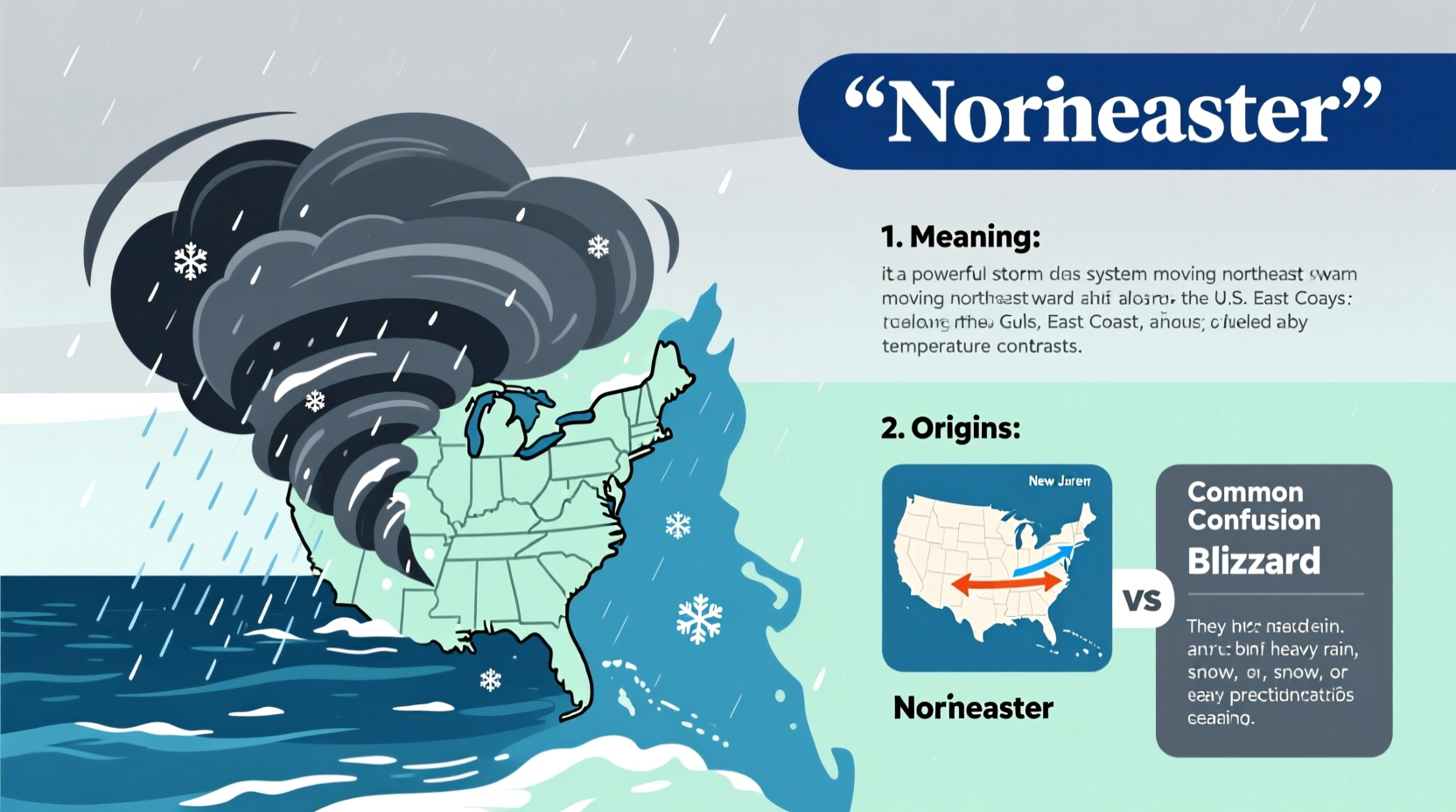
The term nor'easter, sometimes informally written as nor easter, refers to a powerful cyclonic storm that moves along the East Coast of North America, particularly affecting regions from the Mid-Atlantic up through New England. These storms are characterized by strong northeasterly winds, heavy precipitation—often snow in winter—and coastal flooding, making them a defining feature of Northeastern U.S. weather patterns during colder months. Contrary to common confusion sparked by phonetic similarity, nor'easter has no connection to the Christian holiday of Easter; instead, its name derives from the direction of the wind—north to northeast—that drives these systems ashore. This distinction is essential for understanding both meteorological terminology and cultural references involving what is nor easter in American English usage.
Understanding the Term “Nor’easter”
The correct spelling and pronunciation of this weather phenomenon is nor’easter, with an apostrophe indicating the contraction of “north” and “easter,” meaning “northeast storm.” While “nor easter” appears frequently in informal writing, especially online, the accepted meteorological and linguistic form includes the apostrophe: nor’easter. The wind direction associated with these storms blows from the northeast toward the southwest, which intensifies moisture pickup over the Atlantic Ocean and steers storm systems into populated coastal zones.
Nor’easters typically develop between Georgia and New Jersey within 100 miles of the coastline, fueled by the temperature contrast between cold Arctic air masses over land and the warm waters of the Gulf Stream offshore. They can occur at any time of year but are most frequent and severe between November and March. Their impacts include blizzard conditions, downed trees, power outages, beach erosion, and transportation disruptions across major metropolitan areas such as Boston, New York City, Philadelphia, and Washington D.C.
Meteorological Formation and Key Characteristics
A nor’easter forms when a low-pressure system moves up the East Coast and interacts with high-pressure systems over eastern Canada. This pressure gradient generates strong winds from the northeast, drawing in moist air from the Atlantic. As this moisture rises over cooler land or meets cold continental air, it condenses into clouds and precipitation.
Key characteristics of a nor’easter include:
- Duration: Typically lasts 12 to 48 hours, though some prolonged events persist for several days.
- Precipitation Type: Rain, snow, sleet, or freezing rain depending on temperature profiles aloft and at surface level.
- Wind Speeds: Often exceed 50 mph (80 km/h), with gusts reaching hurricane force (75+ mph).
- Storm Surge: Coastal flooding due to onshore winds pushing seawater onto beaches and low-lying communities.
- Snowfall Totals: In winter storms, snow accumulation can range from 6 inches to over 2 feet in inland and northern areas.
These storms are sometimes called &ldquo>winter hurricanes” because of their intensity and spiral structure visible on satellite imagery, although they differ fundamentally from tropical cyclones in formation mechanism and energy source.
Historical Significance of Major Nor’easters
Throughout history, several notable nor’easters have left lasting impacts on infrastructure, emergency planning, and public awareness. Some of the most significant include:
| Storm Name / Year | Impact Summary | Regions Affected |
|---|---|---|
| The Great Blizzard of 1888 | Up to 50 inches of snow, 200+ fatalities, paralyzed cities for days | New York, New Jersey, Connecticut, Massachusetts |
| The Ash Wednesday Storm (1962) | Coastal destruction, dune erosion, widespread flooding | Mid-Atlantic coast (especially NJ, MD, VA) |
| The Perfect Storm (1991) | Famously documented in book and film; merged with Hurricane Grace | Offshore New England, caused shipwrecks |
| Superstorm Sandy (2012) | Hybrid system with tropical and nor’easter traits; catastrophic surge | New Jersey, New York, Pennsylvania |
| January 2016 Blizzard (“Snowzilla”) | Over 3 feet of snow in parts of DC and Maryland | Washington D.C., Virginia, West Virginia, Northeast |
Each of these events contributed to improvements in forecasting technology, evacuation protocols, and building codes in vulnerable coastal zones.
Regional Terminology and Linguistic Debate
The word nor’easter has been subject to debate among linguists and regional writers. Some argue that the term was popularized—or even invented—by New England writers in the 19th century to lend a nautical flavor to local dialect. Skeptics point out that traditional maritime logs used “northeast storm” without contraction, suggesting nor’easter may be a literary affectation.
Despite this controversy, the term is now firmly embedded in both everyday language and official National Weather Service communications. It appears regularly in weather forecasts broadcast across the Northeastern United States and is recognized in dictionaries such as Merriam-Webster and Oxford English Dictionary.
Differences Between Nor’easters and Tropical Cyclones
While both nor’easters and hurricanes produce damaging winds and flooding, they differ significantly in origin, structure, and behavior:
- Energy Source: Hurricanes derive energy from warm ocean water in tropical latitudes; nor’easters thrive on temperature contrasts between polar and subtropical air masses.
- Formation Region: Hurricanes form over open tropical oceans; nor’easters develop near the U.S. East Coast during colder months.
- Wind Field: Hurricanes have concentrated, symmetric wind fields around a calm eye; nor’easters exhibit broad, asymmetric circulation covering hundreds of miles.
- Seasonality: Hurricane season runs June–November; nor’easters peak November–March.
- Intensity Measurement: Hurricanes are ranked using the Saffir-Simpson scale; nor’easters are not formally categorized but assessed based on impact severity.
However, hybrid systems like Superstorm Sandy blur these distinctions, combining elements of both storm types and posing unique challenges for forecasters and emergency managers.
How to Prepare for a Nor’easter
Given their potential for disruption, residents in susceptible areas should take proactive steps before a nor’easter strikes. Here are key preparedness tips:
- Stay Informed: Monitor local news and the National Weather Service (weather.gov) for watches and warnings. Sign up for emergency alerts via text or smartphone apps.
- Stock Essentials: Keep at least three days’ worth of non-perishable food, water (one gallon per person per day), medications, flashlights, batteries, and first aid supplies.
- Protect Your Home: Clear gutters, secure outdoor furniture, insulate pipes, and consider installing storm shutters if in a flood-prone area.
- Plan for Power Outages: Charge electronic devices, have backup charging options (portable battery packs), and use generators safely outdoors only.
- Avoid Travel: Postpone non-essential trips during active storms. If travel is necessary, allow extra time, reduce speed, and maintain safe distances from other vehicles.
- Know Evacuation Routes: If you live near the coast or in a flood zone, identify your evacuation path and shelter locations in advance.
Common Misconceptions About Nor’easters
Several myths persist about nor’easters, often stemming from confusion with similar-sounding terms or misunderstood science:
- Misconception #1: “Nor easter” refers to Easter celebrations in the North.
Reality: There is no religious or seasonal link between nor’easters and the Easter holiday. The similarity in sound is coincidental. - Misconception #2: All East Coast storms are hurricanes.
Reality: Most major winter storms are extratropical cyclones (nor’easters), not tropical systems. - Misconception #3: Nor’easters only bring snow.
Reality: While winter nor’easters often produce heavy snow, those occurring in spring or fall may bring torrential rain and thunderstorms instead. - Misconception #4: Climate change doesn't affect nor’easters.
Reality: Warmer sea surface temperatures may increase moisture content in storms, potentially leading to heavier precipitation, even if overall frequency remains uncertain.
Regional Differences in Impact and Response
The effects of a nor’easter vary widely depending on geography:
- Coastal Areas: Face greatest risk from storm surge, beach erosion, and saltwater intrusion. Communities like Cape Cod, Long Island, and the Outer Banks often experience mandatory evacuations.
- Inland Zones: May see heavier snowfall due to elevation and distance from moderating ocean influences. Cities like Albany, Syracuse, and Pittsburgh can receive significantly more snow than nearby coastal cities.
- Urban Centers: Dense populations amplify risks related to transit shutdowns, school closures, and utility failures. Municipalities invest heavily in snowplows, salt trucks, and emergency coordination.
- Southern States: Even states like North Carolina and Virginia, less accustomed to extreme winter weather, can face paralyzing impacts when rare snowfalls occur during a nor’easter event.
Emergency management strategies reflect these differences, with northern states generally better equipped for snow removal and southern coastal regions focusing more on flood mitigation.
Verifying Information During a Nor’easter Event
During active storm threats, misinformation spreads quickly on social media. To ensure accuracy:
- Rely on official sources: National Weather Service, FEMA, state emergency management agencies.
- Check local government websites for road closures, shelter openings, and curfews.
- Avoid unverified viral posts showing dramatic footage labeled as “live updates” unless confirmed by reputable news outlets.
- Use trusted weather apps (e.g., NOAA Weather Radar, AccuWeather, The Weather Channel) that pull data directly from NWS.
Conclusion: Clarifying What Is Nor Easter Once and For All
To reiterate, what is nor easter is best understood as a colloquial misspelling or misinterpretation of the meteorological term nor’easter—a strong coastal storm affecting the northeastern United States, named for the persistent northeasterly winds that drive it. Despite the phonetic resemblance to the religious holiday Easter, there is no cultural or calendrical relationship between the two. Understanding this distinction helps prevent confusion, improves weather literacy, and supports effective preparedness in regions prone to these impactful winter storms.
Frequently Asked Questions (FAQs)
Q: Is a nor’easter the same as a blizzard?
A: Not necessarily. A blizzard is defined by sustained winds of 35 mph or more and visibility under one-quarter mile for at least three hours. A nor’easter may meet these criteria and become a blizzard, but not all do.
Q: Can nor’easters happen in summer?
A: Yes, though they are less intense. Summer nor’easters typically bring cloudy skies, cool temperatures, and prolonged rain rather than snow, often referred to as “cool season outbreaks” or “derechos” if accompanied by straight-line winds.
Q: Why do some people spell it ‘nor easter’ without an apostrophe?
A: Informal spelling arises from phonetic interpretation. However, the correct form is ‘nor’easter’, reflecting the contracted phrase “north-easter.”
Q: Do nor’easters affect Canada?
A: Yes, especially the Maritime provinces (Nova Scotia, New Brunswick, Prince Edward Island), where they can cause similar impacts including snow, wind, and coastal flooding.
Q: How far inland can a nor’easter reach?
A: These storms can extend effects hundreds of miles inland, bringing snow to Appalachia, the Ohio Valley, and even the Midwest, depending on track and atmospheric conditions.




 浙公网安备
33010002000092号
 浙B2-20120091-4