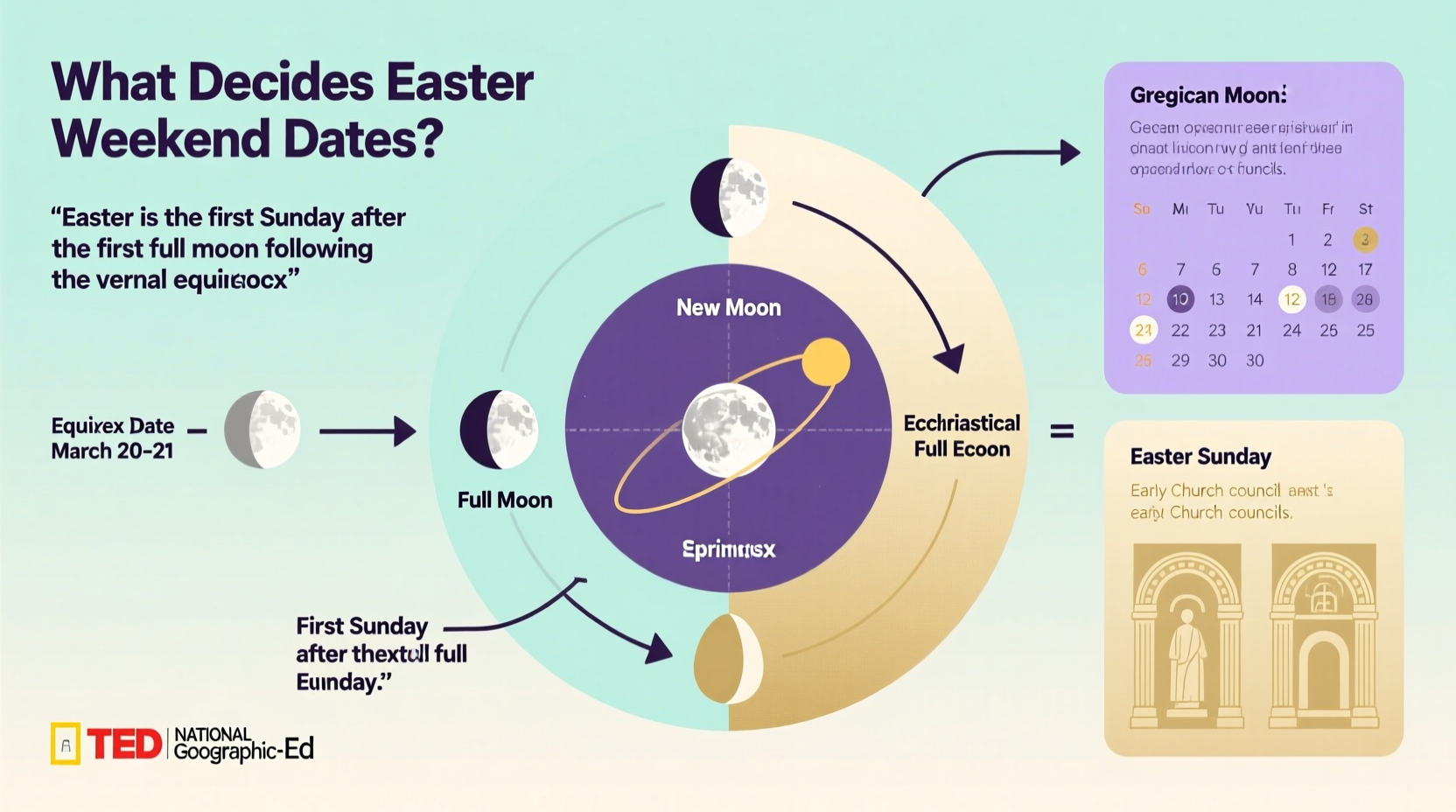
The date of Easter weekend is determined by a unique combination of astronomical events and ecclesiastical rules—specifically, it falls on the first Sunday after the first full moon following the spring equinox. This system, rooted in centuries of Christian tradition, explains what decides Easter weekend and why its timing shifts annually between late March and late April. Unlike fixed holidays such as Christmas, Easter’s fluid calendar placement reflects its deep ties to both solar and lunar cycles, making it one of the most mathematically complex dates in the liturgical year.
Why Does Easter’s Date Change Every Year?
Easter is a moveable feast, meaning it does not occur on the same calendar date each year. The primary reason for this variability lies in the method established by the First Council of Nicaea in 325 CE, which decreed that Easter would be celebrated on the first Sunday after the Paschal Full Moon—the ecclesiastical approximation of the first full moon after the vernal (spring) equinox. Since the lunar cycle doesn’t align perfectly with the Gregorian calendar, the date fluctuates.
The vernal equinox is fixed at March 21 in church calculations, regardless of the actual astronomical event, which can vary slightly. The Paschal Full Moon is not necessarily the same as the astronomical full moon but follows a 19-year Metonic cycle used in the computus—the calculation of Easter’s date. As a result, Easter can fall anywhere from March 22 to April 25 in Western Christianity, which uses the Gregorian calendar.
Eastern vs. Western Easter: Why Are Dates Different?
One common point of confusion is that Eastern Orthodox churches often celebrate Easter on a different date than Western Christian denominations. This discrepancy arises because Eastern churches use the older Julian calendar to calculate the equinox and full moon, while Western churches use the modern Gregorian calendar. The Julian calendar currently runs 13 days behind the Gregorian, leading to divergent Easter dates in most years.
For example, in 2026, Western Easter will be on March 29, while Orthodox Easter will fall on April 5. In some years, however, the calculations align, and both traditions observe Easter on the same day. This variation underscores how calendar systems play a crucial role in determining when Easter weekend occurs across global communities.
Historical Origins of Easter’s Date Calculation
The decision to base Easter on lunar and solar cycles was made during the early centuries of Christianity as a way to distinguish the holiday from Jewish Passover while still maintaining a symbolic connection. Passover begins on the 15th day of Nisan in the Hebrew calendar, which is also tied to the spring full moon. Early Christians wanted Easter to always follow Passover, hence the rule about the Sunday after the full moon.
The Council of Nicaea formalized this practice to unify Christian observance across the Roman Empire. However, disagreements persisted between Rome and Alexandria over astronomical calculations until Dionysius Exiguus developed a standardized table in the 6th century. His work laid the foundation for the computus still used today in Western churches.
How Is the Easter Weekend Defined?
Easter weekend typically refers to the period encompassing Holy Saturday, Easter Sunday, and sometimes Easter Monday. While Easter Sunday is the central day of celebration—commemorating the resurrection of Jesus Christ—many countries treat the surrounding days as part of an extended holiday break.
- Holy Saturday: The final day of Holy Week and the end of Lent; observed with vigil services in many denominations.
- Easter Sunday: The principal day of celebration, marked by church services, family gatherings, and festive meals.
- Easter Monday: A public holiday in many nations, including the UK, Canada, and Australia, though not in the United States.
The exact composition of the Easter weekend varies by country and denomination, influencing travel patterns, retail operations, and school schedules.
When Is Easter in Upcoming Years?
Understanding what decides Easter weekend helps predict future dates. Below is a table showing Easter Sunday dates for the next decade in Western Christianity:
| Year | Easter Sunday (Western) | Easter Monday |
|---|---|---|
| 2024 | March 31 | April 1 |
| 2025 | April 20 | April 21 |
| 2026 | March 29 | March 30 |
| 2027 | April 11 | April 12 |
| 2028 | April 2 | April 3 |
| 2029 | April 15 | April 16 |
| 2030 | March 31 | April 1 |
| 2031 | April 13 | April 14 |
| 2032 | April 4 | April 5 |
| 2033 | March 27 | March 28 |
These dates are calculated using the standard ecclesiastical rules and assume no changes to calendar systems or regional observances.
Which Countries Celebrate Easter and How?
Easter is observed in over 100 countries worldwide, either as a religious holiday, a cultural event, or a national public holiday. Its significance varies widely:
- United States: No federal holiday, but many businesses close on Good Friday or Easter Monday locally. Major retailers may operate with reduced hours.
- United Kingdom: Good Friday and Easter Monday are bank holidays. Public transport runs on holiday schedules.
- Australia and New Zealand: Both have public holidays for Good Friday and Easter Monday, with Easter Saturday also a holiday in some states.
- Canada: Federal employees get Good Friday off; Easter Monday is a statutory holiday in Quebec and some other provinces.
- Germany: Strict laws limit commercial activity on Easter Sunday and Monday.
- Greece and Russia: Orthodox Easter is a major religious and cultural event, often more significant than Christmas.
Tourists and residents should verify local regulations, especially regarding shopping, transportation, and restaurant availability during the Easter weekend.
Common Misconceptions About Easter’s Timing
Several myths persist about what decides Easter weekend:
- Misconception: Easter is based solely on the actual full moon.
Reality: It uses the “ecclesiastical full moon,” a calculated date derived from tables, not real-time astronomy. - Misconception: All Christians celebrate Easter on the same day.
Reality: Due to calendar differences, Eastern and Western churches often celebrate weeks apart. - Misconception: Easter can fall in May.
Reality: In the Gregorian system, Easter cannot occur later than April 25. - Misconception: The Pope sets the date every year.
Reality: The date is computed automatically using established rules; no annual declaration is needed.
How to Prepare for Easter Weekend
Whether observing religiously or participating in secular traditions like egg hunts and family brunches, planning ahead ensures a smooth experience:
- Check Retail Hours: Grocery stores and pharmacies may close early on Good Friday or Easter Sunday. Verify hours online before shopping.
- Plan Travel Early: Airports and highways see increased traffic around Easter weekend. Book accommodations and tickets in advance.
- Attend Services: Many churches offer special services from Palm Sunday through Easter. Reserve seats if required.
- Prepare Symbolic Foods: Hot cross buns, lamb dishes, and decorated eggs are traditional in many cultures.
- Verify Local Holidays: In multinational companies or expatriate communities, confirm whether Easter Monday is recognized locally.
Religious and Cultural Significance Beyond the Date
While what decides Easter weekend is largely technical, the holiday itself holds profound spiritual meaning. For Christians, it marks the culmination of Lent and the triumph of life over death. The preceding week—Holy Week—includes Maundy Thursday (Last Supper), Good Friday (crucifixion), and the Easter Vigil (resurrection).
Culturally, Easter has absorbed pre-Christian symbols like rabbits and eggs, representing fertility and renewal. These elements are especially prominent in secular celebrations in North America and parts of Europe. Despite commercialization, the core religious observance remains central for billions.
Will Easter Ever Be Fixed on a Permanent Date?
There have been ongoing discussions among Christian leaders about establishing a fixed date for Easter, such as the second Sunday in April, to simplify scheduling and reduce discrepancies. Proposals have emerged from ecumenical dialogues involving Catholic, Orthodox, and Protestant representatives.
However, agreement has proven difficult due to theological, cultural, and calendrical differences. Any change would require broad consensus across global Christianity, particularly between Eastern and Western branches. Until then, the current lunar-based system will continue to determine when Easter weekend occurs each year.
Frequently Asked Questions
When is Easter 2026?
In 2026, Easter Sunday falls on March 29 in Western Christianity. Orthodox Easter will be on April 5 of the same year.
Why isn’t Easter on the same date every year?
Easter’s date depends on the lunar cycle and the spring equinox, following ancient ecclesiastical rules that set it on the first Sunday after the Paschal Full Moon.
Do all countries celebrate Easter?
No, not all countries observe Easter. It is primarily celebrated in Christian-majority nations or regions with strong Christian heritage, though some non-Christian countries recognize it as a cultural or historical event.
Is Easter Monday a public holiday everywhere?
No, Easter Monday is a public holiday in many countries like the UK, Canada, and Australia, but not in the United States or some others.
Can Easter ever fall in March?
Yes, Easter can fall in March. The earliest possible date is March 22, though this is rare. More commonly, it appears in late March, such as March 29 in 2026.





 浙公网安备
33010002000092号
浙公网安备
33010002000092号 浙B2-20120091-4