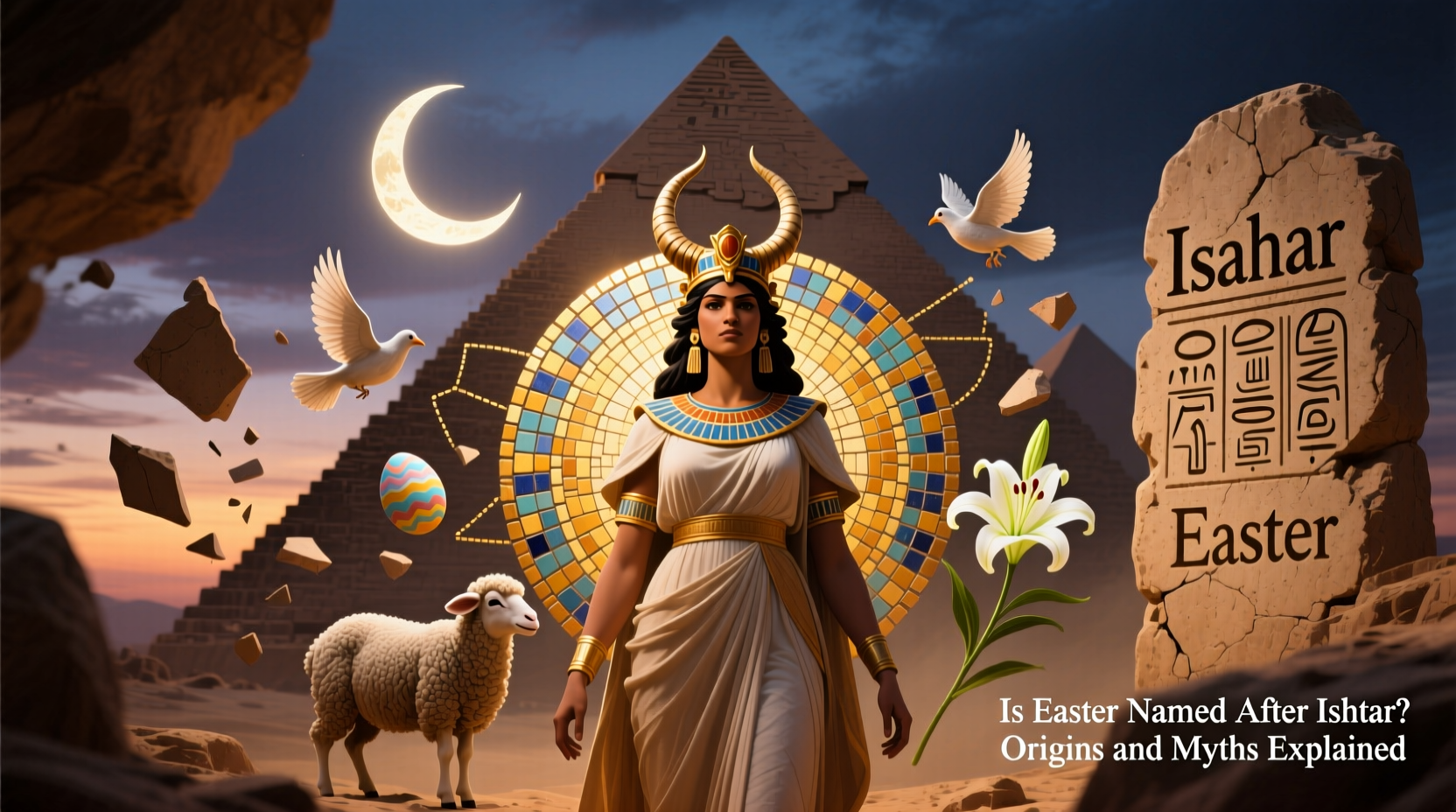
The question is Easter Ishtar has sparked widespread debate, but the clear answer is no—Easter is not directly named after the Mesopotamian goddess Ishtar. While both names sound similar and are sometimes linked in popular culture, linguistic and historical evidence shows that the word 'Easter' most likely derives from the Old English 'Ēostre,' a Germanic dawn goddess associated with spring, rather than from Ishtar, the Babylonian deity of love and war. This misconception, often repeated online, stems from a mix of superficial phonetic resemblance and oversimplified historical claims. Understanding whether is Easter Ishtar requires examining etymology, ancient traditions, and how Christian holidays absorbed and transformed earlier seasonal celebrations.
Etymology of 'Easter': The Ēostre Connection
The origin of the word 'Easter' traces back to early Anglo-Saxon Christianity. The Venerable Bede, an 8th-century English monk and historian, wrote in his work De Temporum Ratione ('The Reckoning of Time') that the month corresponding to April was called 'Eosturmonath'—named after a goddess 'Ēostre,' whom the pagans once honored with festivals. When Christianity spread through England, the name was repurposed for the celebration of Christ’s resurrection.
This explanation is widely accepted among linguists and historians. The Proto-Germanic root '*Austri-' or '*Austrōn' relates to dawn and eastward direction (from the Proto-Indo-European root '*aus-' meaning 'to shine,' as in 'aurora'), reinforcing the link between light, renewal, and springtime—central themes in both pre-Christian and Christian spring festivals.
Critically, there is no direct textual or archaeological evidence connecting Ēostre to Ishtar. Though both figures are associated with fertility and renewal, they originate from entirely different cultural and linguistic traditions: Ishtar from ancient Mesopotamia (Sumerian, Akkadian, Babylonian), and Ēostre from Germanic paganism. Thus, when asking is Easter Ishtar, the scholarly consensus leans strongly toward this being a modern myth rather than historical fact.
Who Was Ishtar? A Brief Historical Overview
Ishtar was a major deity in ancient Mesopotamian religion, worshipped across Sumer, Assyria, and Babylonia for over two millennia. She embodied love, beauty, sex, desire, fertility, war, and justice. Her myths, such as the famous 'Descent of Inanna' (Inanna being her Sumerian counterpart), describe her journey to the underworld, symbolic of death and rebirth—a theme some argue parallels Easter’s resurrection narrative.
However, while thematic parallels exist between various dying-and-rising gods in ancient religions—including Osiris in Egypt, Tammuz in Mesopotamia, and Attis in Anatolia—these do not constitute direct influence on the development of Christian Easter. Early Christians deliberately distanced themselves from pagan practices, even as they adopted existing calendar dates and seasonal symbolism to make conversion more accessible.
The idea that is Easter Ishtar gained traction largely in the 20th century, particularly through speculative works like Alexander Hislop’s 1853 book The Two Babylons. Hislop claimed that many Christian customs were covert survivals of Babylonian paganism. However, modern scholars widely dismiss Hislop's methodology as flawed, biased, and lacking in credible evidence. Despite this, the theory persists in certain religious and internet circles.
Linguistic Analysis: Can 'Easter' Come From 'Ishtar'?
From a linguistic standpoint, the claim that is Easter Ishtar fails under scrutiny. The pronunciation and spelling differ significantly across languages:
- Ishtar: Pronounced /ˈɪʃtɑːr/ in English, derived from Akkadian 'Ištar,' itself from Sumerian 'Inanna.'
- Easter: Comes from Old English 'Ēastre,' pronounced roughly /ˈeːɑstrə/, with roots in Proto-Germanic.
There is no known phonetic evolution path by which 'Ishtar' could have transformed into 'Ēostre' or 'Easter' in any Indo-European or Semitic language family. Furthermore, the worship of Ishtar was geographically confined to the Near East, with little to no presence in Northern Europe where the term 'Easter' originated.
In contrast, many other European languages use terms derived from the Latin 'Pascha,' which comes from the Hebrew 'Pesach' (Passover)—such as 'Pâques' in French, 'Pascua' in Spanish, and 'Pasqua' in Italian. This reflects the close theological and calendrical relationship between Easter and the Jewish festival of Passover, during which Jesus’ crucifixion occurred.
| Language | Word for Easter | Linguistic Origin |
|---|---|---|
| English | Easter | Old English Ēostre (Germanic) |
| German | Ostern | Related to Ēostre (dawn) |
| Spanish | Pascua | Latin Pascha → Hebrew Pesach |
| Italian | Pasqua | Latin Pascha |
| Russian | Пасха (Paskha) | Greek Pascha |
| Arabic | عِيد القيامة (ʿĪd al-Qiyāma) | Resurrection Feast |
Why Do People Believe That Is Easter Ishtar?
The belief that is Easter Ishtar endures due to several factors:
- Superficial Similarity: The words 'Easter' and 'Ishtar' look and sound somewhat alike when spoken quickly in English, creating a false impression of connection.
- Symbolic Overlap: Both Easter and ancient spring festivals involve themes of rebirth, eggs, and rabbits—symbols later incorporated into Easter celebrations. These shared motifs are misinterpreted as evidence of direct lineage.
- Anti-Catholic or Anti-Establishment Narratives: Some groups use the Ishtar-Easter link to argue that mainstream Christianity co-opted pagan beliefs, suggesting it lacks authenticity. This view appeals to those skeptical of institutional religion.
- Viral Misinformation: Social media amplifies simplified or sensationalized versions of history, often without peer-reviewed backing.
While syncretism—the blending of religious ideas—did occur throughout history, it was typically gradual and localized, not a top-down conspiracy to disguise pagan rites as Christian ones.
Christian Origins of Easter: Rooted in Passover
Easter’s true roots lie in the New Testament account of Jesus rising from the dead three days after his crucifixion, an event timed around the Jewish Passover. The earliest Christians, many of whom were Jewish, celebrated this resurrection during Passover. Over time, the Church developed a distinct liturgical calendar, calculating Easter based on the first Sunday after the first full moon following the vernal equinox.
The Council of Nicaea in 325 CE standardized this calculation to ensure uniform observance across Christendom. This method, known as the Computus, remains in use today by most Christian denominations. Unlike the alleged Ishtar connection, this historical development is well-documented in ecclesiastical records.
Spring Festivals and Cultural Parallels
Many cultures celebrate spring as a time of renewal. Before Christianity, Germanic peoples held festivals honoring fertility and the awakening earth. Eggs and hares (later rabbits) were symbols of new life long before they became associated with Easter. Similarly, the Persian festival of Nowruz, dating back over 3,000 years, celebrates the spring equinox with feasting and cleaning.
When missionaries converted pagan populations, they often allowed local customs to be reinterpreted within a Christian framework. For example, Easter eggs came to symbolize the empty tomb of Christ, and the hare represented vigilance and new beginnings. These adaptations helped ease the transition to Christianity but do not imply that the holiday itself is pagan in origin.
How to Evaluate Claims Like 'Is Easter Ishtar'
To critically assess viral historical claims, consider these steps:
- Check Primary Sources: Look for references in ancient texts, archaeological findings, or peer-reviewed scholarship.
- Examine Linguistic Evidence: Are there plausible sound shifts or documented borrowings between languages?
- Assess Scholarly Consensus: Does mainstream academia support the claim, or is it limited to fringe theories?
- Beware of Confirmation Bias: People tend to accept information that aligns with their worldview, even if poorly sourced.
In the case of is Easter Ishtar, none of the above criteria support a direct connection.
Modern Implications and Cultural Sensitivity
Understanding the difference between myth and history matters—not just academically, but culturally. Dismissing Easter as merely a repackaged pagan festival can undermine the genuine religious significance it holds for billions. At the same time, acknowledging the broader human impulse to mark seasonal change enriches our appreciation of global traditions.
For educators, faith leaders, and content creators, clarity about topics like is Easter Ishtar helps combat misinformation while fostering respectful dialogue about cultural heritage.
Frequently Asked Questions
Is there any proof that Easter comes from Ishtar worship?
No, there is no credible historical or linguistic evidence proving that Easter originates from Ishtar worship. The theory relies on phonetic coincidence and outdated interpretations.
Why do some people still believe Easter is connected to Ishtar?
The idea persists due to viral internet content, confirmation bias, and the appeal of alternative religious narratives, despite being rejected by mainstream scholarship.
Are Easter bunnies and eggs pagan symbols?
Eggs and hares were used in pre-Christian spring festivals as symbols of fertility and renewal. However, in Christian tradition, they have been reinterpreted to represent resurrection and new life in Christ.
Do all languages call Easter 'Easter'?
No. Most languages use variations of 'Pascha,' derived from 'Passover.' 'Easter' is primarily used in English and German ('Ostern'), reflecting its unique Germanic etymology.
Should Christians be concerned about Easter’s origins?
Most theologians agree that the meaning of a holiday is shaped by its current practice and belief, not solely its historical antecedents. For Christians, Easter commemorates the resurrection of Jesus, which gives it its central significance.





 浙公网安备
33010002000092号
浙公网安备
33010002000092号 浙B2-20120091-4