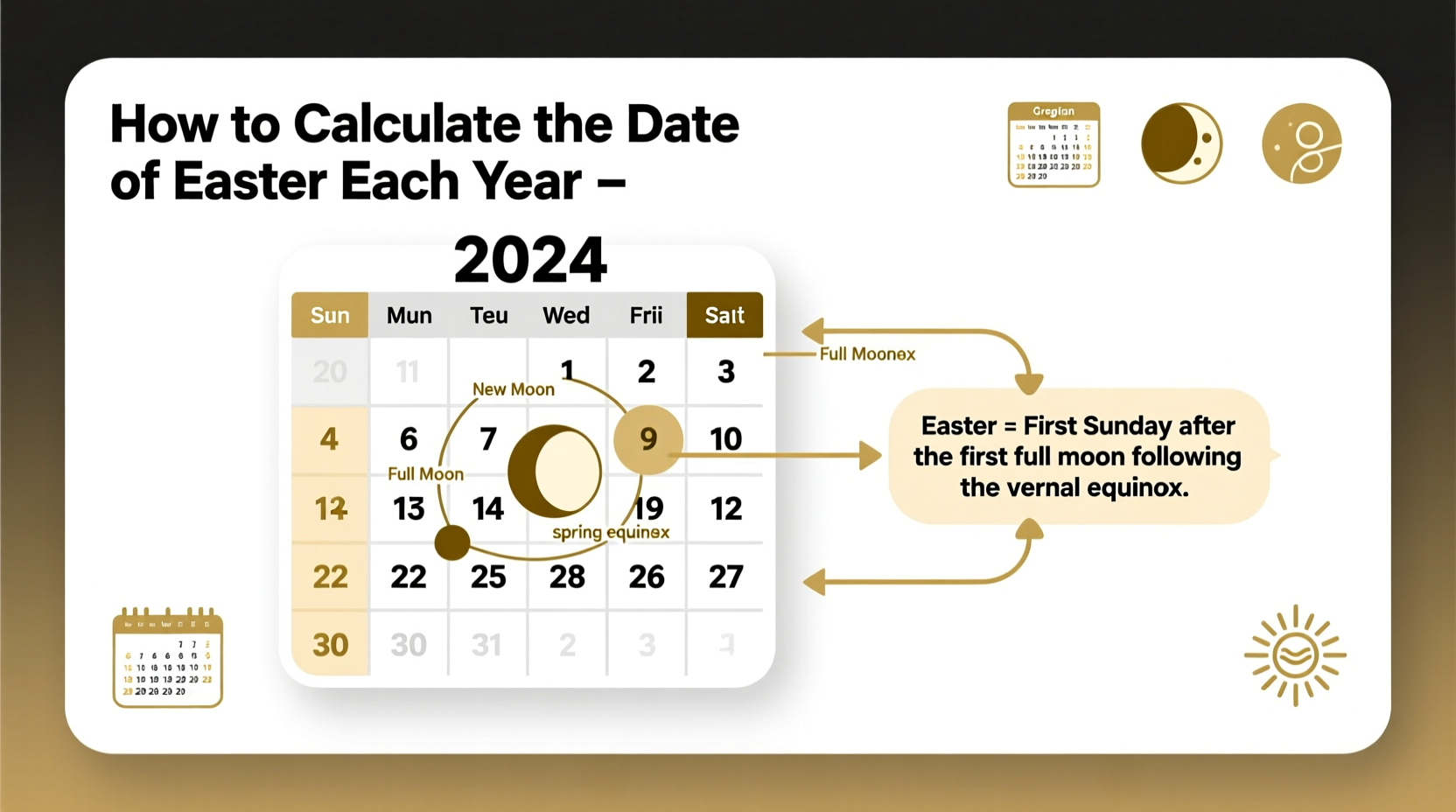
The date of Easter is determined by a unique combination of astronomical and ecclesiastical rules: it falls on the first Sunday after the first full moon following the vernal (spring) equinox in the Northern Hemisphere. This method of how to pick Easter date ensures that the holiday occurs between March 22 and April 25 each year, aligning with historical Christian traditions tied to the Jewish Passover and lunar cycles. Because this calculation relies on both solar and lunar observations—and not a fixed calendar date—Easter is considered a moveable feast, meaning its timing shifts annually. Understanding how to pick Easter date correctly involves knowledge of the ecclesiastical full moon, the established date of the equinox (fixed at March 21 for liturgical purposes), and the consistent observance of Sunday as the Lord’s Day.
Why Does Easter’s Date Change Every Year?
Unlike fixed holidays such as Christmas (December 25), Easter does not occur on the same date each year. The reason lies in its deep historical and theological roots. Easter commemorates the resurrection of Jesus Christ, which according to the Gospels occurred after the Jewish festival of Passover. Since Passover is itself based on the Hebrew lunar calendar—beginning on the 15th day of Nisan, which corresponds to a full moon in spring—early Church leaders sought to preserve this connection when standardizing the date of Easter.
In 325 CE, the First Council of Nicaea convened to unify Christian practice across the Roman Empire. One of its key decisions was establishing a uniform method for determining when Easter should be celebrated. They ruled that Easter would fall on the first Sunday after the first ecclesiastical full moon occurring on or after the ecclesiastical equinox, set permanently at March 21 regardless of the actual astronomical event. This system allows Easter to remain linked to the spring season and the symbolism of renewal, while avoiding direct dependence on the Hebrew calendar.
The Mathematical Rules Behind How to Pick Easter Date
To calculate Easter's date accurately, one must follow specific algorithmic steps rooted in medieval computus—the calculation of Easter. While modern calendars list Easter automatically, understanding the logic behind how to pick Easter date reveals the interplay between astronomy, theology, and calendar science.
- Determine the Vernal Equinox: For ecclesiastical purposes, the spring equinox is always assumed to occur on March 21, even if the astronomical equinox varies slightly from year to year (usually March 19–21).
- Identify the Ecclesiastical Full Moon: The Church uses a tabular approximation of lunar phases known as the 'ecclesiastical moon,' derived from the Metonic cycle—a 19-year pattern where lunar phases recur on the same dates. These tables assign a 'Paschal Full Moon' date for each year.
- Find the Following Sunday: Once the Paschal Full Moon is identified, Easter is set for the next Sunday. If the full moon falls on a Sunday, Easter is delayed by one week to ensure it follows the crucifixion-resurrection timeline (Christ died on Friday, rose on Sunday).
This process results in Easter falling anywhere from March 22 (if the full moon is on March 21 and the next day is Sunday) to April 25 (if the full moon occurs just after March 21 and the following Sunday is late).
Western vs. Eastern Christianity: Different Dates for Easter
One common point of confusion about how to pick Easter date is why Western and Eastern Orthodox churches often celebrate Easter on different days. The discrepancy arises from two main factors:
- Calendar Systems: Most Western Christian denominations (Catholic and Protestant) use the Gregorian calendar, introduced in 1582 to correct drift in the Julian calendar. Eastern Orthodox churches largely retain the older Julian calendar for liturgical purposes.
- Different Lunar Tables: Even when converting dates, Orthodox churches use distinct ecclesiastical moon calculations, leading to variations in the assigned Paschal Full Moon.
As a result, Orthodox Easter typically occurs later than Western Easter—sometimes by a week, five weeks, or even coinciding in rare years. For example, in 2025, Western Easter falls on April 20, while Orthodox Easter will be celebrated on April 20 as well due to alignment of the calendars. In contrast, in 2026, Western Easter is April 5, but Orthodox Easter falls on April 12.
| Year | Western Easter Date | Orthodox Easter Date |
|---|---|---|
| 2024 | March 31 | May 5 |
| 2025 | April 20 | April 20 |
| 2026 | April 5 | April 12 |
| 2027 | March 28 | April 4 |
| 2028 | April 16 | April 16 |
Practical Tips for Predicting Future Easter Dates
If you're planning events, travel, or religious observances, knowing how to pick Easter date in advance can help. Here are several practical methods:
- Use Online Calculators: Numerous websites offer Easter date calculators that apply the official algorithms. Simply input the year, and they return both Western and Orthodox dates.
- Consult Liturgical Calendars: Churches and dioceses publish annual liturgical calendars showing all holy days, including Easter and related feasts like Ash Wednesday and Pentecost.
- Memorize Key Patterns: Easter recurs on similar dates every 19 years (Metonic cycle). While not exact due to calendar adjustments, this pattern helps estimate future dates.
- Check Government or School Holiday Schedules: Many countries declare Easter Monday a public holiday. National calendars often list these dates years in advance.
Common Misconceptions About How to Pick Easter Date
Despite its long-standing rules, several myths persist about how Easter’s date is chosen:
- Myth: Easter is based on the actual full moon. Truth: It uses an ecclesiastical approximation, not real-time astronomical observation.
- Myth: All Christians celebrate Easter on the same day. Truth: Differences in calendars and lunar tables mean global observance varies significantly.
- Myth: The Pope decides Easter each year. Truth: No individual makes the decision; it follows pre-established mathematical rules accepted by most Christian traditions.
- Myth: Easter could fall in May. Truth: Under current rules, Easter cannot occur later than April 25 in the Gregorian calendar.
Regional Observances and Cultural Impact
While the method of how to pick Easter date is standardized within Christian traditions, cultural expressions vary widely around the world. Over 100 countries recognize Easter in some form, either as a religious observance or public holiday. Notable examples include:
- United States, Canada, Australia: Easter Sunday is widely observed with church services, family meals, and egg hunts. Many retailers hold special sales.
- Italy, Spain, Poland: Elaborate Holy Week processions take place, especially in Catholic-majority regions. Good Friday is a public holiday.
- Greece, Russia, Ukraine: Eastern Orthodox communities observe Easter with midnight liturgies, candlelight processions, and traditional foods like paska bread and dyed red eggs.
- Sweden, Finland: Unique customs blend Christian and folk traditions—children dress as 'Easter witches' and go door-to-door for candy.
Even non-religious populations participate in secular aspects like chocolate bunnies and decorated eggs, making Easter a significant commercial and cultural event globally.
Preparing for Easter: Religious and Secular Perspectives
Knowing how to pick Easter date also helps individuals and organizations prepare effectively. From a religious standpoint, Lent begins 46 days before Easter (40 fasting days plus six Sundays), so Ash Wednesday can be calculated once Easter is known. Churches plan special services, educational programs, and outreach initiatives accordingly.
From a retail and hospitality perspective, businesses anticipate increased demand for:
- Easter baskets, chocolates, and confectionery
- Spring clothing and home décor
- Travel and dining reservations (especially for Easter brunch)
Retailers often open on Easter Sunday in some countries (like the U.S.), though others (such as Germany and Ireland) enforce strict closures. Always verify local laws and store policies before planning shopping trips.
Will the Date of Easter Ever Be Fixed?
In recent decades, there have been proposals to establish a fixed date for Easter—such as the second Sunday in April—to simplify scheduling and promote unity among Christian denominations. The World Council of Churches has explored this possibility, particularly to resolve the East-West divide.
However, no agreement has been reached. Changing such a deeply rooted tradition requires consensus across Catholic, Orthodox, and Protestant bodies—an unlikely outcome given the symbolic importance of maintaining the link between Easter, the equinox, and the full moon. Therefore, the current method of how to pick Easter date is expected to continue indefinitely.
Frequently Asked Questions
- When is Easter in 2026?
Western Easter in 2026 falls on Sunday, April 5. Orthodox Easter is on April 12. - What determines the date of Easter each year?
Easter is set as the first Sunday after the first ecclesiastical full moon on or after March 21 (the ecclesiastical spring equinox). - Why do Catholic and Orthodox Easter dates differ?
They use different calendars (Gregorian vs. Julian) and separate lunar tables to determine the Paschal Full Moon. - Can Easter ever fall in March?
Yes. The earliest possible date is March 22. The most recent occurrence was in 1818; the next will be in 2285. - Is Easter Monday a public holiday everywhere?
No. It is observed in many countries (e.g., UK, Canada, Australia), but not in the United States or parts of Asia.




 浙公网安备
33010002000092号
 浙B2-20120091-4