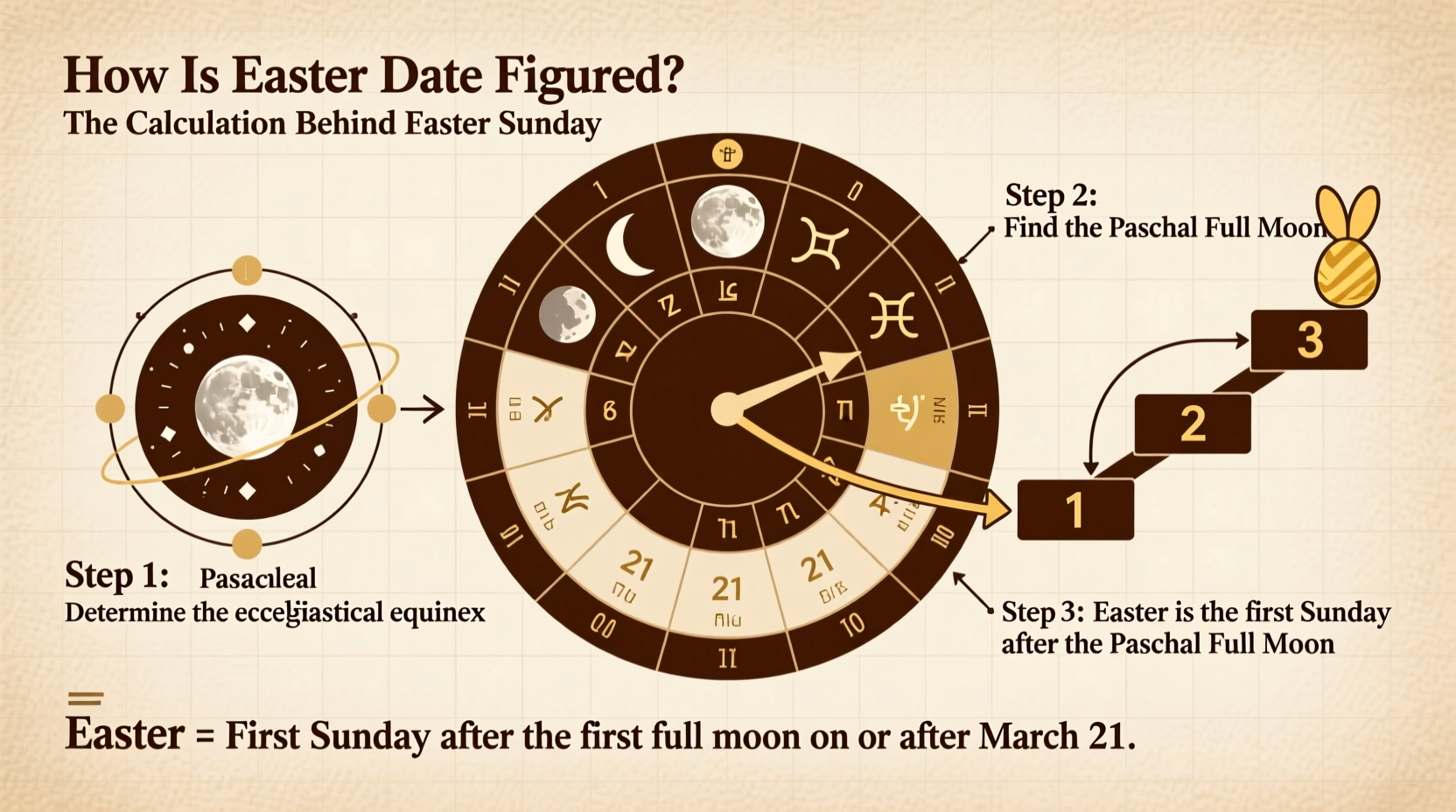
The date of Easter is figured using a calculation based on the first Sunday after the first full moon following the spring equinox, making how is Easter date figured a question rooted in both astronomy and ecclesiastical tradition. This method ensures that Easter always occurs between March 22 and April 25 in the Gregorian calendar used by most Western Christian churches. Unlike fixed holidays such as Christmas, Easter is a moveable feast, meaning its date shifts annually based on lunar cycles and historical church agreements established centuries ago.
Why Does Easter’s Date Change Every Year?
Easter's changing date stems from its foundation in the lunar calendar rather than the solar calendar used for most civil purposes. The holiday commemorates the resurrection of Jesus Christ, which according to the New Testament, occurred after the Jewish festival of Passover. Since Passover is timed with the first full moon after the vernal (spring) equinox, early Christian leaders decided to align Easter with this astronomical event.
The rule formalized at the First Council of Nicaea in 325 AD states: Easter shall be celebrated on the first Sunday after the first full moon occurring on or after the vernal equinox. If the full moon falls on a Sunday, Easter is delayed by one week to ensure it follows the lunar cycle properly. This system ties Easter not just to the solar year but also to lunar phases—making how Easter date is determined unique among major holidays.
The Role of the Vernal Equinox and Ecclesiastical Full Moon
To standardize calculations across different regions and time zones, the Church uses fixed approximations rather than actual astronomical observations. For the purpose of determining Easter:
- The vernal equinox is set as March 21, regardless of the precise astronomical occurrence.
- The “ecclesiastical full moon” is calculated using predetermined tables known as the Ecclesiastical Moon or Metonic Cycle, which approximates the lunar phase over a 19-year period.
This means that even if a real full moon appears earlier or later due to geographic location or atmospheric conditions, the official date used for Easter remains consistent worldwide within each denomination. Thus, understanding how is the date of Easter figured involves recognizing these ecclesiastical conventions rather than relying solely on skywatching.
Differences Between Western and Eastern Orthodox Easter Dates
One common source of confusion around how Easter’s date is figured lies in the discrepancy between Western Christianity (Catholic and Protestant) and Eastern Orthodox traditions. While both follow similar principles, they use different calendars:
- Western Churches: Use the Gregorian calendar, introduced by Pope Gregory XIII in 1582 to correct drift in the Julian calendar.
- Eastern Orthodox Churches: Continue using the older Julian calendar for liturgical purposes, which currently runs 13 days behind the Gregorian calendar.
As a result, Orthodox Easter often occurs later than Western Easter—sometimes by several weeks. In some years, the two Easters coincide (e.g., 2025), while in others, like 2024, Orthodox Easter fell on May 5 compared to the Western date of March 31.
| Year | Western Easter | Orthodox Easter |
|---|---|---|
| 2024 | March 31 | May 5 |
| 2025 | April 20 | April 20 |
| 2026 | April 5 | April 12 |
| 2027 | March 28 | May 2 |
| 2028 | April 16 | April 16 |
Step-by-Step: How Is the Easter Date Calculated?
While modern calendars list Easter automatically, you can understand how is Easter date figured through a simplified process:
- Determine the ecclesiastical vernal equinox: Always assumed to be March 21.
- Find the Paschal Full Moon: The first ecclesiastical full moon on or after March 21.
- Locate the following Sunday: That Sunday becomes Easter Sunday.
For example, in 2026:
- March 21 is the ecclesiastical equinox.
- The next ecclesiastical full moon is April 4.
- The following Sunday is April 5—therefore, Easter 2026 falls on April 5.
Historical Development of the Easter Dating System
The current method for figuring Easter dates evolved over centuries. Before the Council of Nicaea, various Christian communities celebrated Easter on different dates, sometimes causing division. Some followed the Jewish calendar directly, celebrating on Nisan 14 (the day of Passover), while others insisted on holding it on a Sunday.
The Council sought unity by decoupling Easter from the Hebrew calendar while preserving its seasonal alignment. It delegated the responsibility of calculating the date to the Church of Alexandria, renowned for its expertise in astronomy. Over time, tables were developed—most notably the Alexandrian computus—which allowed priests across Europe to determine Easter without advanced tools.
In the 6th century, Dionysius Exiguus refined the system further, introducing the Anno Domini dating system still used today. Later, during the Gregorian reform of 1582, adjustments were made to keep the equinox stable and prevent future drift, ensuring that how the Easter date is figured would remain accurate for centuries.
Modern Tools and Algorithms for Determining Easter
Today, most people rely on printed calendars or digital devices to know when Easter falls. However, mathematicians and programmers have created algorithms to compute Easter automatically. One well-known formula is the Anonymous Gregorian algorithm, which uses arithmetic operations to calculate the month and day of Easter for any given year.
These algorithms are embedded in software libraries, spreadsheets, and online calculators. They reflect centuries of refinement in answering the fundamental question: how is Easter date figured. For developers or educators interested in replicating the logic, open-source implementations exist in Python, JavaScript, and Excel formulas.
Regional Variations and Public Observances
While the method for figuring Easter is standardized within denominations, public observance varies widely by country. Understanding how Easter date is figured helps travelers, businesses, and families plan accordingly.
In predominantly Christian nations such as the United States, Canada, Australia, Germany, and Brazil, Easter Sunday is a national holiday or widely observed non-working day. Many businesses close on Good Friday and Easter Monday (in countries where it's recognized). Retailers may adjust hours, especially around Easter egg sales and religious services.
Conversely, in non-Christian-majority countries like Japan, China, or India, Easter is not a public holiday, though churches and expatriate communities may hold services. Even so, global retail chains often market Easter-themed products internationally, reflecting cultural diffusion.
Common Misconceptions About How Easter’s Date Is Determined
Despite its long-standing rules, several myths persist about how Easter date is figured:
- Misconception 1: “Easter is always the second Sunday in April.”
Reality: Easter can fall as early as March 22 or as late as April 25. - Misconception 2: “The date depends on the actual full moon seen in your area.”
Reality: It uses an ecclesiastical approximation, not local observation. - Misconception 3: “All Christians celebrate Easter on the same day.”
Reality: Due to calendar differences, Eastern Orthodox churches often celebrate later.
Clarifying these points enhances understanding of why how is the Easter date figured matters beyond mere curiosity—it affects worship schedules, school breaks, travel plans, and commercial activity worldwide.
Planning Ahead: Future Easter Dates (2025–2030)
Knowing how Easter is calculated allows individuals and organizations to anticipate upcoming dates. Here’s a look ahead:
| Year | Western Easter Sunday | Orthodox Easter Sunday |
|---|---|---|
| 2025 | April 20 | April 20 |
| 2026 | April 5 | April 12 |
| 2027 | March 28 | May 2 |
| 2028 | April 16 | April 16 |
| 2029 | April 1 | April 8 |
| 2030 | March 31 | May 5 |
Families planning vacations, churches scheduling services, and retailers launching promotions can use this data to prepare well in advance. Remember that local practices may vary—always verify holiday closures or event times with official sources.
Practical Tips for Using Easter Date Knowledge
Understanding how is Easter date figured isn’t just academic—it has real-world applications:
- For travelers: Book accommodations early, especially in countries with large Easter processions (e.g., Spain, Italy, Philippines).
- For educators: Plan curriculum around religious studies or cultural history units leading up to Easter.
- For business owners: Launch seasonal marketing campaigns 4–6 weeks before Easter, particularly for confectionery, apparel, or greeting cards.
- For interfaith families: Coordinate celebrations respectfully, acknowledging differing traditions and dates.
Additionally, those involved in liturgical planning should consult official church publications or diocesan bulletins for exact service times and lectionary readings tied to the Easter cycle.
Conclusion: A Harmonized Yet Complex Tradition
The way how Easter date is figured blends science, theology, and historical compromise into a globally recognized rhythm. Though seemingly complex, the underlying principle—to honor the resurrection on the first Sunday after the spring full moon—remains clear and meaningful. Whether you're curious about 2026’s date (April 5), wondering why Orthodox Easter differs, or seeking to explain the pattern to children, knowing the mechanics behind Easter empowers better planning and deeper appreciation.
Frequently Asked Questions
- When is Easter 2026?
- Easter Sunday in 2026 falls on April 5 for Western Christian churches.
- Why do Catholic and Orthodox Easter dates differ?
- They use different calendars—Gregorian for Catholics, Julian for Orthodox—leading to different calculations of the equinox and full moon.
- Is there a formula to calculate Easter every year?
- Yes, mathematical algorithms like the Anonymous Gregorian method can compute Easter’s date for any year in the Gregorian calendar.
- Does Easter ever fall in March?
- Yes, Easter can occur as early as March 22, though it’s rare. The last time was in 1818; the next will be in 2285.
- Are Good Friday and Easter Monday public holidays?
- It depends on the country. In many Christian-majority nations, yes. In others, only Easter Sunday is observed.





 浙公网安备
33010002000092号
浙公网安备
33010002000092号 浙B2-20120091-4