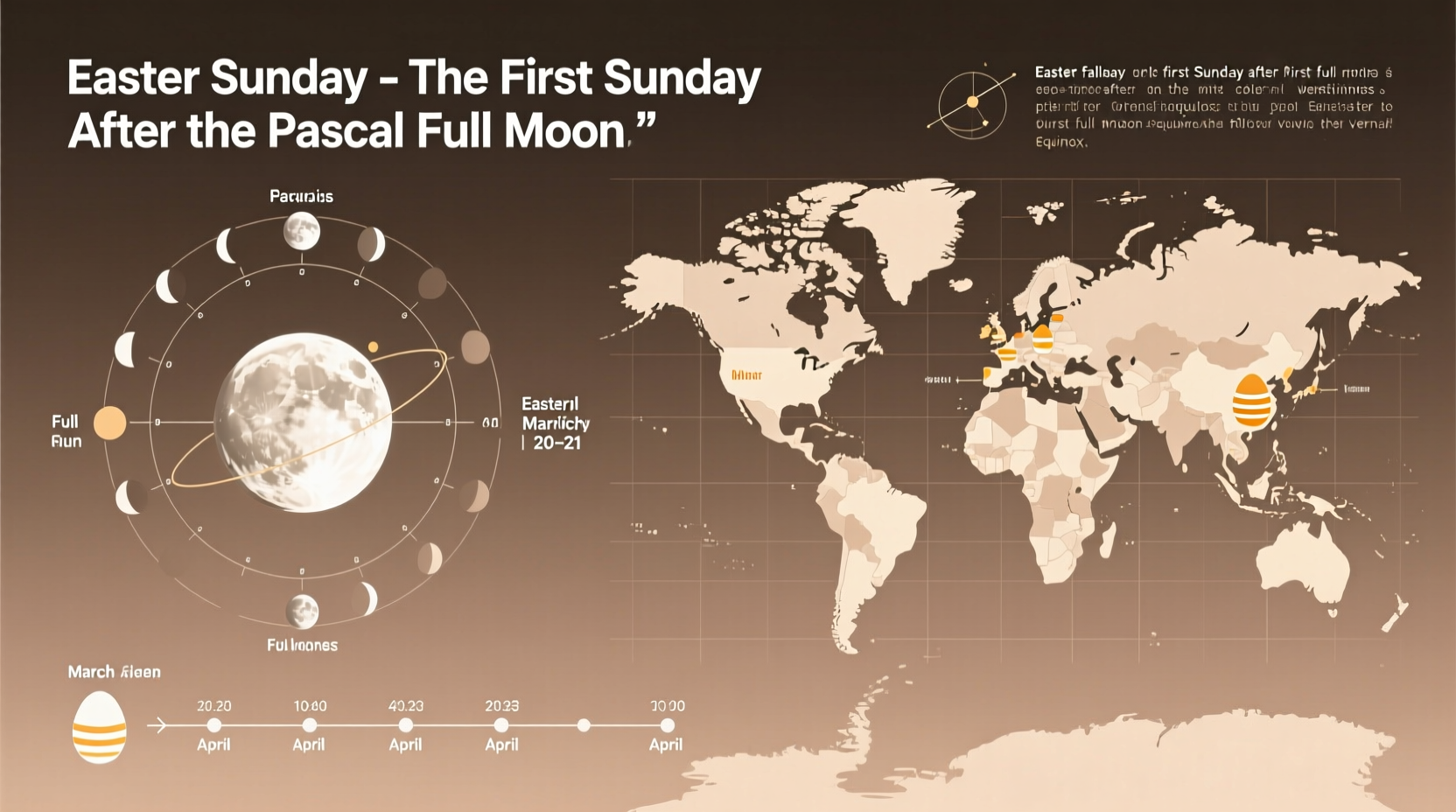
The date of Easter Sunday is determined by a unique combination of astronomical events and ecclesiastical rules, specifically tied to the first Sunday after the first full moon following the vernal (spring) equinox in the Northern Hemisphere. This method of calculating how does Easter day get determined has been used by most Western Christian churches for centuries and explains why Easter falls on a different date each year, typically between March 22 and April 25. The process blends lunar cycles with the solar calendar, rooted in historical efforts to align Easter with Jewish Passover while maintaining a consistent liturgical rhythm.
Why Does Easter’s Date Change Every Year?
Unlike fixed holidays such as Christmas (December 25), Easter is a moveable feast. Its date shifts annually because it is based on the lunar calendar rather than the Gregorian (solar) calendar used in daily life. The core rule is: Easter Sunday is the first Sunday after the Paschal Full Moon, which is the first full moon on or after the spring equinox (set at March 21 for calculation purposes).
This system ensures that Easter always occurs after the equinox, symbolizing renewal and light overcoming darkness. Because the lunar cycle lasts approximately 29.5 days and doesn’t align perfectly with the solar year, the timing of the full moon varies from year to year—thus shifting Easter’s date.
A Brief History Behind the Calculation of Easter
The method for determining Easter was formalized during the First Council of Nicaea in 325 CE. Before this, early Christian communities celebrated Easter on different dates, often influenced by the Jewish calendar and the timing of Passover. To unify observance across the growing Church, bishops agreed that Easter should be celebrated independently of the Hebrew calendar but still linked to its seasonal context.
They established that the Church would use its own calculations—based on the Julian calendar at the time—to determine the “ecclesiastical full moon” and the equinox. Even after the Gregorian calendar reform in 1582, which corrected inaccuracies in the Julian system, many Western churches adopted the new calendar for civil purposes but retained specific tables for computing Easter.
Eastern Orthodox Churches, however, continue to use the Julian calendar for liturgical calculations, which is why their Easter often falls later than the Western celebration. For example, in 2024, Western Easter was on March 31, while Orthodox Easter occurred on May 5.
The Mathematical Rules Behind Easter’s Date
While the concept seems simple—first Sunday after the first full moon post-equinox—the actual computation involves complex algorithms. Astronomers and theologians developed formulas to predict these dates far in advance. One widely used method is the Computus, a set of ecclesiastical rules codified over centuries.
Here’s a simplified breakdown:
- The ecclesiastical spring equinox is fixed on March 21, regardless of the actual astronomical event.
- The Paschal Full Moon is not necessarily the same as the astronomical full moon; it's based on pre-calculated tables known as the Ecclesiastical Full Moon dates.
- If the Paschal Full Moon falls on a Sunday, Easter is the following Sunday.
- Easter cannot occur before March 22 or after April 25 in the Western tradition.
For instance, in 2026, the first full moon after March 21 occurs on April 7 (Tuesday). The next Sunday, April 12, becomes Easter Sunday. In contrast, in 2025, the full moon falls on April 13 (Saturday), so Easter is observed the next day, April 14.
Western vs. Eastern Easter: Why the Difference?
One of the most common questions related to how does Easter day get determined is why there are two Easters. The divergence stems from differing calendars and computational traditions:
| Aspect | Western Christianity (Catholic/Protestant) | Eastern Orthodoxy |
|---|---|---|
| Calendar Used | Gregorian Calendar | Julian Calendar |
| Equinox Date | March 21 (Gregorian) | March 21 (Julian), equivalent to April 3 Gregorian |
| Full Moon Reference | Ecclesiastical tables aligned with Gregorian reform | Older Alexandrian tables based on Julian calendar |
| Earliest Possible Easter | March 22 | April 4 (Gregorian) |
| Latest Possible Easter | April 25 | May 8 (Gregorian) |
These differences mean that Eastern and Western Easters coincide only when the lunar and calendar alignments overlap—which happens occasionally, such as in 2028 when both will celebrate on April 16.
Common Misconceptions About How Easter Is Set
Several myths persist about how Easter’s date is chosen:
- Myth: Easter is based on the actual astronomical full moon.
Fact: It uses an approximate “ecclesiastical” full moon derived from mathematical tables, not real-time observation. - Myth: All Christians celebrate Easter on the same day.
Fact: Due to calendar differences, millions observe Easter on different Sundays. - Myth: The Pope decides Easter each year.
Fact: No individual sets the date; it follows predetermined rules and calculations accepted by each denomination.
When Is Easter in Upcoming Years?
Knowing how does Easter day get determined helps anticipate future dates. Here are the upcoming Western Easter Sundays:
| Year | Easter Sunday (Western) | Easter Sunday (Orthodox) |
|---|---|---|
| 2025 | April 20 | April 20 |
| 2026 | April 5 | April 12 |
| 2027 | March 28 | May 2 |
| 2028 | April 16 | April 16 |
| 2029 | April 1 | April 8 |
Note that in 2025 and 2028, both traditions align—a rare occurrence due to converging lunar and calendar cycles.
How to Verify Easter Dates for Your Location
If you're planning travel, church services, school breaks, or retail operations around Easter, it's wise to confirm local practices. While national calendars usually list Easter, some regions may have variations in public holiday observance. For example:
- In the United States, Easter Sunday is not a federal holiday, but many businesses close or operate on reduced hours.
- In Australia and New Zealand, Easter Monday is a public holiday; check state-specific schedules.
- In predominantly Catholic countries like Italy, Spain, and the Philippines, Holy Week processions and Good Friday are major observances, with widespread closures.
To verify exact dates and customs:
- Consult official church websites (e.g., Vatican, Orthodox Patriarchates).
- Check government holiday calendars for your country.
- Review retailer or transportation service announcements closer to the date.
Cultural and Commercial Impact of Easter’s Changing Date
The variability of Easter affects more than religious observance—it influences commerce, education, and tourism. Retailers plan sales campaigns around Easter baskets, chocolate, clothing, and home goods. Because Easter can fall as early as late March or as late as late April, marketing timelines must be flexible.
Schools often schedule spring breaks around Easter, especially in Europe and Latin America. In the UK, Easter holidays typically begin two weeks before Easter Sunday, meaning the break shifts annually. Similarly, airlines and hotels see demand spikes depending on whether Easter lands near other holidays or weekends.
Understanding how does Easter day get determined allows organizations to forecast more accurately and adapt to annual fluctuations.
Fun Facts About Easter Dating
- The earliest possible Easter in the Gregorian system is March 22; this last occurred in 1818 and won’t happen again until 2285.
- The latest possible Easter is April 25; the most recent was in 1943, and the next will be in 2038.
- Over a 500-year span (1600–2099), Easter most frequently falls on April 19.
- There is no Easter on March 21—even if the full moon falls on March 20—because the equinox is considered March 21, and Easter must come after.
Conclusion: A Unique Blend of Astronomy, Theology, and Tradition
The way how does Easter day get determined reflects a fascinating intersection of science, faith, and history. By anchoring the holiday to the rhythms of the moon and sun, the Church preserves ancient symbolism of resurrection and rebirth. While modern society runs on precise atomic clocks and digital calendars, Easter remains one of the few holidays governed by celestial patterns and centuries-old rules.
Whether you observe Easter for religious reasons or simply enjoy the cultural traditions—egg hunts, family meals, spring fashion—understanding its variable date enriches appreciation for its deeper significance. And now that you know how the calculation works, you can predict future Easters with confidence—or even impress friends with your knowledge of ecclesiastical astronomy!
Frequently Asked Questions
Q: What determines the date of Easter each year?
A: Easter is set as the first Sunday after the first ecclesiastical full moon on or after March 21 (the spring equinox), resulting in a date between March 22 and April 25.
Q: Why is Easter sometimes in March and sometimes in April?
A: Because it depends on the lunar cycle relative to the spring equinox, Easter can fall in late March if the full moon occurs early enough.
Q: Do all Christians celebrate Easter on the same day?
A: No. Western churches (Catholic, Protestant) use the Gregorian calendar, while most Eastern Orthodox churches use the Julian calendar, leading to different dates in most years.
Q: Is Easter always after Passover?
A: Not always. While historically linked, the ecclesiastical calculation of Easter doesn’t require it to follow Passover; sometimes it precedes or overlaps with it.
Q: Can I calculate Easter’s date myself?
A: Yes, using algorithms like the Gauss Easter formula or online calculators based on the Computus method, though most people rely on published liturgical calendars.




 浙公网安备
33010002000092号
 浙B2-20120091-4