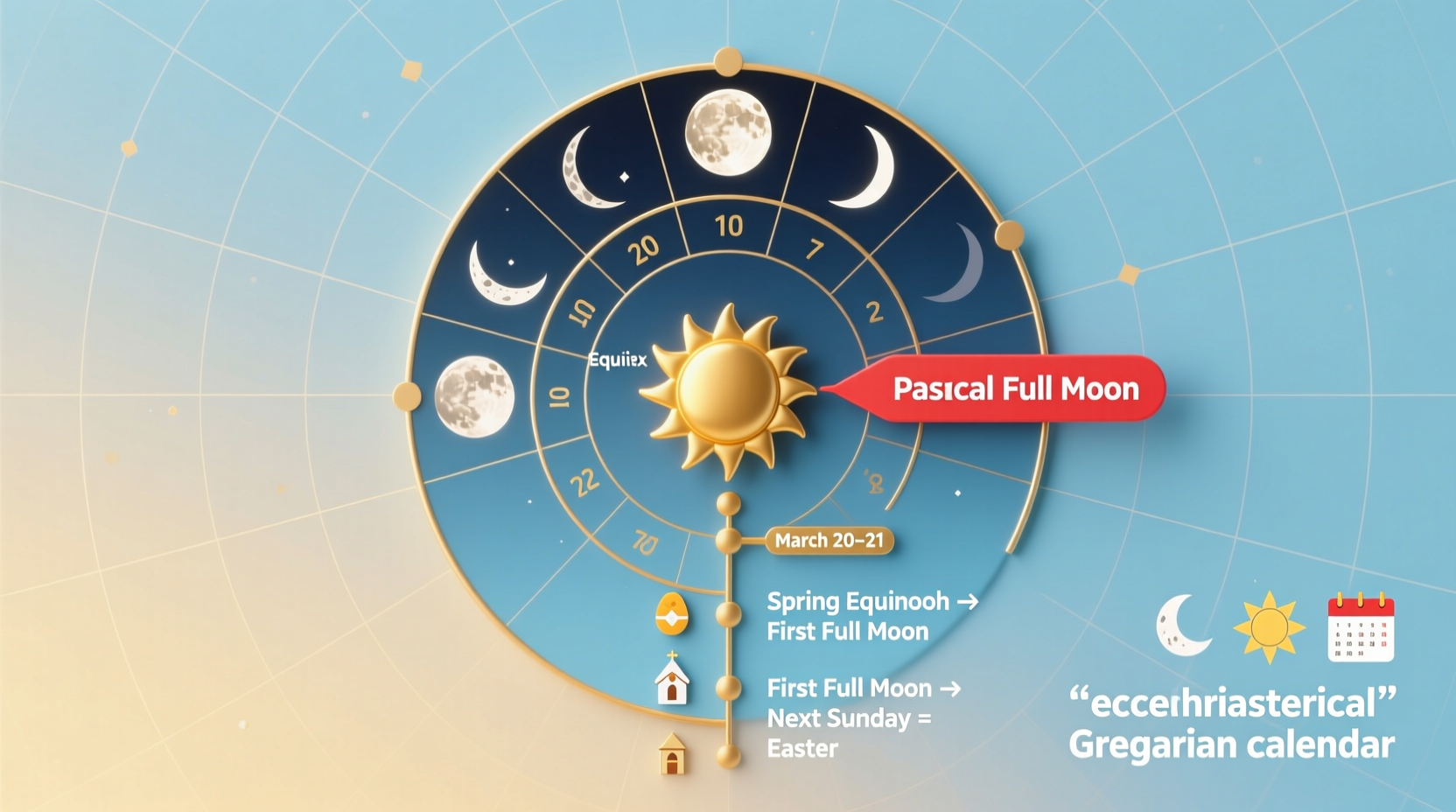
The date of Easter is determined by a calculation based on the first Sunday after the first full moon following the spring equinox, making how does Easter date get picked a question rooted in both astronomy and ecclesiastical tradition. This method ensures that Easter always falls between March 22 and April 25 in the Gregorian calendar used by most Western Christian churches. The process involves aligning the lunar cycle with the solar calendar, specifically targeting the ecclesiastical approximation of the vernal (spring) equinox on March 21. Because of this unique combination of solar and lunar measurements, the exact timing of Easter shifts each year, unlike fixed-date holidays such as Christmas.
Why Does Easter’s Date Change Every Year?
Unlike holidays that occur on a specific calendar date, Easter is a moveable feast. Its variability stems from its historical and theological connection to the Jewish festival of Passover, which itself is timed according to the Hebrew lunar calendar. Early Christians sought to commemorate Jesus Christ’s resurrection in relation to Passover, since the Gospels place the crucifixion and resurrection immediately after Passover. However, different Christian communities developed varying methods for calculating the correct Sunday, leading to disputes that were partially resolved at the Council of Nicaea in 325 CE.
At Nicaea, church leaders agreed that Easter should be celebrated on the first Sunday after the first full moon occurring on or after the vernal equinox. To standardize the calculation, they established March 21 as the fixed date for the equinox, regardless of astronomical variations. This decision decoupled the calculation from actual celestial observations and instead relied on ecclesiastical tables—essentially a set of predictable rules known as the computus.
The Role of the Lunar Calendar in Determining Easter
The moon plays a central role in determining when Easter occurs. Specifically, the ‘ecclesiastical full moon’—not necessarily the same as the astronomical full moon—is used in the calculation. Church authorities use a system called the Metonic cycle, a 19-year pattern that approximates the relationship between the solar year and the phases of the moon. Based on this cycle, a table of dates called the 'Ecclesiastical Full Moon Dates' was created, allowing churches to predict Easter decades in advance without needing real-time astronomical data.
For example, if the ecclesiastical full moon falls on March 20, Easter will be the following Sunday. But if the full moon occurs on March 21, then Easter will be the next Sunday unless that Sunday is March 22, in which case Easter would fall on March 29. This complex interplay explains why people often ask, how does Easter date get picked, especially when trying to plan religious observances, school breaks, or retail promotions tied to the holiday.
Differences Between Western and Eastern Easter Dates
One major source of confusion around how Easter's date is chosen lies in the difference between Western Christianity (Roman Catholic and Protestant) and Eastern Orthodox Christianity. While both follow the rule of the first Sunday after the full moon following the spring equinox, they use different calendars and lunar calculations.
Western churches use the Gregorian calendar, introduced by Pope Gregory XIII in 1582 to correct drift in the Julian calendar. Most Eastern Orthodox churches, however, continue to use the older Julian calendar for liturgical purposes. Since the Julian calendar is currently 13 days behind the Gregorian, the equinox is considered to occur on April 3 in the modern civil calendar. Additionally, Orthodox churches require that Easter must come after the Jewish Passover, adding another layer of complexity.
As a result, Eastern Orthodox Easter often falls one to five weeks later than Western Easter. In some years, the dates coincide—for instance, in 2025, both East and West will celebrate Easter on April 20. But in 2026, Western Easter falls on March 29, while Orthodox Easter occurs on April 5. This divergence underscores the importance of understanding regional and denominational differences when answering questions like how is Easter’s date decided.
A Historical Overview: From Passover to the Council of Nicaea
The origins of Easter’s dating go back to the earliest centuries of Christianity. Initially, some Christian communities celebrated Easter on the same day as Passover (the 14th of Nisan in the Hebrew calendar), regardless of the day of the week. These groups were known as Quartodecimans (from the Latin for “fourteenth”). Others insisted that Easter must always be on a Sunday, emphasizing the resurrection rather than the crucifixion.
This disagreement led to significant debate within the early Church. The Council of Nicaea in 325 aimed to unify Christian practice and affirm core doctrines, including the nature of Christ. Part of its resolution included establishing an independent method for calculating Easter so that all churches would celebrate it on the same day—and separate from Jewish Passover observances. The council did not specify the exact computational method but affirmed the principle: Easter is the first Sunday after the first ecclesiastical full moon on or after March 21.
Over time, various regions adopted slightly different systems until the Roman method became dominant in Western Europe. By the 6th century, Dionysius Exiguus developed a comprehensive Easter table based on the Alexandrian method, which influenced medieval computistics. Later, the Gregorian reform refined these calculations further to maintain alignment with the solar year.
Modern Methods and Predictability
Today, the date of Easter can be predicted centuries in advance thanks to standardized algorithms. Mathematicians and astronomers have developed formulas—such as the Gauss algorithm—that compute Easter’s date using modular arithmetic. These tools are widely used by almanacs, liturgical planners, and government agencies setting public holidays.
For practical purposes, knowing how Easter’s date gets picked helps institutions plan accordingly. Schools schedule spring breaks around Easter. Retailers prepare for increased demand for chocolate, eggs, and seasonal clothing. Churches organize special services, baptisms, and community events. Governments declare public holidays in many countries—including the UK, Australia, Canada, and several Latin American nations—based on the calculated Easter Sunday.
| Year | Western Easter | Orthodox Easter |
|---|---|---|
| 2024 | March 31 | May 5 |
| 2025 | April 20 | April 20 |
| 2026 | March 29 | April 5 |
| 2027 | March 28 | April 11 |
| 2028 | April 16 | April 16 |
Common Misconceptions About How Easter Is Dated
Several myths persist about how Easter’s date is determined. One common misconception is that Easter is based solely on the actual astronomical full moon and equinox. In reality, the church uses fixed tables and approximations, meaning the ecclesiastical full moon may differ from what is observed in the sky.
Another misunderstanding is that Easter could fall in May. Under current rules, this is impossible; the latest possible date is April 25. Some also believe that all Christians celebrate Easter on the same day, ignoring the split between Gregorian and Julian calendar users.
Additionally, there have been proposals to fix Easter’s date—such as setting it on the second Sunday in April—to eliminate annual variation. While discussed by ecumenical bodies, no consensus has been reached, largely due to resistance from Orthodox churches and concerns about breaking centuries-old traditions.
How to Find Easter Dates for Future Years
If you’re planning travel, worship schedules, or business operations, it’s essential to verify Easter dates well in advance. Reliable sources include:
- Official church websites (e.g., Vatican, Anglican Communion)
- National almanacs and meteorological services
- Liturgical calendars published by religious organizations
- Government sites listing public holidays
Be sure to check whether your region observes Western or Eastern Easter, particularly in multicultural or multinational contexts. For example, in Greece, Cyprus, Russia, and Serbia, Orthodox Easter is a national holiday, while in Germany or France, the Western date prevails.
Regional Variations and Cultural Observances
The way Easter is celebrated varies significantly around the world, partly influenced by the date on which it is observed. In predominantly Catholic countries like Italy and Spain, Holy Week processions begin days before Easter Sunday. In Eastern Europe, richly decorated eggs (pysanky) and special breads (paska) are prepared during the week leading up to Orthodox Easter.
In contrast, secular traditions like the Easter Bunny and egg hunts—popularized in parts of North America and Northern Europe—are typically tied to the Western date, even in areas with Orthodox populations. Retailers in countries like the United States base their marketing campaigns on the Western Easter, potentially overlooking minority communities that observe a different date.
This highlights the need for cultural sensitivity and accurate information when addressing topics like how is the Easter date calculated, particularly in global communications, education, or event planning.
Frequently Asked Questions
- Why doesn’t Easter have a fixed date?
- Easter’s date is based on the lunar cycle and the spring equinox to maintain its link to Passover and early Christian traditions. A fixed date would break this historical and theological connection.
- What is the earliest and latest possible date for Easter?
- The earliest possible date is March 22, and the latest is April 25, based on the ecclesiastical rules adopted by the Western Church.
- Do all Christian denominations celebrate Easter on the same day?
- No. Most Western churches (Catholic, Protestant) use the Gregorian calendar, while many Eastern Orthodox churches use the Julian calendar, resulting in different dates in most years.
- Is there a formula to calculate Easter’s date?
- Yes, mathematicians like Carl Friedrich Gauss developed algorithms to compute Easter’s date for any given year using modular arithmetic.
- Has there been talk about changing how Easter is dated?
- Yes, ecumenical discussions have proposed fixing Easter on a permanent Sunday (e.g., second Sunday in April), but agreement remains elusive due to theological and traditional differences.
In conclusion, understanding how does Easter date get picked reveals a fascinating blend of science, religion, history, and cultural diversity. Whether you're curious about the mechanics behind the holiday or need to know when it falls for personal or professional reasons, recognizing the underlying principles ensures greater clarity and appreciation for one of Christianity’s most important feasts.





 浙公网安备
33010002000092号
浙公网安备
33010002000092号 浙B2-20120091-4