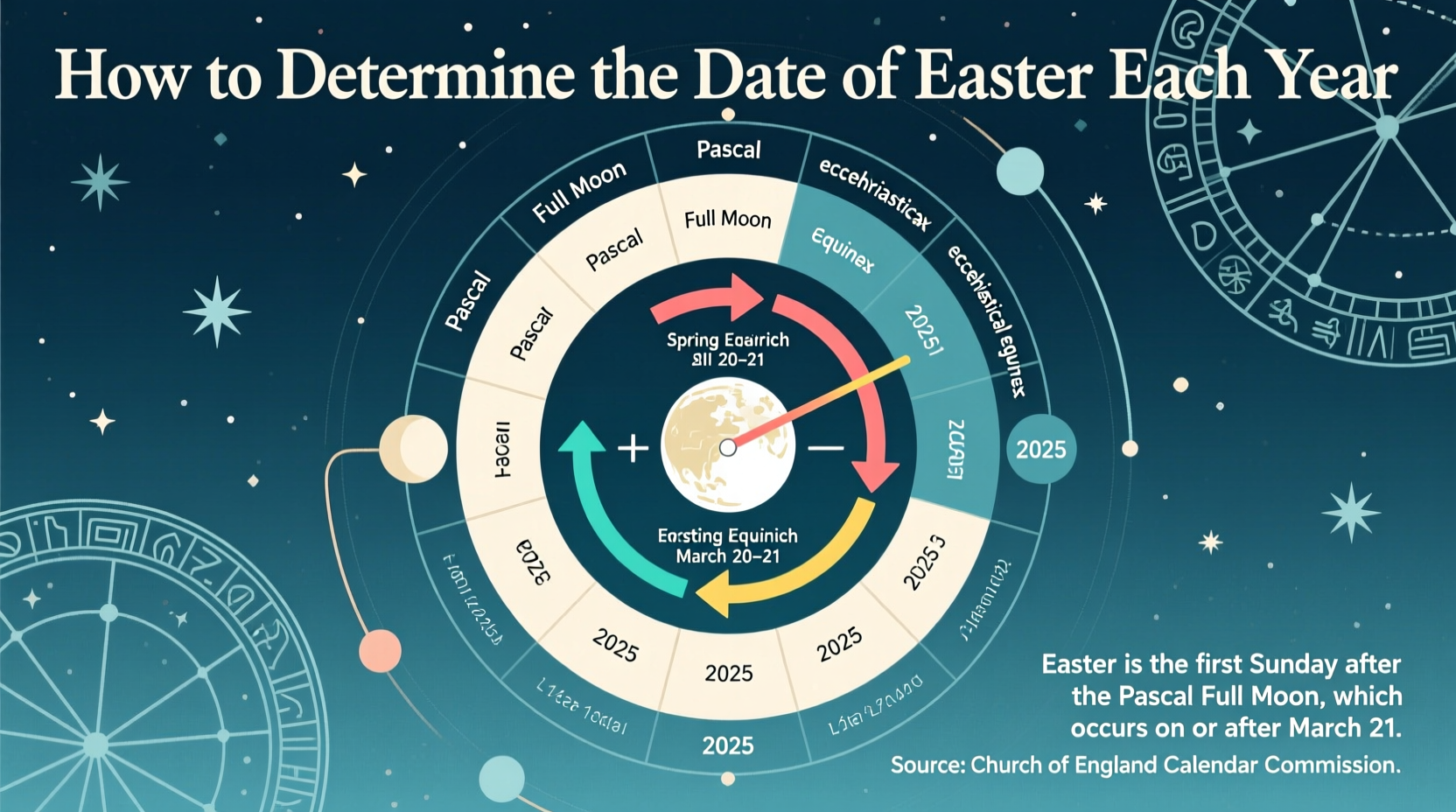
The date of Easter is determined by a unique combination of lunar cycles and the Gregorian calendar, specifically falling on the first Sunday after the first full moon following the spring equinox—this method to how do you determine Easter has been used for centuries by Christian churches worldwide. Because this calculation relies on astronomical events and ecclesiastical conventions rather than fixed dates, Easter can occur as early as March 22 or as late as April 25 in the Western (Gregorian) calendar. Understanding how to determine Easter involves exploring historical traditions, religious doctrine, and subtle differences between Eastern and Western Christianity.
Understanding the Astronomical and Ecclesiastical Rules Behind Easter
To fully grasp how to determine Easter, one must consider both astronomy and church tradition. The most widely accepted rule—used by most Western Christian denominations—is that Easter falls on the first Sunday after the Paschal Full Moon. But this isn’t an actual observed moon; it’s a calculated 'ecclesiastical' full moon based on tables established by the First Council of Nicaea in 325 AD.
The spring equinox is fixed at March 21 in these calculations, regardless of the actual astronomical equinox, which can vary slightly each year. So, when determining Easter:
- Find the ecclesiastical spring equinox: March 21
- Determine the next ecclesiastical full moon (the Paschal Full Moon)
- Select the first Sunday after that date
This system ensures consistency across years and regions, even if it doesn't always align perfectly with real-time lunar observations. For example, in 2026, the Paschal Full Moon falls on Saturday, April 4. Therefore, Easter Sunday will be April 5—the following Sunday.
Why Does the Date of Easter Change Every Year?
Unlike holidays such as Christmas (December 25), which follow the solar calendar, Easter follows a lunisolar calendar—a hybrid system combining lunar phases with the solar year. This blending reflects its roots in both Jewish Passover (which also uses a lunisolar calendar) and early Christian efforts to maintain symbolic continuity.
The variability stems from three key factors:
- Lunar Cycles: A lunar month is about 29.5 days, so 12 lunar months total roughly 354 days—11 days shorter than the solar year. To keep festivals aligned with seasons, leap months were historically added. While Christianity no longer adds leap months, it still references lunar cycles when calculating Easter.
- Sunday Observance: Early Christians decided that Christ’s resurrection should be celebrated on a Sunday, reinforcing the weekly cycle of worship. Thus, Easter must fall on a Sunday, not on a fixed day like other feasts.
- Ecclesiastical Standardization: Rather than relying on local moon sightings, the Church adopted mathematical tables to standardize the process globally. This avoids discrepancies between regions and allows liturgical calendars to be printed years in advance.
These elements together explain why answering how do you determine Easter requires more than just checking a calendar—it involves understanding historical theology and computational astronomy.
Differences Between Western and Eastern Easter Dates
One common point of confusion arises from the fact that many Orthodox Christians celebrate Easter on a different date than Catholics and Protestants. This discrepancy occurs because Eastern Orthodox churches use the older Julian calendar for their liturgical computations, while Western churches use the modern Gregorian calendar.
The Julian calendar is currently 13 days behind the Gregorian calendar, and its method for calculating the Paschal Full Moon differs slightly. Additionally, Orthodox tradition requires that Easter must come after the Jewish Passover, adding another layer of complexity.
For instance, in 2025:
- Western Easter: April 20
- Eastern (Orthodox) Easter: April 20 (coincidentally the same date)
- Western Easter: April 5
- Eastern Easter: May 3
| Year | Western Easter | Eastern (Orthodox) Easter | Reason for Difference |
|---|---|---|---|
| 2024 | March 31 | May 5 | Julian vs. Gregorian calendar; different full moon tables |
| 2025 | April 20 | April 20 | Rare alignment due to overlapping calculations |
| 2026 | April 5 | May 3 | Full moon after March 21 differs between systems |
| 2027 | March 28 | April 25 | Significant gap due to calendar drift |
Historical Development: How the Method to Determine Easter Was Established
The question of how to determine Easter was not always settled. In the early centuries of Christianity, different communities celebrated Easter on varying dates, sometimes causing division. Some churches in Asia Minor followed the Quartodeciman practice—celebrating Easter on the 14th day of Nisan (the date of Passover), regardless of the day of the week.
To resolve this, Emperor Constantine convened the Council of Nicaea in 325 AD. One of its major decisions was to establish a uniform date for Easter: the first Sunday after the first full moon following the vernal equinox. The goal was unity across Christendom and independence from the Jewish calendar.
Over time, the Roman Church developed detailed tables known as the Dionysian computus, named after Dionysius Exiguus, who helped refine the method in the 6th century. These tables allowed monks and clergy to predict Easter decades in advance. Eventually, this became the foundation for the Gregorian reform of the calendar in 1582, introduced by Pope Gregory XIII to correct drift in the equinox date.
Practical Tools: How You Can Calculate Easter Yourself
While most people today rely on published calendars or digital tools, it’s possible to calculate Easter manually using algorithms. One well-known method is the Anonymous Gregorian algorithm, which works for years between 1900 and 2099.
Here’s a simplified version:
- Divide the year by 19 → get remainder a
- Divide the year by 100 → get quotient b and remainder c
- Divide b by 4 → get quotient d and remainder e
- Divide (8*b + 13) by 25 → get quotient f
- Divide (19*a + b - d - f + 15) by 30 → get remainder g
- Divide (a + 11*g) by 319 → get quotient h
- Divide c by 4 → get quotient i and remainder k
- Divide (2*e + 2*i - k - g + h + 32) by 7 → get remainder m
- Divide (g - h + m + 90) by 25 → get month
- Divide (g - h + m + 120) by 365 → get day
Using this formula for 2026 gives April 5—demonstrating how mathematical precision underlies the answer to how do you determine Easter.
Common Misconceptions About Determining Easter
Despite its long-standing rules, several myths persist about how Easter’s date is set:
- Misconception 1: "Easter is based on the actual full moon."
Reality: It uses a theoretical, ecclesiastical full moon—not necessarily visible in your location. - Misconception 2: "All Christians celebrate Easter on the same day."
Reality: Due to calendar differences, Orthodox and Western churches often observe Easter weeks apart. - Misconception 3: "Easter could fall in May."
Reality: In the Gregorian system, Easter cannot fall later than April 25. However, under the Julian calendar, Orthodox Easter may appear in May on the Gregorian calendar. - Misconception 4: "The equinox used is the exact astronomical event."
Reality: The Church fixes the equinox at March 21, even if the true equinox occurs on March 19 or 20.
Modern Implications: Why Knowing How to Determine Easter Matters
Understanding how to determine Easter affects more than religious observance. It influences school holidays, retail planning, travel schedules, and public services in many countries. For example:
- In Australia and the UK, banks and government offices close for Good Friday and Easter Monday.
- In the U.S., while only Good Friday is a state holiday in some areas, many businesses adjust hours around Easter weekend.
- Retailers plan major sales campaigns (e.g., Easter egg promotions) based on the variable date.
Because Easter shifts annually, organizations must update their calendars each year. Educational institutions often release academic breaks contingent on Easter’s timing. Therefore, being able to anticipate Easter’s date—even without performing complex calculations—is valuable for personal and professional planning.
How to Stay Updated on Future Easter Dates
You don’t need to perform manual calculations every year. Several reliable resources make it easy to find upcoming Easter dates:
- Official Church Calendars: The Vatican and major denominations publish liturgical calendars years in advance.
- Government Holiday Lists: National websites list public holidays, including Easter-related closures.
- Online Calculators: Websites like timeanddate.com offer Easter date calculators for any year.
- Almanacs and Religious Publications: Many print and digital almanacs include Easter dates through 2100.
For those interested in deeper study, books on liturgical computation or software programs designed for ecclesiastical dating can provide advanced insights into how to determine Easter across centuries.
Frequently Asked Questions (FAQs)
When is Easter in 2026?
Easter Sunday in 2026 falls on April 5 for Western Christian churches. Orthodox Easter will be celebrated on May 3, 2026.
What is the earliest and latest possible date for Easter?
In the Gregorian calendar, the earliest Easter can occur is March 22, and the latest is April 25. These extremes are rare but mathematically possible.
Do all countries celebrate Easter on the same day?
No. While most Western nations observe Easter based on the Gregorian calendar, many Eastern Orthodox countries (such as Russia, Greece, and Ukraine) follow the Julian calendar, resulting in a different date.
Is there a pattern to when Easter falls?
Easter dates repeat in a 5.7 million-year cycle due to the interaction of solar and lunar cycles. However, within human timescales, the dates appear irregular and unpredictable without reference tools.
Can I calculate Easter for any year easily?
Yes. Use online calculators or apply the Anonymous Gregorian algorithm for years 1900–2099. For historical or future dates beyond this range, specialized astronomical or ecclesiastical tables are required.




 浙公网安备
33010002000092号
 浙B2-20120091-4